


Accept crypto with CoinGate
Accept crypto with confidence using everything you need in one platform.
How to Automate Crypto Refunds via API (With Status Tracking and Callbacks)
Refunds are part of running any serious business. That does not change when payments move on-chain.
While crypto transactions themselves are irreversible, businesses still need a reliable way to reimburse customers. As soon as refund volumes grow or refunds need to integrate with internal systems, manual workflows stop scaling.
This guide explains how crypto refunds work at a technical level, how to automate them via API, and what to watch out for when building refund flows in production.
Note that refunds can also be done manually. Learn more about it in this guide to manual refunds.
Why automating crypto refunds matters
At low volume, refunds can be handled manually. A support request comes in, someone verifies the details, and a refund is issued.
As volume grows, that approach breaks down.
Businesses need refunds to:
- integrate with customer support tools
- update order states automatically
- sync with accounting and reconciliation systems
- notify customers without manual follow-ups
Automation turns refunds from an exception into a predictable operational process.
What a crypto refund actually is (and isn’t)
A crypto refund is not a reversal of the original transaction.
Once a payment is confirmed on the blockchain, it is final. A refund is a new outbound transaction that returns value to the customer.
From an API perspective, this distinction matters:
- the original order remains unchanged
- the refund has its own ID, lifecycle, and status
- accounting treats it as a separate transaction
Even if you are not implementing refunds yourself, understanding this distinction is essential when designing support, accounting, and compliance processes.
How CoinGate’s refund API fits into a real workflow
A useful way to think about refunds is as a second lifecycle attached to the original order.
In practice, the flow looks like this:
- an order is created
- the order is paid
- a refund is requested
- the refund is completed or rejected
CoinGate’s refund system mirrors how businesses already think about orders and reimbursements. Refunds are first-class objects with their own identifiers, statuses, and records, rather than side effects of the original payment.
This is what allows refunds to scale without introducing ambiguity.
Creating a refund programmatically
Refunds are created using the Create Order Refund endpoint.
When initiating a refund, the merchant specifies:
- the order ID
- the refund amount (in the order pricing currency)
- the customer’s wallet address
- the refund currency and network
- the ledger balance the refund will be deducted from
- metadata such as reason and customer email
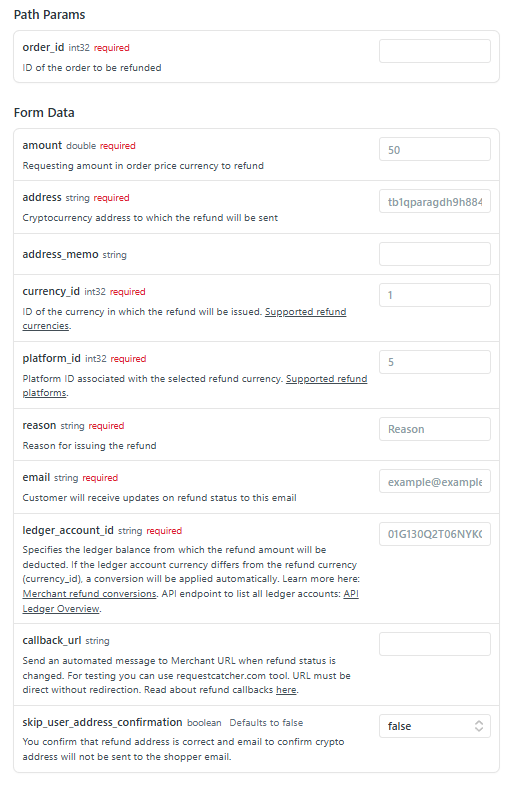
For example, if an order was priced at €50 and later refunded, the refund amount is defined in EUR, not in crypto units. That amount is then converted into the selected refund currency using the exchange rate at the time the refund is issued.
Once created, the refund receives a CoinGate-issued refund ID. This ID becomes the reference point for all further tracking.
New to CoinGate? Create a business account or start testing your API in the sandbox.
Tracking refund status and lifecycle
Refunds move through defined statuses that show exactly where they are in the process.
Typical states include:
- Pending – refund has been created
- Processing – refund is being handled
- Rejected – refund will not proceed
- Completed – funds were sent to the customer
These statuses are essential for keeping customer support, finance, and users aligned on what has already happened and what still requires action.
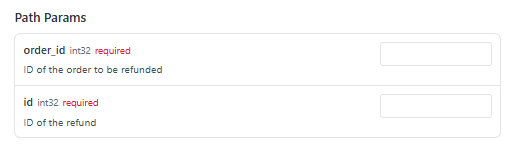
Refund details can be retrieved at any time using the Get Order Refund endpoint.
Handling refunds at scale
Once refunds are no longer isolated events, visibility becomes critical.
The Get Refunds and Get Order Refunds endpoints allow businesses to:
- list refunds across orders
- filter by creation or update time
- sort by date or status
- paginate through large datasets
This makes it possible to build internal dashboards, prepare audits, reconcile balances, and monitor refund volumes without manual intervention.
Refunds stop being opaque blockchain events and become traceable business records.
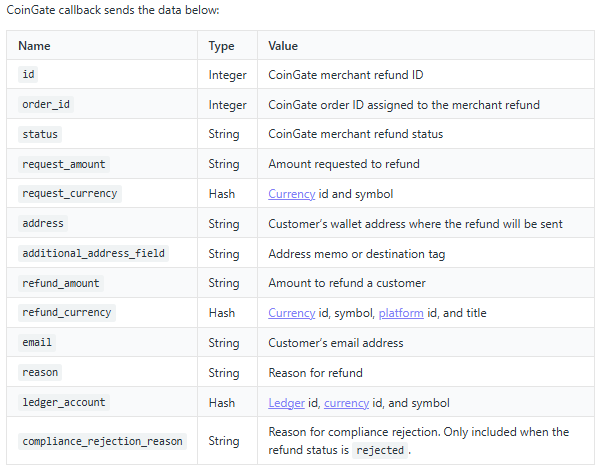
Using refund callbacks for real-time updates
Polling refund status works, but it does not scale well.
Refund callbacks solve this by sending automated notifications whenever:
- a refund is created
- its status changes
- it is completed or rejected
This allows systems to react immediately:
- order states can be updated automatically
- customers can be notified without delays
- internal workflows can be triggered in real time
Without callbacks, refund handling quickly turns into manual reconciliation and delayed customer communication.
Choosing supported currencies and networks safely
Refunds require sending funds to a specific wallet address on a specific network.
To reduce risk, CoinGate provides a Supported Refund Currencies endpoint that returns valid currency and network combinations. These identifiers must be used when creating refunds.
This step is critical. Sending funds to the wrong network can result in permanent loss. Automating validation around supported currencies and platforms significantly reduces operational errors.
Common mistakes and how to avoid them
Most refund issues are operational rather than technical.
Common pitfalls include:
- mismatching wallet addresses and networks
- assuming refunds mirror the original crypto amount
- treating refunds as reversals instead of new transactions
- not handling rejected refunds programmatically
A robust refund flow treats refunds as a lifecycle with validation, status tracking, and clear error handling.
When API-based refunds make sense
Not every business needs automated refunds on day one.
API-based refunds become valuable when:
- refund volumes increase
- refunds must sync with internal systems
- multiple teams rely on refund status
- audit and compliance requirements grow
At that point, manual workflows become a bottleneck.
Refunds as infrastructure, not exceptions
Crypto refunds are not a workaround. They are part of how crypto payments are meant to function in production environments.
By exposing refunds as structured, trackable, and automatable processes, CoinGate allows businesses to handle reimbursements with the same confidence they apply to payments themselves.
When refunds are treated as infrastructure, crypto payments stop feeling risky and start behaving like a mature payment rail.
Payouts work the same way. Our guide to automating crypto payouts via API covers the same lifecycle statuses, webhooks and approval controls for outgoing transfers.
This approach is especially relevant for businesses that handle refunds regularly, integrate payments into internal systems, or operate under audit and compliance requirements.
CoinGate provides crypto payment infrastructure designed to support refunds, reporting, and automation in real business workflows. If you’re not a registered business yet, sign up.
Accept crypto with CoinGate
Accept crypto with confidence using everything you need in one platform.