


Accept crypto with CoinGate
Accept crypto with confidence using everything you need in one platform.
How MiCA Reshapes Vendor Risk for EU Businesses

For a long time, crypto payments occupied an unusual position inside EU businesses.
They were operationally effective, often faster and cheaper than traditional rails, yet difficult to classify from a risk perspective. Finance teams could account for them, operations teams could run them, but responsibility was rarely explicit. Markets in Crypto-Assets (MiCA) regulation changes that dynamic.
With MiCA now in force, crypto payment providers are regulated financial counterparties. This shifts crypto payments from a tolerated exception into a governed part of a company’s payment infrastructure, and it turns vendor selection into a direct risk decision, which mostly matters to finance leaders, compliance teams, and decision-makers responsible for vendor risk.
Think it’s time to introduce cryptocurrency operations to your business? Sign up for CoinGate.
Before MiCA, vendor risk existed without clear ownership
Before MiCA, most crypto payment setups relied on a mix of registrations, national exemptions, and cross-border arrangements. Providers often served EU businesses while being regulated elsewhere, or while operating under frameworks that were never designed for full-scale payment processing. Learn more about the differences between licensed and unlicenced payment providers.
In practice, this meant that responsibility was diffuse. Merchants carried much of the compliance burden by default, even when the underlying infrastructure was external. Auditors depended heavily on provider statements and internal explanations rather than on standardized regulatory expectations. Business continuity was also difficult to assess, particularly when providers relied on fragile banking relationships or operated without clear supervisory oversight.
Crypto payments functioned, but vendor risk was implicit rather than designed. Businesses absorbed it quietly, often without fully realizing where accountability began and ended.
“Before MiCA, a lot of the work wasn’t about running clear processes, but about explaining grey areas,” notes Dovile Marcikonienė, CoinGate’s MLRO in Compliance. “During audits and reviews, we often had to justify how the provider operates based on their statements, exports, and internal explanations, because the market didn’t have one common baseline.”
MiCA introduces provider-level accountability
MiCA introduces a single regulatory framework for crypto-asset service providers across the European Union. Instead of fragmented national interpretations, providers are now classified, licensed, and supervised under a shared set of rules.
This framework establishes clear expectations around how crypto payment services must be operated. Governance structures, internal controls, capital requirements, AML and transaction monitoring processes, incident reporting, and record-keeping are no longer optional or provider-defined. They are enforced conditions of operating in the EU market.
Most importantly, MiCA shifts supervision to the provider level. Regulators no longer rely primarily on businesses to explain how crypto flows are handled but oversee the entities that process, convert, and move funds.
“A licensed provider gives you a shared baseline and common language to map responsibilities, evidence controls, and align expectations,” Dovilė explains. “I can stand behind our controls because I know how our internal system is built and maintained. With vendors, you don’t see behind the walls, so it’s harder to judge how risk is distributed and whether controls are equivalent.”
This change does not remove risk from crypto payments. It changes where that risk lives, how it is documented, and who is accountable for managing it.
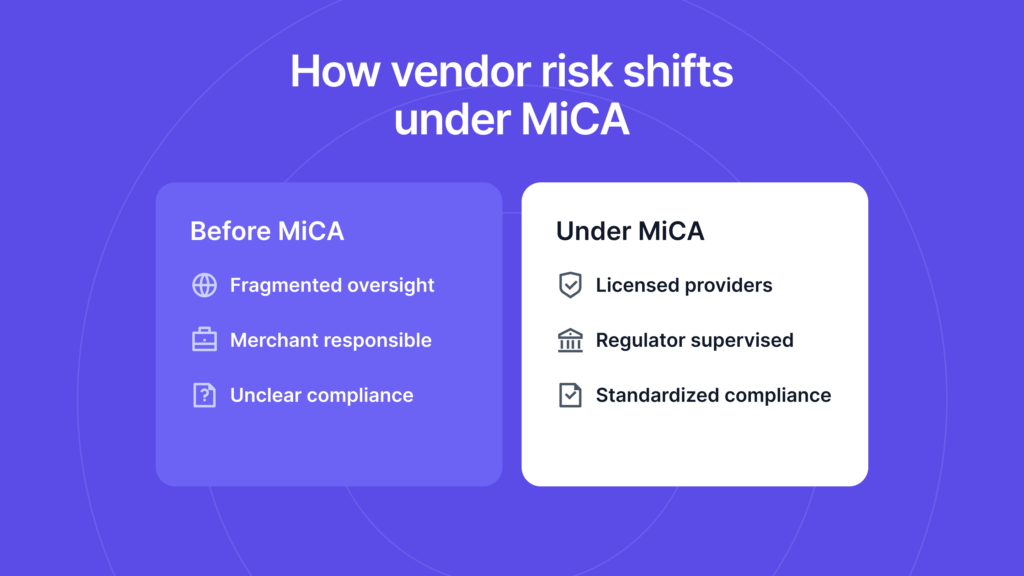
How does MiCA reshape vendor risk for EU businesses?
Rather than introducing new risks to crypto payments, MiCA formalizes existing ones and assigns responsibility more clearly between businesses and their providers.
One of the most significant changes is regulatory accountability. Under MiCA, licensed crypto payment providers are directly supervised by EU authorities. This reduces the need for businesses to justify the legitimacy of their payment infrastructure during audits or regulatory reviews. When a licensed provider is involved, regulatory expectations are largely addressed at the infrastructure level rather than pushed downstream to the merchant.
This shift also changes how operational risk is managed. MiCA requires providers to operate with documented processes, internal controls, and defined procedures for handling incidents. For businesses, this removes much of the uncertainty that previously surrounded crypto operations. Payment flows become predictable. Changes are communicated formally. Sudden disruptions are less likely to originate from undocumented internal decisions at the provider level.
Compliance and audit risk is similarly reshaped. Standardized reporting and record-keeping requirements make crypto payments easier to explain and verify. Instead of relying on custom exports or manual reconciliations, businesses gain access to consistent transaction histories that align more closely with traditional financial reporting practices. Crypto stops being the outlier in the audit process.
“From an audit perspective, the biggest shift is consistency,” says Dovilė. “Transaction records, reporting, and control expectations become more standardized, so crypto payments stop being “that special case” that needs a separate explanation every single time. What auditors want is repeatability, and MiCA brings more of it.”
Finally, MiCA affects counterparty and continuity risk. Licensed providers must meet capital and governance requirements designed to support long-term operational stability. While no regulation can eliminate failure entirely, MiCA reduces the likelihood that businesses will need to urgently replace critical payment infrastructure due to regulatory or financial instability at the provider level.
Together, these changes move crypto vendor risk from an implicit assumption to a defined, manageable component of payment operations.
What MiCA does not remove
Despite these structural improvements, MiCA does not make crypto payments risk-free.
Market risk remains unchanged. Price volatility, conversion timing, and treasury strategy are still business decisions that sit outside the scope of regulation. Internal process risk also persists. How crypto payments are configured, recorded, and integrated into accounting systems remains the responsibility of the business.
MiCA should be understood as a framework for accountability, not a substitute for operational discipline. It defines who is responsible for running payment infrastructure correctly, but it does not manage crypto usage on behalf of businesses.
“MiCA creates clarity around who is responsible for running the infrastructure properly,” adds Vilius Semėnas, the CEO of CoinGate. “However, it doesn’t replace strong internal processes on the business side. You still need clean configurations, good reconciliations, clear roles, and disciplined operational handling. If your internal setup is messy, nothing will help.”
This distinction is important. Treating MiCA as a safety net rather than a structure can lead to misplaced expectations and poor internal controls.
What EU businesses should now evaluate when choosing a crypto payment provider
With responsibilities more clearly defined, choosing a crypto payment provider now requires the same level of scrutiny as selecting any other financial service partner.
In practice, this translates into a short but critical checklist for vendor evaluation:
- Is the provider licensed under MiCA and in which jurisdiction?
- Which services are explicitly covered by that license?
- How are AML, transaction monitoring, and reporting responsibilities divided?
- What documentation and records are available for audits and compliance reviews?
Under MiCA, vendor selection directly affects a company’s regulatory posture, audit readiness, and operational resilience. Crypto payments have matured into regulated infrastructure. Vendor choice now reflects not just technical capability, but risk management standards.
Where licensed crypto payment processors fit in
Within the MiCA framework, licensed crypto payment providers take on a defined share of regulatory and operational responsibility. They are no longer intermediaries operating at the edge of the financial system, but supervised entities with clear obligations around governance, controls, and reporting.
For EU businesses, this changes how crypto payments fit into broader financial operations. Working with a licensed provider simplifies discussions with auditors, banks, and internal risk teams. Responsibilities are easier to explain. Documentation is easier to produce. Crypto infrastructure begins to resemble other regulated payment rails rather than a special-case system that requires constant justification.
CoinGate is one of the crypto payment processors operating under this framework. We obtained our MiCA license on December 17, 2025, formalizing the regulatory standards we had already been applying across payments, payouts, and compliance processes. For EU businesses, this provides a clearer counterparty relationship and a more predictable compliance environment when using crypto for payments.
At CoinGate, we see this shift as a sign of market maturity. MiCA allows businesses to use crypto payments with clearer accountability and fewer unknowns, integrating them into existing compliance and operational frameworks instead of working around them.
Vendor risk is now a strategic decision
MiCA marks a turning point in how EU businesses should think about crypto payments. What was once a technical choice has become a strategic one.
Vendor selection now affects regulatory exposure, audit readiness, operational stability, and long-term continuity.
Crypto payments themselves have not become risk-free, but the risks surrounding them are no longer opaque or informal. They are identifiable, assignable, and manageable.
For EU businesses, this is the real impact of MiCA. Crypto payments are no longer an exception to manage carefully on the side. They are part of the financial stack, and the vendors behind them matter accordingly.
Using crypto payments under MiCA
If you’re evaluating crypto payments under MiCA, you can explore CoinGate’s MiCA-licensed payment infrastructure or create a business account when you’re ready.
Accept crypto with CoinGate
Accept crypto with confidence using everything you need in one platform.