


Accept crypto with CoinGate
Accept crypto with confidence using everything you need in one platform.
SOL and Solana: Consumer Payments Data Report (2024 May–2025 Oct)
This report covers Solana payments from May 2024 to October 2025. For our latest overall figures, see the H1 2026 crypto payments report.
Key Highlights (2024–2025 Oct):
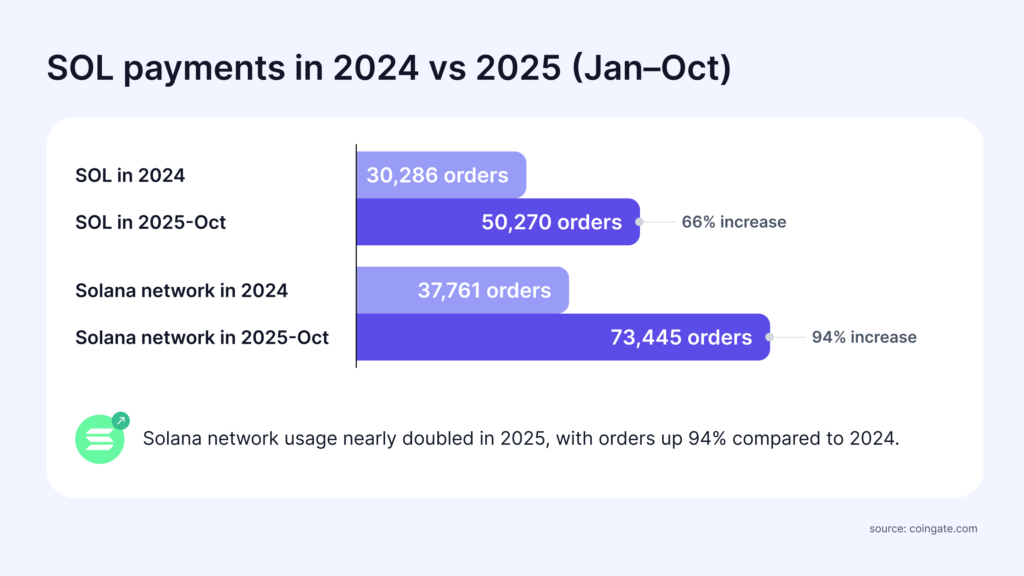
- +66% YoY growth in SOL payments and +94% YoY growth in total payments processed on the Solana network.
- SOL ranks #7 among payment currencies in 2025 with a 6.8% share, following BTC, USDT, LTC, USDC, TRX, and ETH.
- Solana network peaked in September, reaching 8.4% of all CoinGate payments – its highest point to date.
- SOL accounts for 3.2% of all CoinGate payments processed between 2024 and 2025.
- Network composition: 68% SOL, 28% USDC, 4% USDT.
- Top shopper countries: US (30%), Germany (6%), Canada (5%), India (4.6%), Netherlands (4.5%).
- Top industries: Web hosting (35.5%), Consumer goods & services (11.8%), Computers (9%), Proxies (5.3%), VPN (4.4%).
- Leading merchants: Hostinger (30.4%), IPRoyal (5.3%), CoinGate Gift Cards (5.2%), NordVPN (2.9%).
- Average SOL cart size €50; 2025 orders range from €0.12 to €14,019.
- Most settlements converted to EUR (64.4%), USDC (21%), and BTC (4.6%); 1% kept in SOL (down from 2.3% in 2024).
Executive Summary
Solana entered CoinGate’s ecosystem in May 2024. In a relatively short time, it has grown into one of the most active and fast-expanding payment options on the platform.
Between 2024 and 2025, SOL-denominated payments increased by 66%, while payments processed on the Solana network rose by 94%. Across all cryptocurrencies used during this period, SOL accounted for 3.2% of total processed payments, positioning it in the mid-tier of CoinGate’s overall currency mix.
By 2025, SOL had already become the seventh most used cryptocurrency for payments, while the Solana blockchain climbed to the sixth most used network for on-chain settlements.
Looking specifically at 2025 (January–October), SOL holds a 6.8% payment share, following BTC, USDT, LTC, USDC, TRX, and ETH.
Solana’s network activity paints an equally strong picture. In 2025, 68% of payments on the Solana network were made in SOL, followed by USDC (28%) and USDT (4%). Network usage reached its highest point in September, when 8.4% of all CoinGate payments were processed through Solana.
SOL payments come from a geographically broad audience. The United States leads with 30% of all SOL payments, followed by Germany (6%), Canada (5%), India (4.6%), and the Netherlands (4.5%).
When grouped by continent, Europe and North America contribute nearly equal shares – 36.9% and 36.1%, respectively – with notable participation from Asia, Africa, and South America.
Spending behaviors reflect Solana’s versatility. In 2025, the average cart size reached €50, with transactions ranging from €0.12 micro-purchases to €14,019 paid for IT services. High-value transactions were already visible shortly after Solana’s integration in 2024, including a 169.08 SOL (€30,957) payment for proxy services.
Solana’s strongest industries so far are web hosting (35.5%), consumer goods and services (11.8%), computers (9%), proxies (5.3%), VPNs (4.4%), and IT services (3%). Among merchants, Hostinger stands out, accounting for 30.4% of all SOL orders, followed by IPRoyal (5.3%), CoinGate Gift Cards (5.2%), and NordVPN (2.9%).
Feels like it’s time to introduce cryptocurrency payments to your checkout? Sign up for CoinGate.
Methodology & Definitions
This report analyzes all Solana-related payments processed on CoinGate between May 2024 and October 2025.
Metrics include:
- Payment share – SOL’s percentage of all processed orders.
- Network share – total orders settled on the Solana blockchain.
- Geographical distribution – orders grouped by country and continent.
- Industry segmentation – merchant categories based on business type.
- Settlements – whether merchants kept SOL or converted it to EUR, USD, BTC, USDC, or other currencies.
- Cart size analysis – average, smallest, and largest payment amounts.
Values are rounded where appropriate, and FIAT equivalents reflect EUR valuation at payment time.
Adoption Trajectory (2024–2025)
Launch and Early Momentum (May–December 2024)
Solana entered CoinGate’s payment ecosystem in May 2024, and SOL adoption began accelerating almost immediately.
Despite joining midway through the year, SOL quickly established itself as a meaningful payment currency, supported by its fast settlement speed, low fees, and strong user awareness.
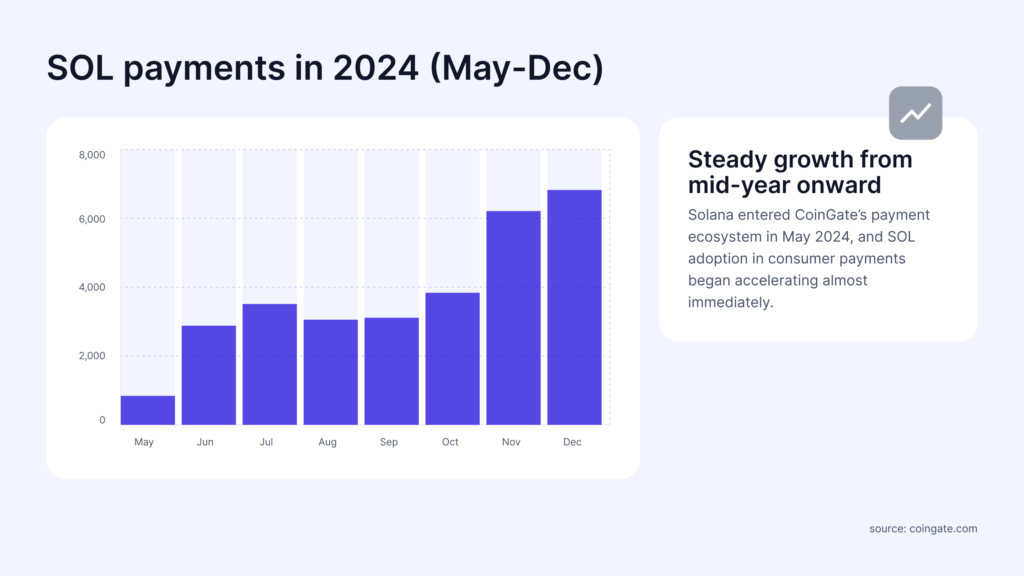
By late 2024, SOL had already become a visible part of the overall payment mix. Large-value payments began appearing within months of integration, including the year’s highest SOL transaction in November: 169.08 SOL, valued at approximately €30,957, spent on proxy services.
Acceleration and Expansion in 2025
In 2025, Solana’s role in crypto payments expanded significantly. SOL-denominated payments increased by 66% year-over-year, while total payments processed via the Solana network grew by 94% compared to 2024.
It’s a dual growth in both the currency and the underlying network, which means Solana is being increasingly used as a practical payment rail rather than just a home for speculative assets.
Across all transactions processed on CoinGate between 2024 and 2025, SOL represents 3.2% of total payments, placing it in the mid-range among supported cryptocurrencies. However, in 2025 alone, SOL already holds a 6.8% payment share, making it the seventh most used currency on the platform.
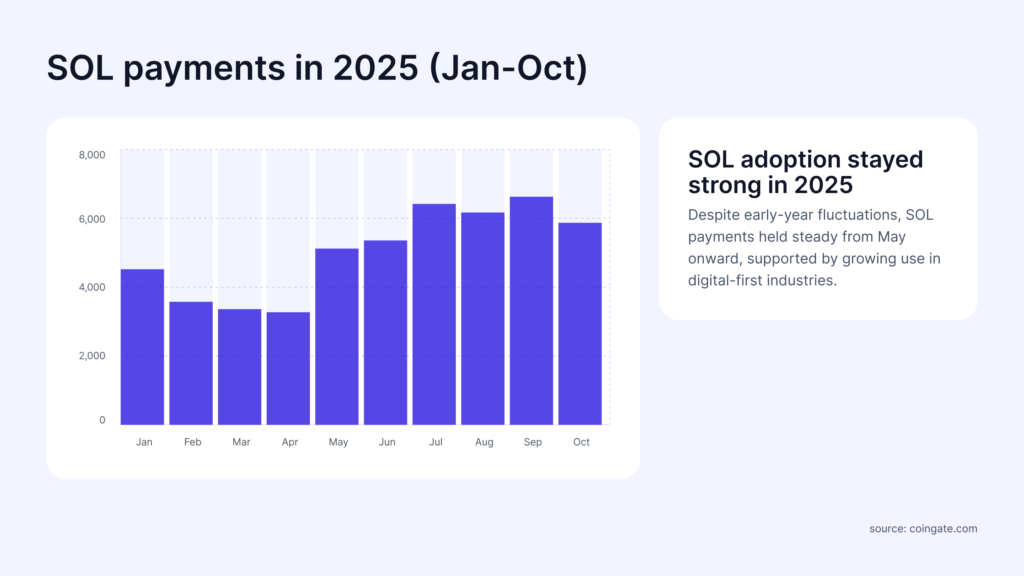
A temporary decline of SOL payments in March and April of 2025 coincided with a significant increase in USDC usage, much of it also flowing through the Solana network. This shift did not reflect reduced interest in SOL itself but rather a new user demand for USDC following the discontinuation of USDT support.
Solana’s activity continued to grow throughout the year. The network reached its highest point in September, when 8.4% of all CoinGate payments were processed via Solana – the network’s strongest performance to date.
By the end of the reporting period, Solana had firmly established itself as one of the fastest-growing currencies and networks on CoinGate, supported by strong user demand, industry fit, and its consistently smooth transaction experience.
2025 Snapshot: Currency vs. Network
Solana’s position within CoinGate’s payment ecosystem can be viewed through two complementary lenses: SOL as a currency and the Solana blockchain as a settlement network. Both sides of this equation grew meaningfully in 2025, but each reveals a different aspect of Solana’s adoption.
SOL as a Payment Currency
In 2025 (Jan–Oct), SOL ranks as the seventh most popular cryptocurrency on CoinGate, contributing 6.8% of all processed payments. It sits just behind the largest and most established assets on the platform:
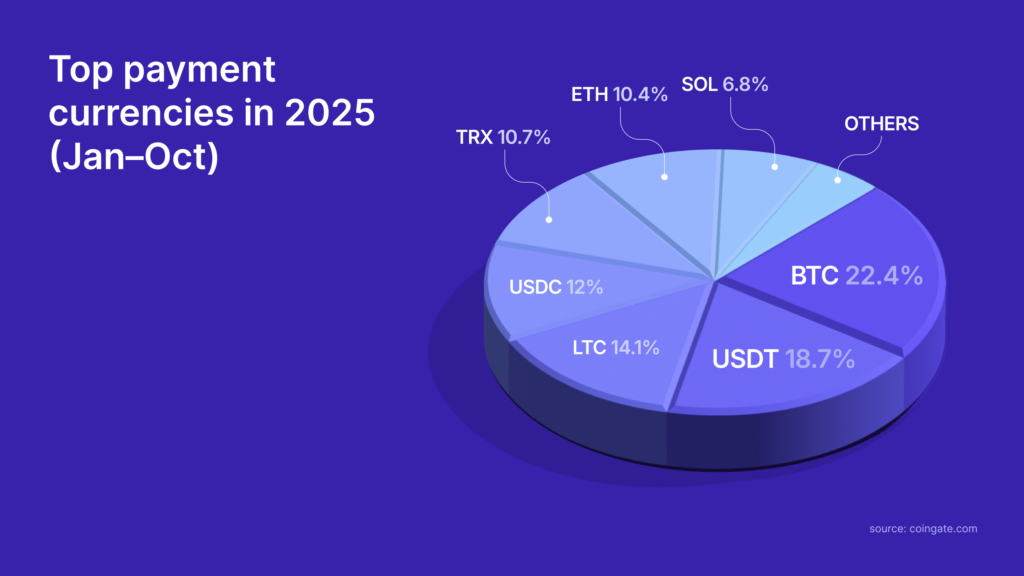
Solana has achieved notable traction within a short timeframe. It entered a competitive field and quickly became one of the most commonly used alternatives to major payment rails.
One notable monthly fluctuation occurred in March 2025, when SOL’s share temporarily decreased due to an increase in USDC-denominated payments, many of which were routed through the Solana network. This reflects a momentary shift in user preference toward stable-value assets rather than a decline in Solana usage itself.
Solana as a Payment Network
The Solana network has seen even stronger relative growth than SOL as a currency. In 2025, the network ranks as the sixth most used blockchain for crypto payments on CoinGate, supported by consistently low fees and fast confirmation times.
Within the Solana network specifically, the activity is concentrated among three currencies:
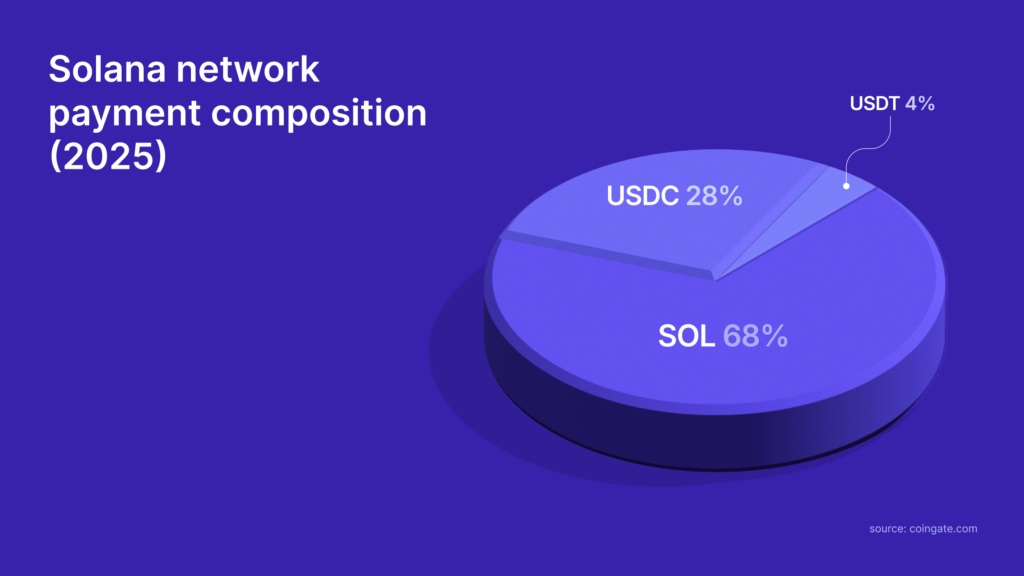
This composition underscores Solana’s role not only as a currency ecosystem but also as an efficient settlement layer for stablecoins – particularly USDC, which has become deeply integrated with Solana’s high-throughput infrastructure.
Network activity peaked in September 2025, when 8.4% of all CoinGate payments were processed through Solana, marking the strongest network share since integration.
Who Pays with SOL? Shopper Geography (2025 YTD)
Solana payments on CoinGate reflect a globally distributed user base, with strong traction across both mature markets and emerging regions. Solana’s appeal as a fast, low-fee payment option resonates with diverse audiences – from subscription-heavy Western markets to rapidly digitizing economies.
Country-Level Adoption
From January to September 2025, the top countries for SOL-denominated payments were:
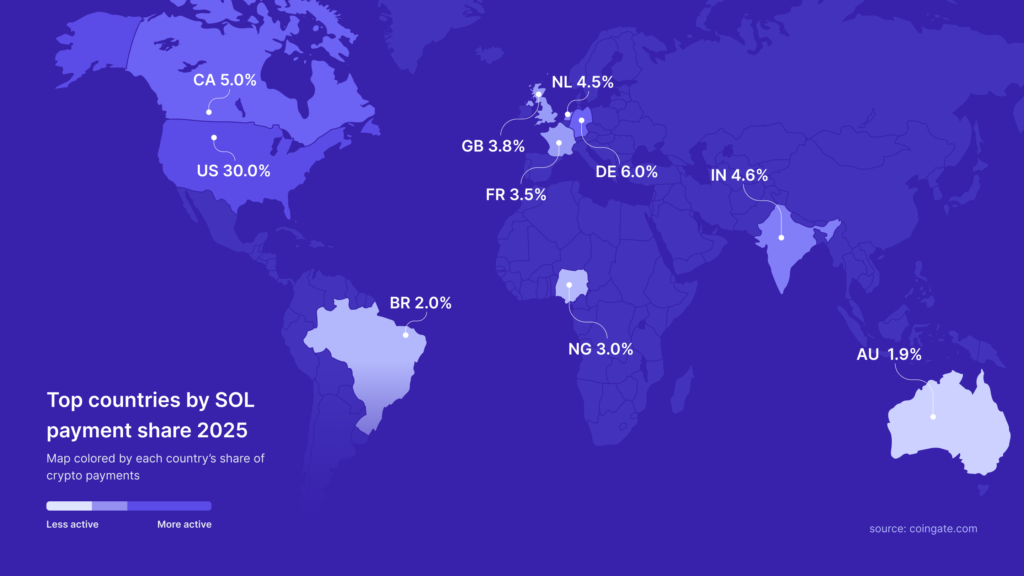
The United States leads by a significant margin with 30% share, benefiting from strong retail crypto adoption, widespread availability of Solana wallets, and a deep ecosystem of merchants offering digital services. Europe follows closely, with Germany and the Netherlands showing consistent transaction volume, particularly in hosting, VPNs, and consumer services.
India, Nigeria, and Brazil represent the fastest-growing emerging markets, where Solana’s low fees and fast transaction finality offer clear practical advantages, especially for cross-border digital services.
Continental Trends
When grouping SOL payments by continent, the distribution becomes even clearer:
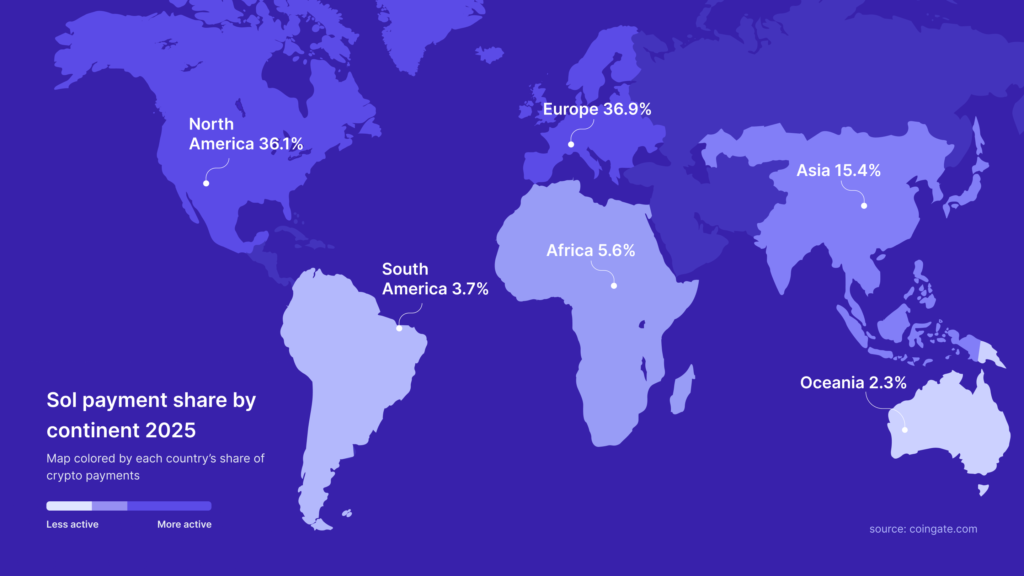
Europe and North America jointly account for nearly three-quarters of all SOL orders. These regions are early adopters of subscription-based services and developer tools – categories where Solana is increasingly used due to its smooth payment experience.
At the same time, Asia, Africa, and South America already represent more than 24% combined. These regions signal meaningful future growth potential, especially as crypto infrastructure and merchant availability continue to expand.
What Do People Buy? Industries & Merchants (2025 YTD)
Solana payments on CoinGate are concentrated in digital-first industries, reflecting Solana’s strengths: fast confirmation times, low fees, and seamless integration with subscription-driven and online service merchants. In 2025, SOL usage spans a broad mix of sectors while showing clear dominance in categories aligned with recurring or high-volume digital purchases.
Industry Breakdown
Across all Solana payments in 2025, the distribution is as follows:
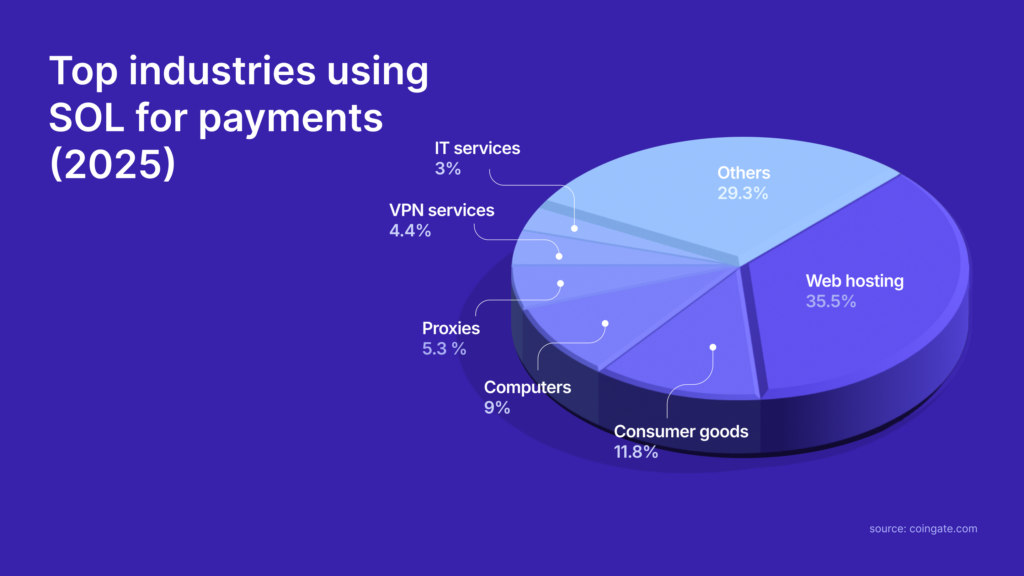
Web hosting clearly leads, accounting for more than one-third of all SOL orders. This aligns with the broader trend observed across other cryptocurrencies – technical users and online businesses often prefer fast, low-cost payment options for subscriptions, domains, and hosting plans.
Consumer goods and computer-related purchases make up a notable portion of SOL activity, demonstrating that Solana is not limited to niche crypto-native services. Instead, it is used for a wide range of retail-oriented transactions.
Proxies, VPNs, and IT services together represent a substantial share of Solana payments as well. These categories often attract users who value privacy, efficiency, or cross-border accessibility – areas where Solana’s performance advantages translate directly into a smoother checkout experience.
Leading Merchants
The merchant breakdown reinforces the industry trends:
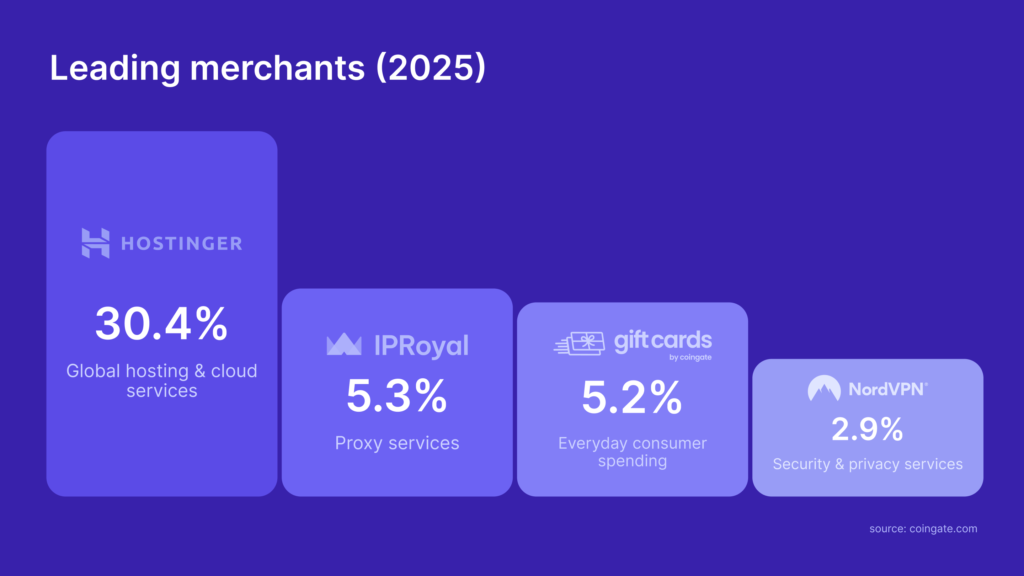
Hostinger stands out as the clear leader. Its global user base and strong overlap with the kind of customer segments that adopt Solana early – developers, tech startups, and online service buyers.
IPRoyal and other proxy-related platforms perform strongly. They benefit from Solana’s suitability for micro-to-mid-range recurring purchases. CoinGate Gift Cards also hold a significant position, suggesting that users see SOL as a convenient way to cover everyday spend through indirect merchant options.
Overall, it seems like Solana has already gained meaningful traction within high-demand digital industries, with additional room for expansion into broader consumer categories as general awareness increases.
Cart Sizes & Purchase Behavior
Solana payments show a balanced transaction profile, supporting everything from micro-purchases to large invoices. This versatility reflects both the efficiency of the Solana network and the types of merchants that attract SOL users.
Average and Median Cart Values
In 2025, the average SOL cart size stands at €50. This places Solana comfortably within the range associated with subscription services, hosting plans, digital goods, and mid-range online purchases.
The average aligns closely with categories where Solana is most popular – web hosting, computers, and consumer services – suggesting that users rely on SOL for practical, everyday transactions rather than solely sporadic or high-value payments.
Transaction Range: Micro to High-Value Orders
Solana supports a remarkably wide range of payment sizes:
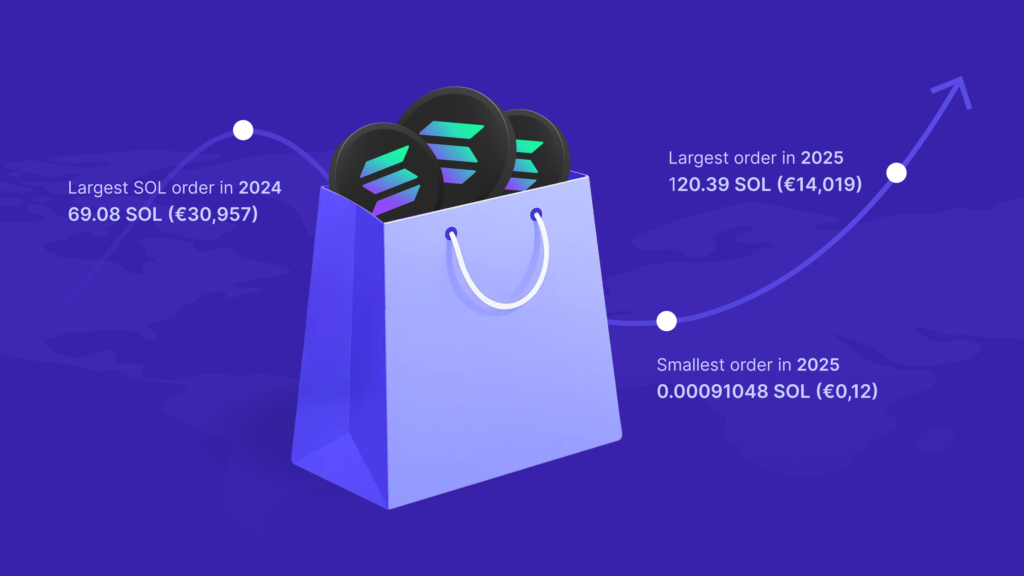
- The smallest order in 2025 was 0.00091048 SOL (€0.12) for proxy services.
- The largest order in 2025 reached 120.39 SOL (€14,019), paid for IT services in March.
- In 2024, the largest order hit 169.08 SOL (€30,957), reflecting early adoption among high-value service providers.
This distribution indicates Solana’s strong fit for:
- micropayments, enabled by negligible fees,
- subscription or recurring services,
- and occasional large professional invoices, especially in IT and infrastructure-related sectors.
The small-fee environment also encourages payment fragmentation – users can make lower-value purchases without incurring disproportionate network costs, something not always feasible on higher-fee chains.
Behavioral Insight
The consistency of cart sizes across 2024 and 2025 suggests that Solana is being used primarily as a utilitarian payment method rather than a speculative gateway. Users rely on SOL for predictable, routine digital services, and merchants benefit from quick settlements, low operational costs, and higher payment completion rates – particularly for lower- and mid-range purchases where fees matter most.
Settlements in SOL (2024–2025)
Merchant settlement behavior provides a clear view into how businesses treat Solana today – not only as a payment method but as part of their operational and treasury workflows. Unlike Bitcoin or even Litecoin, where a meaningful share is often retained on merchant balance sheets, Solana is currently used primarily as a transaction rail rather than a long-term holding asset.
How Merchants Settle SOL Payments
In 2025, only 1% of SOL-denominated payments were kept in SOL, a slight decline from 2.3% in 2024. This indicates that most businesses receiving SOL still prefer to convert it to another currency immediately after payment.
The majority of conversions in 2025 were directed toward:
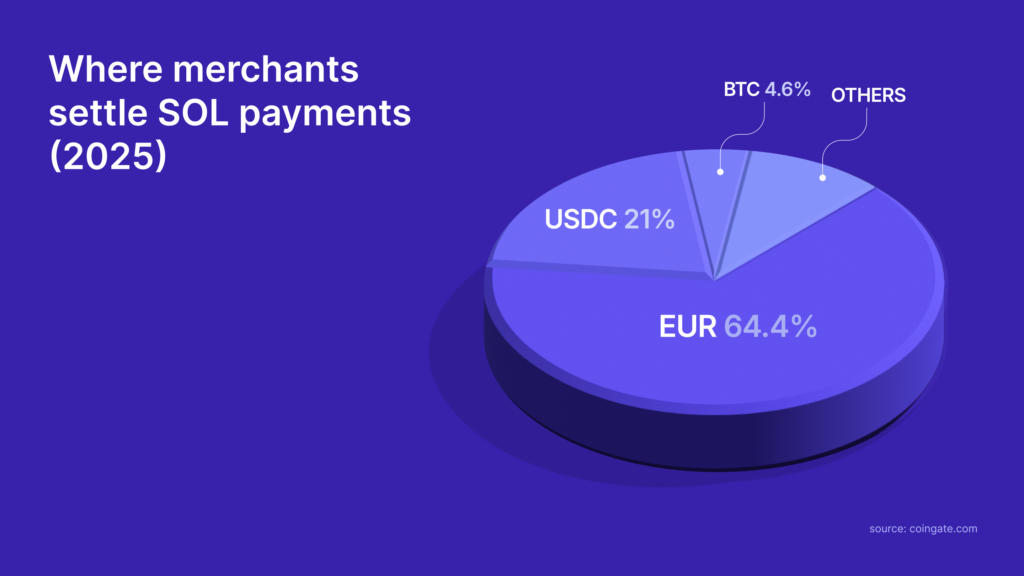
This distribution is important for two reasons:
- High EUR conversions show that many merchants treat Solana as a fast, low-fee gateway into fiat – similar to stablecoins, but with stronger performance characteristics.
- The significant share of USDC conversions reflects the growing role of Solana as a settlement network for stablecoins. Many merchants effectively move value laterally within the Solana ecosystem, converting SOL to USDC for treasury stability while keeping the operational benefits of the network.
Year-over-Year Comparison
Comparing settlement behavior between 2024 and 2025 reveals a consistent pattern:
- A slightly larger proportion of merchants kept SOL in 2024 (2.3%) than in 2025 (1%).
- Conversions to EUR have remained strong, though stablecoin settlements – particularly USDC – have grown proportionally.
- The share of BTC and other crypto conversions remains secondary, pointing to Solana’s role as a complement, not a competitor, to core store-of-value assets.
Taken together, the settlement data suggests that Solana is valued primarily for its transactional qualities – speed, cost efficiency, and reliability – rather than for its long-term value properties. As the ecosystem matures and more merchants become comfortable holding alternative assets, the retention rate may grow, but for now, Solana functions as a highly efficient payment and settlement conduit.
Why Solana? (Speed, Fees, UX)
Solana’s rise as a payment currency and network at CoinGate is closely tied to its underlying technical advantages. While many blockchains can process crypto payments, Solana’s combination of speed, low fees, and user-friendly ecosystem has positioned it as one of the most practical networks for real-world commerce.
Speed and Throughput
Solana consistently offers some of the fastest confirmation times among major blockchains. For merchants and shoppers, this translates into:
- near-instant payment finality,
- fewer abandoned checkouts,
- and a smoother payment experience, especially on mobile devices.
Fast settlement is particularly valuable for subscription purchases, hosting plans, and digital services, which make up a large share of Solana payments on CoinGate. These categories tend to involve frequent, lower-value transactions where waiting times can meaningfully influence conversion rates.
Extremely Low Transaction Fees
One of Solana’s defining advantages is its negligible transaction cost. Fees remain far below those of many other networks, even during periods of high activity. This is especially important for:
- microtransactions,
- recurring billing cycles,
- and price-sensitive purchases like VPNs, proxies, and low-cost consumer services.
Low fees also encourage more granular purchasing behavior. Instead of consolidating payments, users feel free to transact in smaller increments – a pattern reflected in the presence of orders as low as €0.12 in 2025.
Wallet and Ecosystem Support
Solana’s wallet ecosystem has expanded substantially over the past two years. Popular wallets, simplified UX flows, strong mobile experiences, and fast transaction signing have all lowered friction for everyday users.
At checkout, this translates into:
- fewer declined transactions,
- faster wallet connections,
- And more predictable transaction outcomes.
These strengths help explain why Solana saw a 94% increase in network-based payments between 2024 and 2025, even in competitive conditions where multiple networks vie for user attention.
Alignment with Stablecoins
A notable portion of Solana network activity on CoinGate involves USDC, which accounts for 28% of all payments on the Solana blockchain. This reflects a wider industry trend: Solana has become one of the preferred networks for USDC settlement, thanks to its fast performance and cost efficiency.
For merchants, this means Solana serves both:
- as a payment currency (SOL itself), and
- as a settlement infrastructure for stablecoins.
This dual role reinforces Solana’s long-term potential within crypto payments, particularly for businesses that rely on stable-value assets but want the operational advantages of a low-fee network.
What This Means for Businesses (Actionable Takeaways)
The data from 2024–2025 shows that Solana has quickly become one of the most efficient and fast-growing payment rails on CoinGate. While its share is smaller compared to long-established currencies, its adoption trajectory and performance characteristics offer clear, practical advantages for merchants.
Offer Solana and USDC on Solana Together
SOL and USDC are the two dominant assets on the Solana network, representing 96% of all payments processed on Solana through CoinGate. Enabling both at checkout captures the broadest segment of Solana users – those who prefer native SOL and those who rely on stablecoins but want Solana’s speed and low fees.
Expect Strong Performance in Digital-First Industries
Web hosting, consumer digital services, computers, proxies, VPNs, and IT services collectively account for the majority of Solana payments. If your business operates within these sectors, Solana support can directly improve conversion rates by reducing friction for users who rely on fast, low-cost crypto checkouts.
Prepare for a Global Customer Base
SOL payments come from a geographically diverse audience across North America, Europe, Asia, Africa, and South America. Solana’s low-fee model is especially valuable in regions with limited access to traditional payment systems or high cross-border transaction costs. Merchants serving international customers can expect higher payment reliability and fewer abandoned transactions on Solana.
Leverage Solana for Lower-Value and Recurring Purchases
With an average cart size of €50 and meaningful activity at the microtransaction level, Solana is well suited for subscription products, usage-based billing, and low-cost digital goods. Its negligible fees allow merchants to offer flexible billing structures that may not be viable on higher-fee networks.
Treat Solana as a Payment Rail First
Only 1% of SOL-denominated payments were retained by merchants in 2025, with the majority converted to EUR, USDC, or BTC. Today, Solana is primarily valued for its operational efficiency rather than as a long-term treasury asset. Merchants should view it as an opportunity to lower payment friction, not necessarily as a balance-sheet strategy.
Anticipate Continued Growth
Solana’s 66% growth in SOL payments and 94% growth in Solana network usage suggest a trajectory similar to early-stage adoption patterns seen in Litecoin and TRON. As wallet support expands and more users become familiar with the network, Solana’s share of crypto payments is likely to grow – particularly in digital industries and emerging markets.
Accept crypto with CoinGate
Accept crypto with confidence using everything you need in one platform.