


Accept crypto with CoinGate
Accept crypto with confidence using everything you need in one platform.
Crypto at CoinGate in 2025: Payments Evolve Into Operations
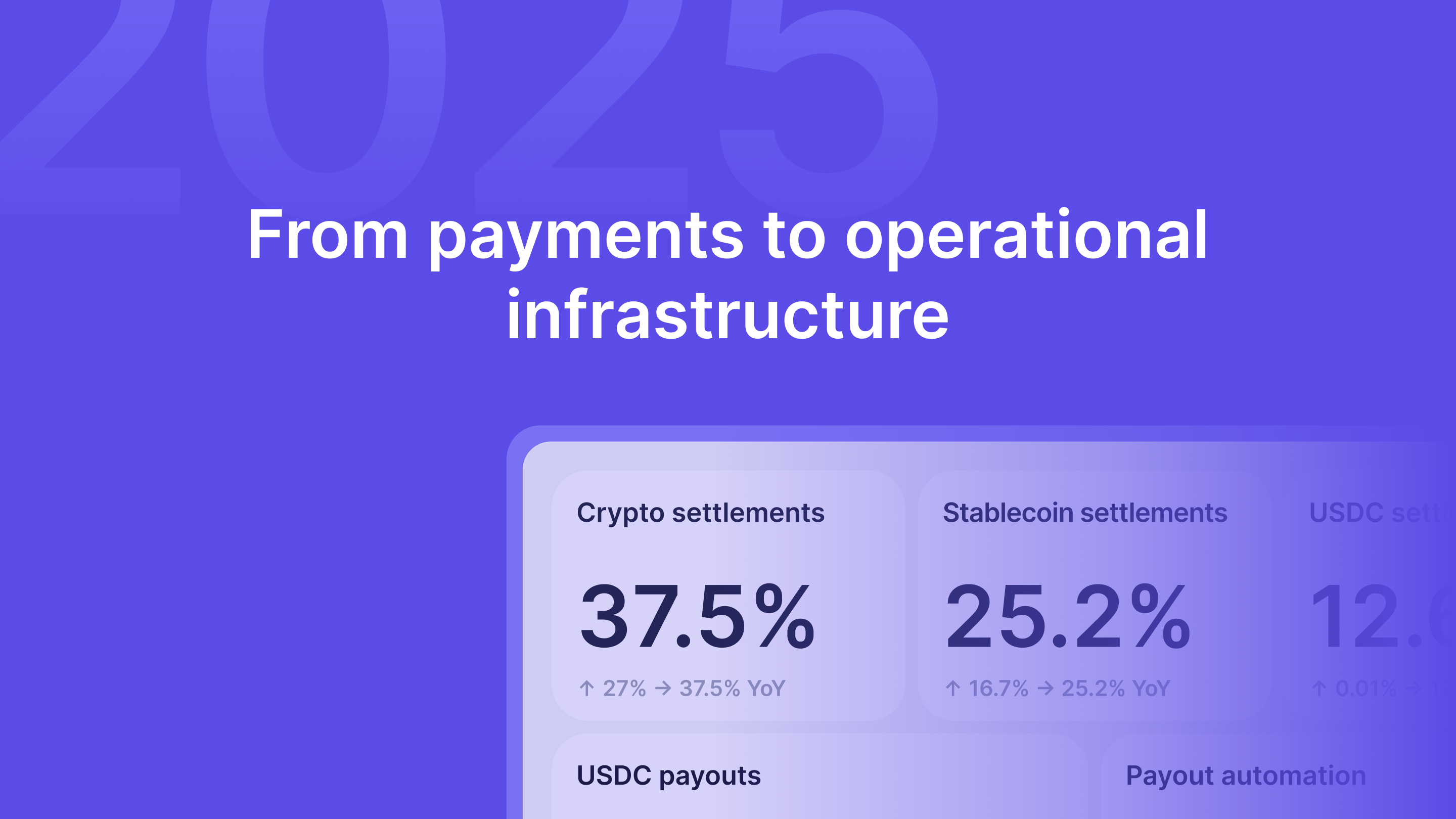
This report covers January to December 2025. For our latest figures, see the H1 2026 crypto payments report.
2025 didn’t look dramatic for crypto payments. There were fewer headlines and fewer headline-grabbing spikes. But across more than 1.42 million transactions, a new pattern emerged. This year was no longer just about accepting funds at checkout, but about how businesses hold, move, and use crypto operationally, including settlements, treasury management and automated payouts.
Key takeaways:
- 1.42M crypto payments were processed in 2025, bringing total CoinGate volume to over 7 million payments since launch.
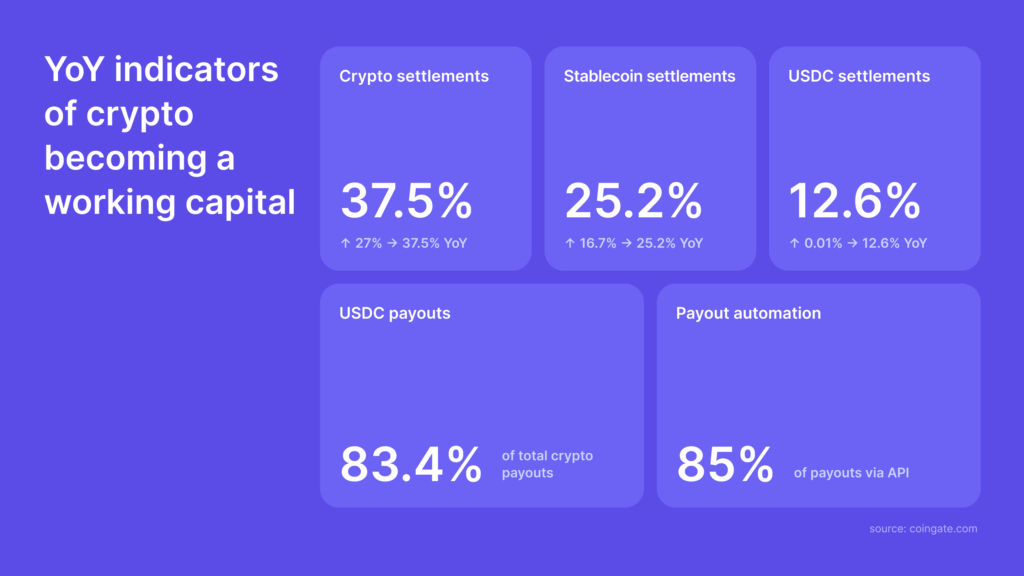
- Merchants increasingly use crypto as operational capital, with 25.2% of all payments settled in stablecoins, up from 16.7% last year.
- USDC emerged as the dominant operational asset following regulatory changes affecting USDT compliance, with USDC orders up 1264% YoY and 83.4% of all payouts executed in USDC.
- Payout automation is now the norm, with 85% of merchants executing payouts via API.
- Bitcoin reclaimed the #1 spot with a 22.1% payment share, reinforcing its role as a reliable asset for payments.
- Stablecoins still accounted for 29.8% of all payments, but their composition shifted decisively toward USDC as the sole EU-compliant and widely adopted stablecoin.
- Litecoin retained its position as the third most-used crypto, reaching a 14.4% payment share.
Executive Summary
BTC reclaimed its position as the most-used cryptocurrency, overtaking USDT, with a 22.1% share of all payments. At the same time, stablecoins began rebalancing. USDC emerged as the dominant stablecoin over USDT, with its payment share increasing from 2.5% in 2024 to 44.2% of all stablecoin payments in 2025, alongside a 13X increase in processed order volume year-over-year.
Think it’s time to introduce cryptocurrency operations to your business? Sign up for CoinGate.

In 2025, CoinGate processed 1.42 million crypto payments (or one order every 22 seconds), adding to more than seven million payments processed on the platform to date. Transaction volumes adjusted during the year as USDT was phased out per MiCA requirements, but underlying usage shifted toward more operational and treasury-driven use cases. The data in this report suggests that crypto payments became more operationally embedded, particularly in settlements, payouts, and treasury workflows.
Merchants increasingly chose to keep crypto on their balance sheets, while also using FX payouts to convert funds into USDC at the moment payouts were executed. Settlements into crypto rose from 27% to 37.5%, while fiat settlements declined accordingly. Payout behavior followed the same path: USDC became the clear standard for outbound payments, and automation became the norm, with 85% of merchants using APIs to execute payouts at scale.
This shift toward crypto being used as operational financial infrastructure was reinforced on the regulatory side. CoinGate was granted a MiCA license by the Bank of Lithuania in 2025. We’ve aligned our operations with the European Union’s new crypto regulatory framework and brought greater legal clarity and long-term stability for merchants.
Infrastructure usage also evolved. The Bitcoin network, including Lightning, became the most-used blockchain for payments, again. Ethereum regained relevance as a payment rail, Layer 2 networks continued steady growth, and the newly integrated layer-two chain, Base, became prominent almost immediately.
More importantly than how customers paid in 2025 is what merchants did with the crypto they received, and the data shows a clear shift toward holding, reallocating, and paying out crypto as operational capital.
Methodology and Scope
This report analyzes crypto payment activity processed through CoinGate between January and December 2025.
The dataset includes 1,424,519 completed orders, representing successful crypto payments made by shoppers to merchants using CoinGate. Off-chain transactions are included in total order count (100,114 transactions) but excluded from crypto and blockchain-specific analyses.
Key definitions used throughout this report:
- Processed orders – successfully completed customer payments using cryptocurrencies via CoinGate
- Payment share – a cryptocurrency’s percentage of all crypto payments within a given timeframe
- Stablecoin payments – payments made using fiat-pegged digital assets
- Settlements – how merchants choose to receive funds (fiat or crypto) after payment completion
- Payouts – outbound payments executed by merchants to external recipients, in crypto assets
Several external factors influenced 2025 data trends and are reflected throughout the report:
- Regulatory changes, including the phased delisting and full shutdown of USDT for most merchants
- Infrastructure upgrades, such as Lightning Network usage and Base integration
- Merchant behavior shifts, including increased crypto retention and API-driven automation
All monetary values are converted to euros at the time of transaction unless stated otherwise.
What Changed in 2025? From Volume Adjustment to Increased Operational Use
2025 was a year of transition across the crypto payments landscape. At first glance, overall transaction volumes declined year-over-year, with total processed orders decreasing by 15%, from 1.68 million in 2024 to 1.42 million in 2025. This shift was not driven by a single factor, but by a combination of structural, regulatory, and ecosystem-level changes that shaped how and where transactions were processed throughout the year.
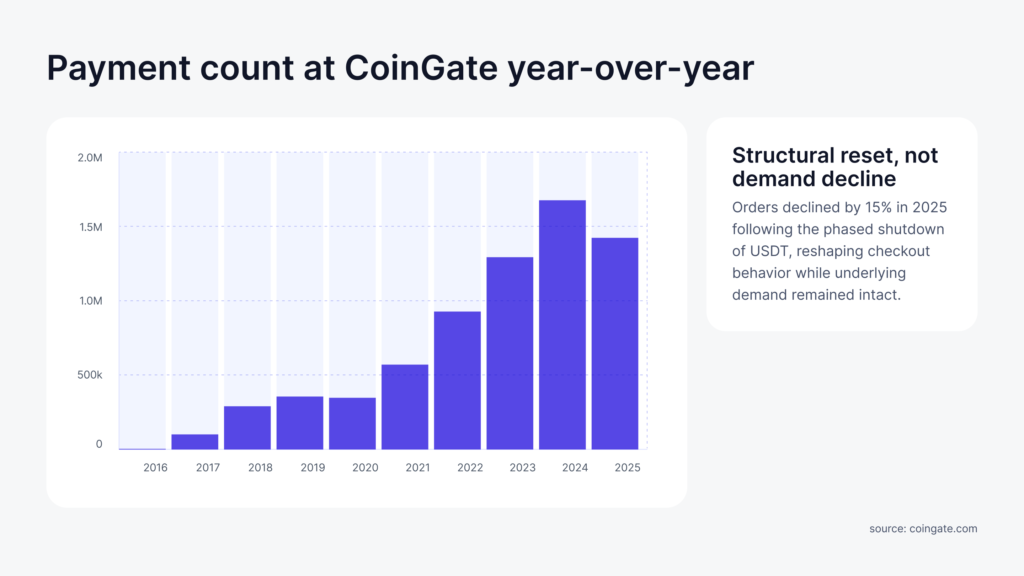
A contributing factor was a change in activity among a small number of high-volume use cases, which had a disproportionate impact on aggregate volumes. In parallel, Binance Pay reduced availability in certain geographies, affecting merchants operating in those markets. Lastly, 2025 marked the implementation of the Crypto Travel Rule in Europe, introducing additional data requirements – while necessary for long-term compliance and industry maturity, these changes added incremental friction at checkout and had a modest impact on conversion in specific scenarios.
Importantly, these shifts did not reflect reduced demand for crypto payments overall. The majority of active merchants maintained stable and, often, growing processing volumes, and operational usage across core products continued to deepen throughout the year.
Despite fewer total orders, average cart value reached €108, indicating that crypto payments are traditionally concentrated in higher-value transactions.
Seasonal behavior also remained consistent, with Q4 standing out as the most active, in line with broader e-commerce trends such as Black Friday and the holiday period.
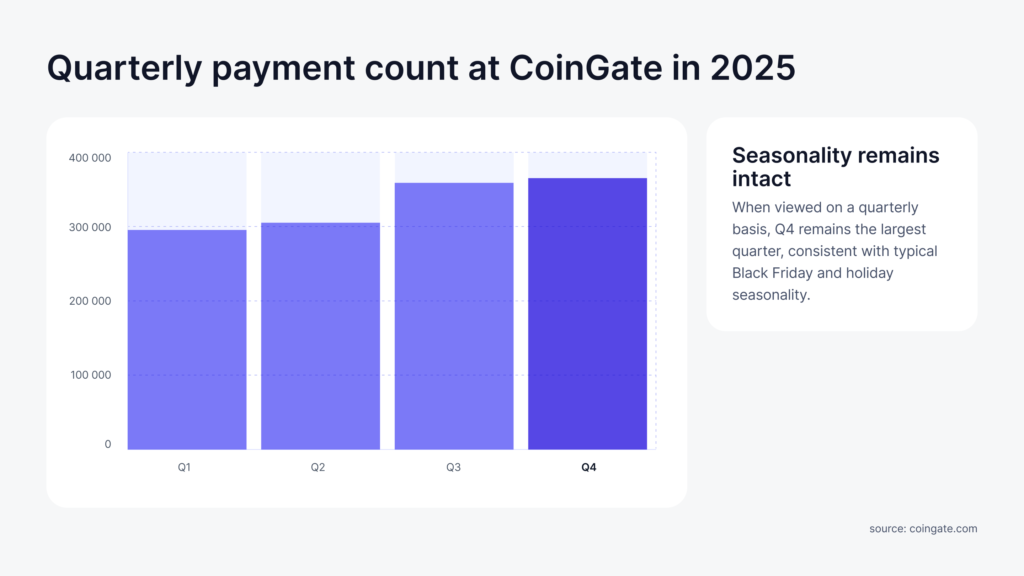
From a market maturity perspective, this is a healthy signal. Crypto payments at CoinGate in 2025 were less about volume at any cost and more about reliability, compliance, and long-term operational use.
How Merchants Use Crypto After Receiving Payments?
One of the strongest indicators of market maturity in 2025 came from merchant settlement behavior.
Compared to 2024, fiat settlements dropped from 73% to 62.5%, while settlements in cryptocurrencies increased from 27% to 37.5%
This is one of the strongest signals of crypto payments moving beyond checkout and into core financial operations.
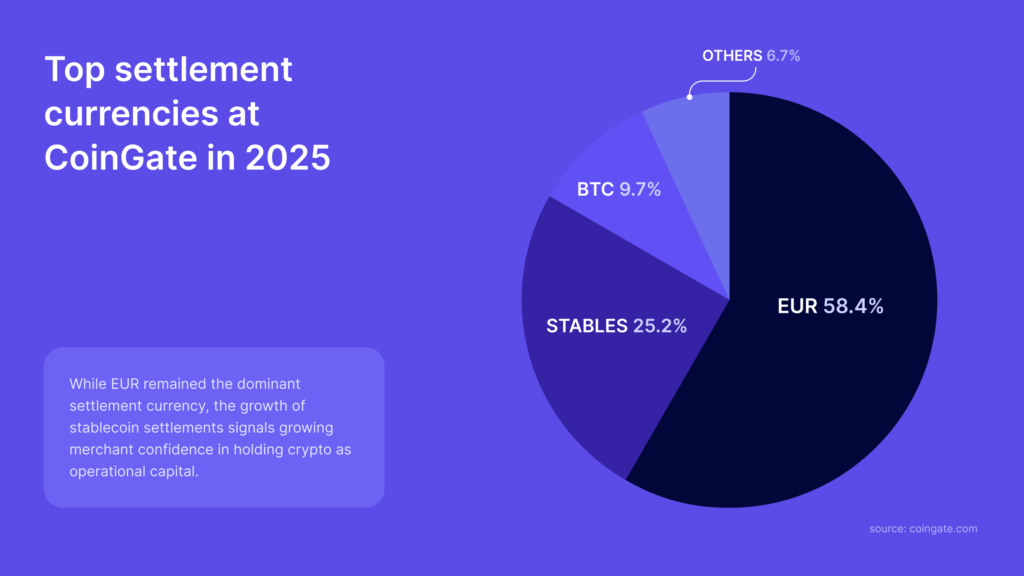
From all CoinGate orders, 25.2% were settled in stablecoins, up from 16.7% in 2024, representing an 8.5% increase year-over-year.
USDC stands out most clearly. Settlements in USDC increased from 0.01% in 2024 to 12.6% in 2025, transforming it from a marginal option into a core treasury asset.
For many long-term CoinGate merchants, crypto is no longer just a checkout option. It is increasingly used as working capital held on balance sheets, converted strategically, or redeployed through payouts.
Payouts Went From Simple Transfers to FX-Driven Operations
Payouts at CoinGate can be executed in two distinct ways. Merchants can either send cryptocurrency directly from an existing crypto balance, or convert funds from another balance – including fiat – at the moment of payout. The latter option, known as FX payouts, allows businesses to dynamically convert and send the desired crypto asset without pre-holding it.
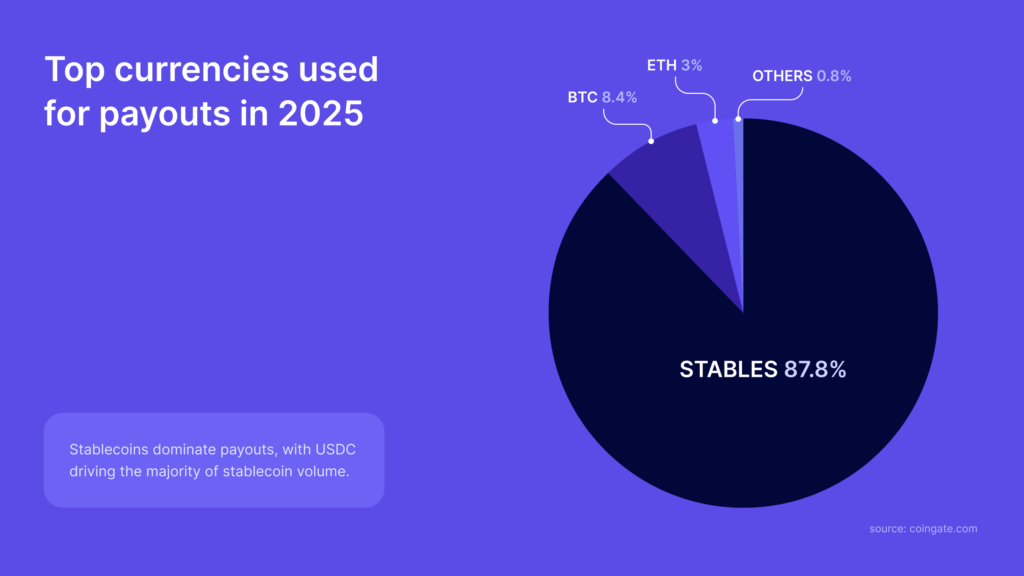
Looking at all payouts executed in 2025, USDC clearly emerged as the primary payout currency, accounting for 83.4% of all payouts, followed by BTC (8.4%), USDT (4.4%), and ETH (3.0%). This reflects the final currency that recipients actually received, regardless of which balance the payout originated from.
However, the conversion data reveals how merchants arrived there.
FX Payouts in Practice: Converting at the Moment of Payment
When merchants initiated payouts from EUR balances, the conversion path was highly concentrated. In 85.4% of cases, EUR was converted directly into USDC at payout time. BTC accounted for 9.8% of EUR-based conversions, ETH for 4.1%, with all other assets representing only marginal shares.
FX payouts were primarily used to convert funds into USDC, not to cycle between assets. Once converted, 96.8% of payouts remained in USDC, indicating that merchants treat it as a stable operational endpoint for outbound payments.
This behavior shows that merchants are not experimenting with payout currencies. Instead, they are using FX payouts to reliably convert working capital into a single, predictable settlement asset at the moment it is needed.
What This Reveals About Merchant Behavior
Taken together, the data shows that payouts in 2025 were not ad-hoc transfers, but deliberate financial operations:
- Fiat balances were frequently converted into USDC at payout time
- USDC functioned as the dominant operational currency for outbound payments
- Crypto-to-crypto conversions were rare once funds were held in a preferred asset
This reinforces the broader trend seen across the report: crypto at CoinGate is increasingly used as operational capital, with FX payouts enabling flexibility while still converging on a small set of trusted assets.
Cryptocurrency Rankings and Payment Share Shifts
One of the clearest signals of market maturity in 2025 was the reordering of crypto payment preferences. Rather than chasing short-term trends, usage consolidated around assets with strong infrastructure, liquidity, stability, and regulatory clarity.
Bitcoin Returns to the Top
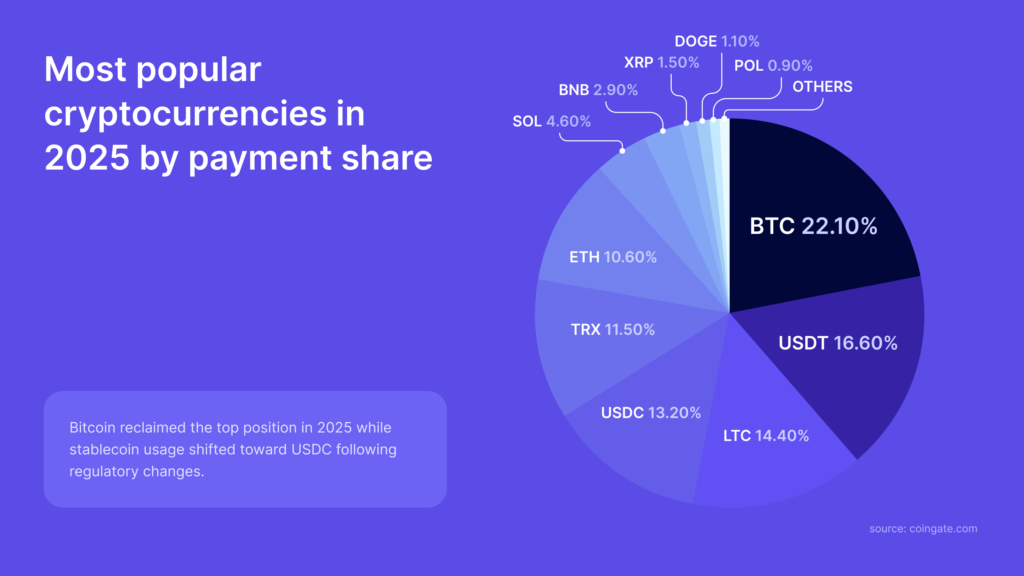
BTC reclaimed its position as the most-used cryptocurrency on CoinGate in 2025, reaching a 22.1% payment share with 292,217 orders and overtaking USDT.
This shift was not driven by speculation or price volatility. Instead, it reflects BTC’s role as a trusted, neutral asset for payments, particularly as regulatory pressure reshaped stablecoin usage.
Bitcoin’s role as a payment rail was further reinforced by the growing use of the Lightning Network, with 11.3% of Bitcoin payments processed via Lightning Network, while the remaining 88.7% settled on-chain.
Recently, we did a deep dive into 11 years of our Bitcoin payments data. Here’s our findings.
The Rebalancing of Stablecoins
USDT finished 2025 as the second most-used crypto, but its payment share declined steadily after Q2.
For most merchants, USDT was discontinued in April, with a complete shutdown by the end of the year. This regulatory-driven change reshaped checkout behavior across the platform.
Importantly, stablecoins did not disappear but recalibrated.
In 2025, 29.8% of all CoinGate payments were made in stablecoins, where USDT dominated until April. However, USDC rapidly replaced USDT as the preferred stablecoin for compliant, long-term usage leading to a 1264% increase in USDC order volume year-over-year.
As a result, USDC payment share rose from 2.5% in 2024 to 44.2% of all stablecoin payments in 2025.
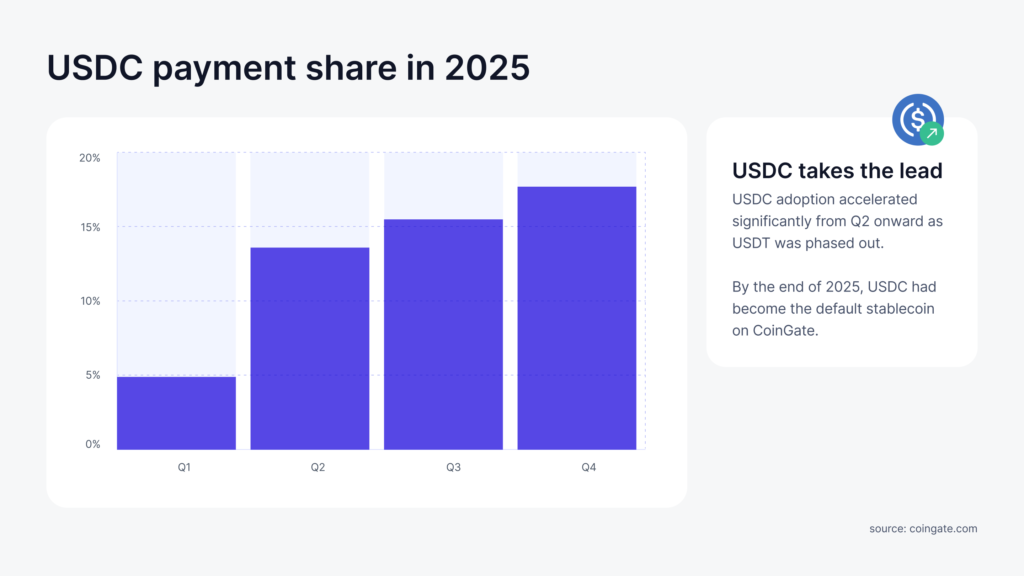
The most significant inflection point occurred between March and April, when processed order volume in USDC surged by 229% compared to January–February. This coincided with regulatory changes affecting USDT availability and marked a decisive shift in merchant and shopper preferences.
By year-end, USDC was no longer an alternative stablecoin. It became the default choice for stablecoin payments on CoinGate.
Litecoin Stays Consistent Through Change
Litecoin remained the third most popular payment method, increasing its payment share from 13.1% in 2024 to 14.4% in 2025.
Notably, in June and July, Litecoin briefly rose to the second most-used crypto, overtaking USDT. This pattern reinforces Litecoin’s role as a reliable fallback currency, particularly valued for its low fees, speed, and long-standing presence in digital commerce.
Litecoin has been one of the most consistent currencies at CoinGate. We took time to explore seven years of our Litecoin payment data to find out why.
Broadening Asset Mix
Beyond the top three, several assets strengthened their positions:
- USDC climbed from 7th place in 2024 to 4th in 2025
- TRX payment share grew from 9.1% to 11.5%
- ETH increased from 8.9% to 10.6%
- SOL more than doubled, rising from 2.1% to 4.6%
Rather than fragmentation, this reflects selective diversification around assets with clear operational advantages. Merchants and shoppers alike gravitated toward assets with clear operational benefits, strong network support, and predictable settlement behavior.
Prominent Blockchains and Payment Infrastructure
Asset preferences were closely mirrored by changes at the network level, revealing how crypto payments are increasingly shaped by infrastructure quality rather than novelty.
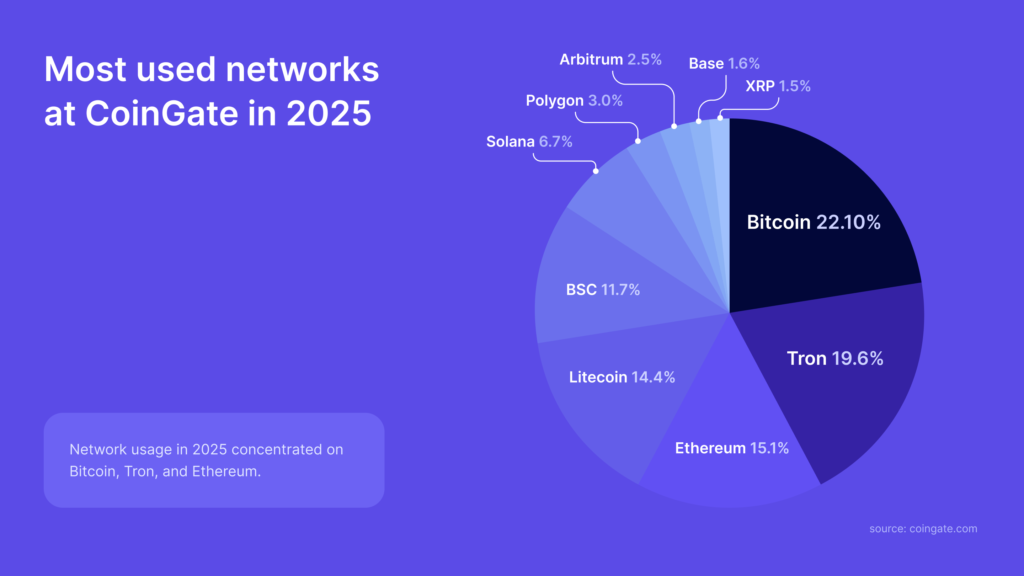
TRON’s Internal Shift After USDT Delisting
TRON network activity declined overall following USDT delisting, but usage patterns shifted internally. Even as stablecoin activity declined, native network assets absorbed a portion of demand.
TRX’s share on the network increased from 20.2% to 80.3% in later months, which resulted in 58.5% of all TRON payments made in TRX, a significant increase from a previous year.
Despite delisting earlier in the year, USDT still accounted for 41.4% of payments on TRON on average and reflects its residual usage during the transition period.
Ethereum Regains Ground
Ethereum overtook Litecoin to become the third most-used payment network in 2025. 62.1% of Ethereum-based payments were made in ETH, whereas 26.6% were made in USDC, signaling the network’s growing role as a stablecoin settlement layer.
Base Breakout Year
After being integrated in February, Base quickly became a notable payment network. 63.6% of Base payments were made in USDC, while 36.4% were made in ETH.
Merchants had no problems quickly adopting new infrastructure when it delivers lower fees and operational efficiency.
Growing Layer-2 Payments Show Users Appreciate Efficiency
Layer-2 (L2) networks continued their steady ascent in 2025, reinforcing a broader shift toward lower-cost, high-throughput payment rails that integrate seamlessly into business operations.
For example, Polygon usage increased by 19% year-over-year, with USDC and POL as the most commonly used assets.
Arbitrum usage grew as well by 21% compared to 2024, primarily driven by USDC payments.
L2s offer cost efficiency without sacrificing reliability, making them increasingly attractive for payment use cases. Stablecoins dominated L2 usage, underlining their role as the preferred medium for fast, predictable settlement.
What’s notable is the absence of sharp spikes or drops. L2 adoption in 2025 was incremental and consistent, suggesting infrastructure maturity. Learn more about that in our Layer 2 payment data report conducted in September of 2025.
Shopper Behavior and Geography
Higher-Value Transactions
In 2025, the average cart size reached €108, which is around the same as in previous years, suggesting that higher value purchases are more common in crypto transactions.
Crypto payments are being used primarily for digital services and software, subscription-based products, also B2B and cross-border transactions.
Rather than reflecting a drop in demand, the data suggests that crypto payments in 2025 were concentrated in use cases where they offer the most practical value – fast, borderless payments for globally distributed customers.
Top Shopper Countries
Crypto payment activity remained globally distributed, with clear leaders:
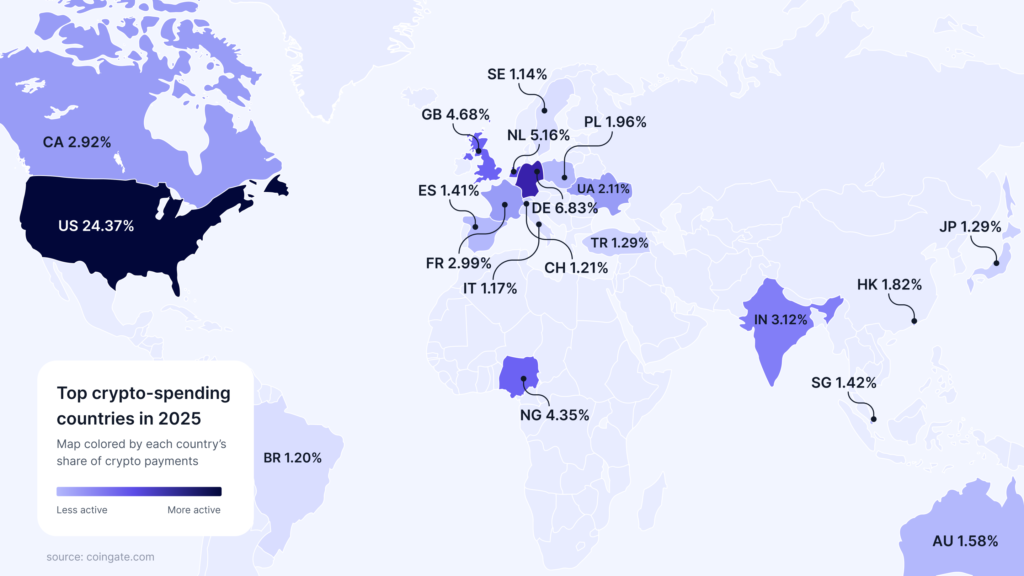
Like every year before, the US shoppers remain at the top. Most notably, the Netherlands rose from fifth to third place over a year.
Also, Nigeria’s continued presence in the top five throughout the years reinforces crypto’s importance in regions where traditional payment access remains limited. However, if payments are split by continent, Europe collectively takes the lead.
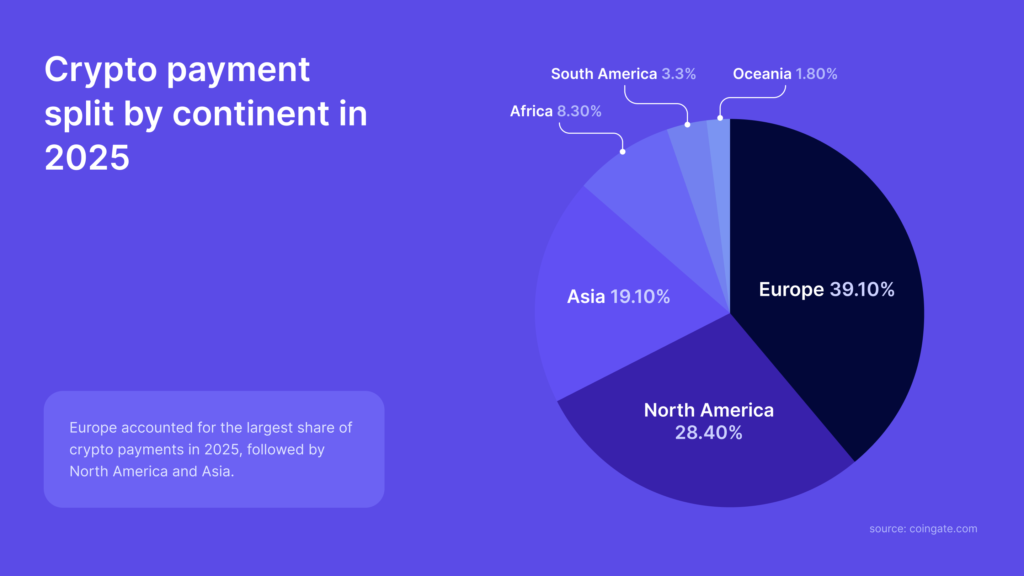
If you’re curious about top spending countries, check out our regional data report where we compare countries’ activities over the years and identify prominent trends.
What This Means for Businesses
Looking across 2025, several clear conclusions stand out – and they go beyond how customers pay.
Crypto is becoming operational capital
Merchants increasingly use crypto not just to accept payments, but to hold value, manage treasury, and execute payouts. Higher crypto settlement rates and the growing use of FX payouts show that crypto is now part of day-to-day financial operations.
Stablecoins have professionalized business workflows
USDC’s rise reflects a shift toward predictability, compliance, and operational efficiency. It has become the default asset for settlements and payouts, not because of legacy dominance, but because it fits real business needs.
Automation is no longer optional
API-driven payouts are now the norm. With 85% of payouts executed via API, crypto payments and payouts are increasingly embedded into backend systems, rather than handled manually.
Bitcoin remains foundational
Bitcoin’s return to the top reflects its role as a trusted, neutral settlement asset, supported by mature infrastructure across on-chain and Lightning networks.
Regulation enabled long-term stability
MiCA licensing provided the legal clarity needed for businesses to treat crypto as a reliable financial tool, particularly across Europe.
Crypto payments are no longer experimental
Lower order counts alongside higher cart values and more predictable usage patterns suggest that crypto payments are now used where they make the most operational sense, rather than as an experiment.
Closing Thoughts
2025 was not defined by hype or rapid expansion. It was defined by consolidation, discipline, and confidence.
Crypto payments at CoinGate became more selective and more deeply integrated into real business operations. Merchants chose reliability over novelty. Shoppers used crypto for meaningful purchases. Infrastructure matured quietly in the background.
This is what adoption looks like when an industry grows up.
If you’re ready to build on that foundation, now is the right time to explore crypto payments with CoinGate. Sign up.
Accept crypto with CoinGate
Accept crypto with confidence using everything you need in one platform.