


Accept crypto with CoinGate
Accept crypto with confidence using everything you need in one platform.
Crypto in 2025: Crypto Payments and Bitcoin’s Evolution (Part 4)
In 2025, using cryptocurrency for payments made measurable technical and adoption gains, driven by scaling solutions, improved network infrastructure, and the growing use of stablecoins.
At the same time, Bitcoin’s role expanded beyond a store of value, as its network capabilities and payments utility continued to develop.
This fourth article of our 5-part series examines how crypto payments matured in 2025 and how Bitcoin’s network evolved as part of that process.
Read the previous articles here:
- Crypto in 2025: Mainstream Adoption and Market Growth (Part 1)
- Crypto in 2025: Institutional Adoption and Market Integration (Part 2)
- Crypto in 2025: Stablecoins and the Expansion of Digital Payments (Part 3)
- Crypto in 2025: Regulatory Milestones Across the Globe (Pt. 5)
Feels like it’s time to introduce cryptocurrency payments to your checkout? Sign up for CoinGate.
Crypto Payments and Bitcoin in 2025
Bitcoin became more payment-friendly as the Lightning Network – its layer-2 solution for fast, low-fee transactions – reached new levels of capacity and adoption.
After a period of stagnation, Lightning activity increased in late 2025. Public capacity reached an all-time high of over 5,600 BTC (approximately $500 million), according to the article on TradingView.
This growth was supported by wider exchange integration. Major exchanges such as Binance and OKX increased BTC liquidity on Lightning in Q4, contributing to higher network capacity and signaling increased confidence in the technology.
With Lightning and similar solutions, Bitcoin payments became faster and significantly cheaper, enabling use cases such as micropayments, real-time transfers, and low-cost cross-border transactions.
BTC was also the #1 currency used for payments at CoinGate, accounting for 22.1% of a total of 1.4 million transactions in 2025. Learn more in 2025 crypto payments data report.

Bitcoin Network Upgrades and Asset Support
Bitcoin’s throughput and functionality continued to improve through protocol upgrades.
One of the most significant changes came from Lightning Labs, which rolled out the Taproot Assets protocol. This upgrade allows assets such as stablecoins to be issued on Bitcoin and transferred over the Lightning Network.
This created a technical foundation for Bitcoin-based stablecoin transactions, faster settlement using Bitcoin’s security model, and hybrid payment models combining BTC and stablecoins.
By the end of 2025, Bitcoin was increasingly described not only as a store of value but also as a payments network and settlement layer with support for additional digital assets.
Payments Infrastructure Scaled Across Blockchains
Beyond Bitcoin, the broader crypto payments stack matured.
Major blockchain networks – including Ethereum, Solana, and emerging layer-2s – scaled transaction capacity and reduced fees. By 2025, public blockchains were collectively handling over 3,400 transactions per second on average, more than 100× their throughput five years earlier.
Improved performance, combined with better wallet user experience, made crypto payments faster and more reliable. QR-based payments became more common, confirmation times dropped across major networks, and average transaction costs declined. These changes made crypto more suitable for point-of-sale payments and recurring transaction flows.
The same pattern is recognized across the behavior at CoinGate checkout. After the WalletConnect integration in November 2025, we notice:
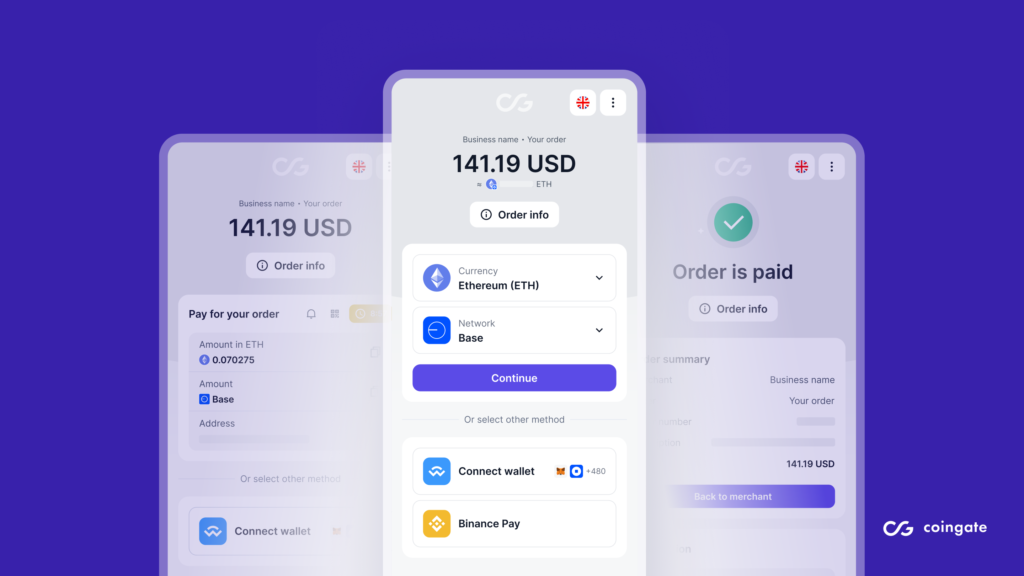
- 20% higher overall conversion
- 15% higher conversion for first-time shoppers
- 20% higher completion rates for returning customers
- Payments complete about 25% faster
Merchant Adoption and Consumer Usage
With improved infrastructure, merchant adoption increased.
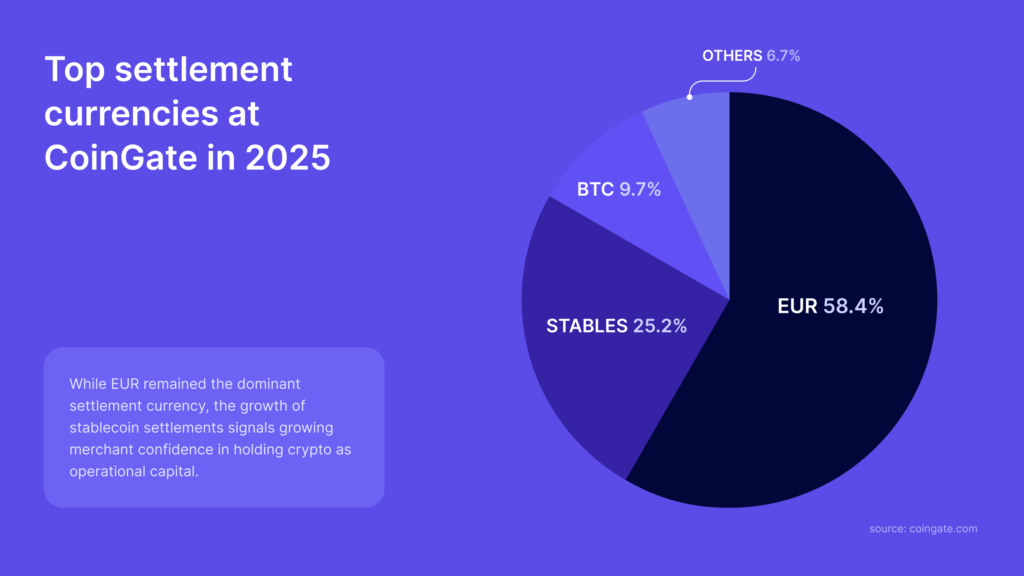
More businesses began accepting crypto payments, often using payment processors that instantly convert crypto to fiat, reducing volatility exposure. At CoinGate, 58.4% of all payments settle into EUR.
E-commerce and travel companies reported higher crypto usage, particularly for cross-border purchases, where crypto’s 24/7 settlement and lower transaction costs offered practical advantages over card networks.
Crypto was also increasingly used for outbound payments. Content platforms, marketplaces, and freelancers adopted crypto – especially stablecoins like USDC – for payouts, allowing recipients in different countries to receive funds without relying on local banking rails.
On-Ramps, Off-Ramps, and Payment Tooling
Behind the scenes, crypto payments became easier to integrate into everyday financial workflows.
Startups focused on crypto on-ramps and off-ramps simplified the process of moving between fiat and crypto, reducing friction for both consumers and businesses. Wallet interfaces improved, custody options expanded, and compliance tooling matured.
Payroll platforms integrated stablecoins for global payouts. Remittance apps adopted crypto rails to reduce fees and settlement times. Subscription services and marketplaces began testing crypto billing and stablecoin-based settlements.
These tools made crypto usable not only for one-off payments but also for recurring operational transactions.
Bitcoin’s Financial Role in 2025
Bitcoin’s position in the financial system also evolved alongside its payments utility.
In 2025, Bitcoin reached a new all-time high above $126,000, driven by a combination of institutional inflows via ETFs, post-halving supply tightening following the 2024 block reward halving, and a macroeconomic environment of moderating inflation and interest rates.
Some companies and public figures described Bitcoin as a “strategic reserve asset” or “digital gold.” Business intelligence firm MicroStrategy (rebranded as Strategy) continued increasing its Bitcoin holdings, exceeding 640,000 BTC on its balance sheet.
There were also discussions about nation-states potentially holding Bitcoin in their reserves, though most governments remained cautious beyond early adopters such as El Salvador.
Summary
By the end of 2025, crypto payments were no longer limited to experimental pilots.
Infrastructure improvements, stablecoin adoption, and scaling solutions made crypto a more practical option for cross-border payments, merchant transactions, global payouts, remittances, and digital services.
Bitcoin, in parallel, expanded beyond a pure store-of-value narrative into a payments network and settlement layer with growing technical capability.
Although volatility and usability challenges remained, crypto payments became more functional, more scalable, and more integrated into real financial workflows than in previous years.
In Part 5, we examine how regulatory clarity in 2025 reduced legal uncertainty and enabled this infrastructure to scale across institutions and jurisdictions.
Accept crypto with CoinGate
Accept crypto with confidence using everything you need in one platform.