


Accept crypto with CoinGate
Accept crypto with confidence using everything you need in one platform.
Crypto in 2025: Stablecoins and the Expansion of Digital Payments (Part 3)

In 2025, stablecoins became one of the most significant growth areas within the crypto industry.
After several years of steady expansion, stablecoins reached a new level of scale and integration, driven by higher transaction volumes, clearer regulation, and increasing use in real-world payment flows.
This third article of our 5-part series examines how stablecoins evolved during 2025 and why they became a core part of crypto’s practical utility.
Read the previous articles here:
- Crypto in 2025: Mainstream Adoption and Market Growth (Part 1)
- Crypto in 2025: Institutional Adoption and Market Integration (Part 2)
- Crypto in 2025: Crypto Payments and Bitcoin’s Evolution (Part 4)
- Crypto in 2025: Regulatory Milestones Across the Globe (Pt. 5)
Feels like it’s time to introduce cryptocurrency payments to your checkout? Sign up for CoinGate.
Stablecoin Market Growth in 2025
No segment of the crypto market expanded more rapidly in 2025 than stablecoins.
Stablecoins – digital currencies pegged to stable assets such as the U.S. dollar – entered a new phase of maturity and adoption. After years of growth, stablecoins began operating at a scale comparable to traditional payment networks.
Over the year, stablecoins facilitated up to $46 trillion in on-chain transaction volume globally (approximately $9 trillion when adjusting for technical churn), placing them in the same range as Visa’s annual payment volume.
Their share of total crypto activity reached an all-time high. By August 2025, stablecoins accounted for around 30% of all on-chain transaction volume, with more than $4 trillion transacted in 2025 up to that point – an 83% year-over-year increase.
The supply of dollar-pegged stablecoins expanded substantially. Market capitalization grew by roughly 50% during the year, reaching new highs and approaching $250 billion by late 2025.
This growth reflected increasing demand for stablecoins as digital cash for trading, remittances, and payments.
Regulatory Developments in the U.S. and Europe
Regulatory clarity played a central role in legitimizing stablecoins in 2025.
In the United States, lawmakers enacted the first federal stablecoin law, the Guiding and Establishing National Innovation for U.S. Stablecoins Act of 2025 (GENIUS Act).
Passed by Congress in mid-2025 and signed into law, the GENIUS Act established federal standards for stablecoin reserves, audits, licensing, and transparency. It also clarified that compliant stablecoins are not treated as securities.
This created a clearer legal foundation for U.S. dollar stablecoins and increased confidence among traditional financial institutions and investors.
In Europe, the Markets in Crypto-Assets (MiCA) framework became fully applicable at the end of 2024, making 2025 the first full year under the regime.
MiCA introduced unified rules across EU member states for stablecoin issuance, including reserve requirements, transparency obligations, and licensing standards, under EU-level supervision.
CoinGate obtained a MiCA license from the Bank of Lithuania, allowing it to operate crypto payment services under a regulated EU framework.

Together, these developments reduced legal uncertainty around stablecoins and supported broader institutional participation.
Stablecoins in Real Payment Flows
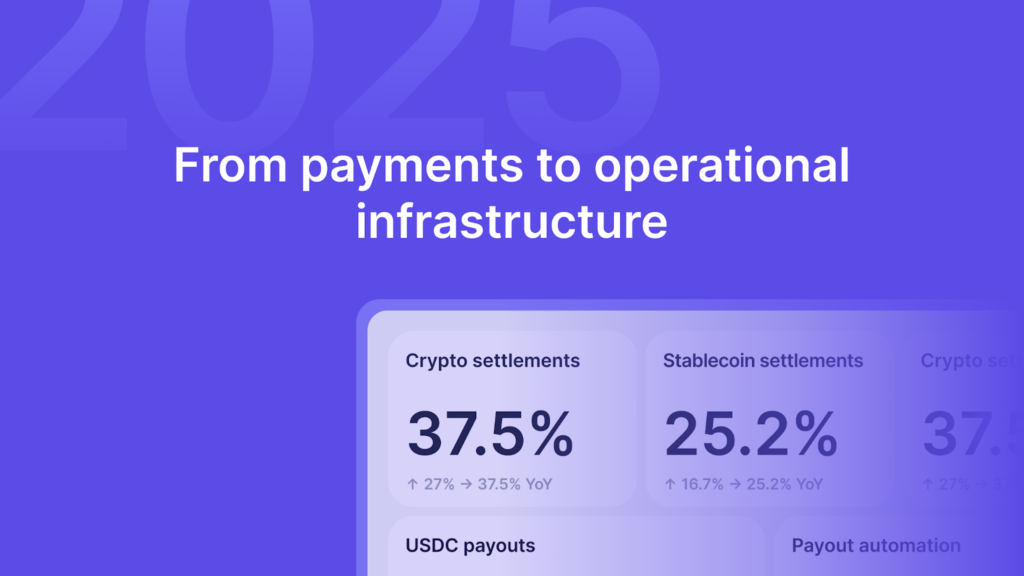
With clearer regulation and growing trust, stablecoins moved further into practical payment use cases, as we see at CoinGate. In 2025, merchants increasingly used crypto not just for accepting payments, but as operational capital. Stablecoins accounted for 25.2% of all payments processed on the platform, up from 16.7% in 2024, reflecting growing preference for price-stable settlement.
While stablecoins represented 29.8% of total payment volume, their composition shifted decisively toward USDC, which emerged as the dominant stablecoin following its status as the sole EU-compliant and widely adopted option. Learn more in our 2025 crypto payments data report.
Because they combine the stable value of fiat with the speed of crypto networks, stablecoins were increasingly used for cross-border business payments, instant payouts for gig workers and creators, global payroll, e-commerce settlement, and remittance flows in emerging markets.
Throughout 2025, more pilots and platforms adopted stablecoins for remittances, global e-commerce, payroll and contractor payments, and humanitarian aid transfers. In many cases, funds were delivered in minutes rather than days, bypassing correspondent banks and other intermediaries.
Major technology firms and startups launched stablecoin-based payment services, leveraging blockchain infrastructure for faster settlement and lower transaction costs. Fintech companies integrated stablecoins into payroll tools and remittance apps to streamline cross-border flows.
Payment Network Integration and Product Innovation
Traditional payment networks also expanded stablecoin integration.
Visa’s stablecoin settlement pilot – introduced earlier – illustrated how stablecoins could upgrade backend payment rails. Visa enabled banks and merchants to settle transactions in USD Coin (USDC). By the end of 2025, Visa was clearing stablecoin payments at an annualized run-rate of $3.5 billion, indicating growing institutional demand for blockchain-based settlement.
At the same time, new stablecoin models emerged.
Some projects introduced yield-bearing stablecoins, allowing users to earn returns via decentralized finance strategies. Others explored non-USD stablecoins, including euro- and pound-pegged tokens designed to serve local and regional markets.
These developments indicated that stablecoins were evolving beyond a single-product category into a broader financial layer supporting multiple currencies and business models.
Stablecoins as Financial Infrastructure
By late 2025, the stablecoin ecosystem had changed structurally.
It had achieved global scale, regulatory legitimacy, institutional trust, and deeper integration into payments and fintech platforms.
Stablecoins were no longer limited to crypto trading activity. They had become a foundational component of modern digital finance.
For businesses, stablecoins reduced volatility in payments, lowered cross-border transaction costs, and enabled faster settlement across jurisdictions.
By the end of 2025, stablecoins had moved from a niche crypto utility into a widely used payments and settlement instrument. Want to start using stablecoins in your line of work? Sign up for a CoinGate account.
In Part 4, we examine how crypto payments became faster and cheaper at scale and how Bitcoin’s network evolved beyond a store of value into a functional payments and settlement layer.
Accept crypto with CoinGate
Accept crypto with confidence using everything you need in one platform.