


Accept crypto with CoinGate
Accept crypto with confidence using everything you need in one platform.
Your Processor Called You High Risk. Here Is What Crypto Actually Changes
The email usually arrives after a good month. Your acquirer has reviewed the account, reclassified the business as high risk, and attached new terms. A higher rate. A rolling reserve. Sometimes a hold on the current settlement while somebody finishes a review nobody told you had started.
The frustrating part is that usually nothing changed. The business is the same one it was last quarter. The label came out of a model, not out of a conversation with someone who read your accounts.
So the useful question is narrower than whether you should take crypto. Which of the problems that arrive with the high risk label does a high risk payment processor built on crypto actually remove, and which ones follow you no matter what sits in your checkout? Both halves matter. Most pages competing for this search answer only the first half, usually because whoever wrote them is selling the reserve.
Tired of a reserve sitting on money you already earned? Open a CoinGate account and see where you land.
What “high risk” means to an acquirer
High risk is not a judgment about your business. It is an estimate of loss, and the loss being estimated belongs to the acquirer.
When a cardholder disputes a transaction, money moves back through the card network. If the merchant cannot fund that reversal, because the company is gone, the balance is empty or the disputes all arrived in the same week, the acquirer covers it. Almost everything on the high risk checklist is a proxy for that one exposure.
- Dispute and refund rates running above card scheme tolerances
- A long gap between payment and delivery, which is why travel, ticketing and pre-orders sit on the list permanently
- Subscription and free trial models, where disputes cluster around the renewal
- Cross-border card volume, where issuer behaviour is harder to predict
- Licence-dependent activity, where the acquirer inherits a regulatory question it did not ask for
- A new company with no processing history to model
The label sticks because it behaves like a record rather than an assessment. Processing history follows you between providers, and industry classification does not improve when your operation does. You can clean up a dispute rate over two years and still be quoted high risk terms by the next acquirer, because it is pricing the category and not you.
The rolling reserve, and what it costs
A rolling reserve is the acquirer holding back a share of your settled volume for a set period before releasing it, so there is a pool of your own money available in case disputes arrive later.
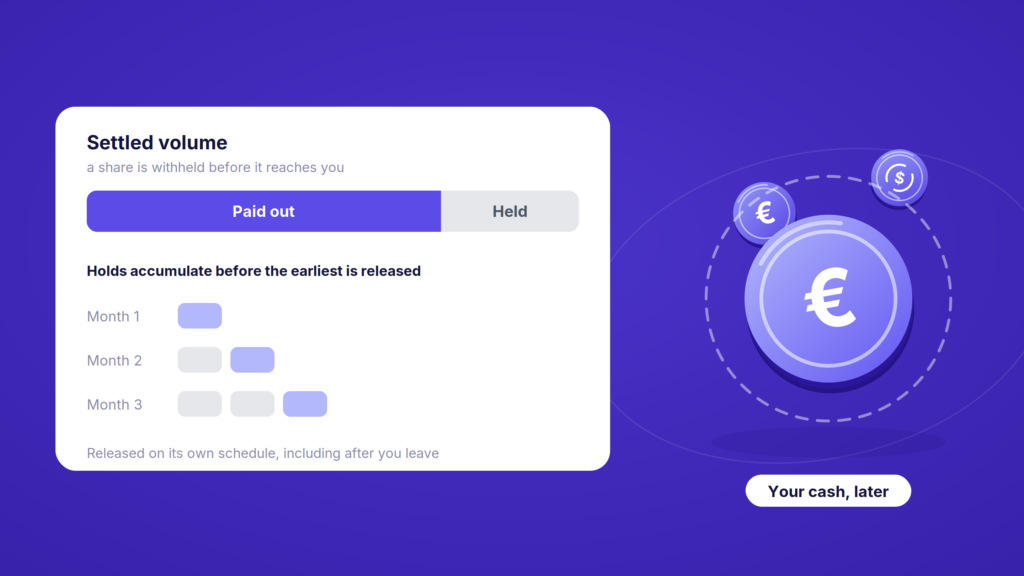
On paper it is not a cost, since you get it back. In practice it behaves like an interest free loan you were required to make, and it hurts in three places.
Working capital. The money is deducted from revenue you have already earned and, more to the point, already committed. Inventory, ad spend and payroll do not run on the release schedule.
Compounding at the start. In the first months, new holds pile up before the earliest are released. The gap is widest exactly when a business on new terms can least afford it.
The exit. Leaving the provider does not free the pool. It unwinds on its own schedule, which means the month you switch is also the month you have the least cash to switch with.
A reserve is priced against dispute exposure, so it helps to know what a dispute actually costs. We put that in numbers in a breakdown of what chargebacks cost a business once the fee, the lost goods and the staff hours are counted.
What crypto genuinely removes
Three things, and together they are most of what the label is built from.
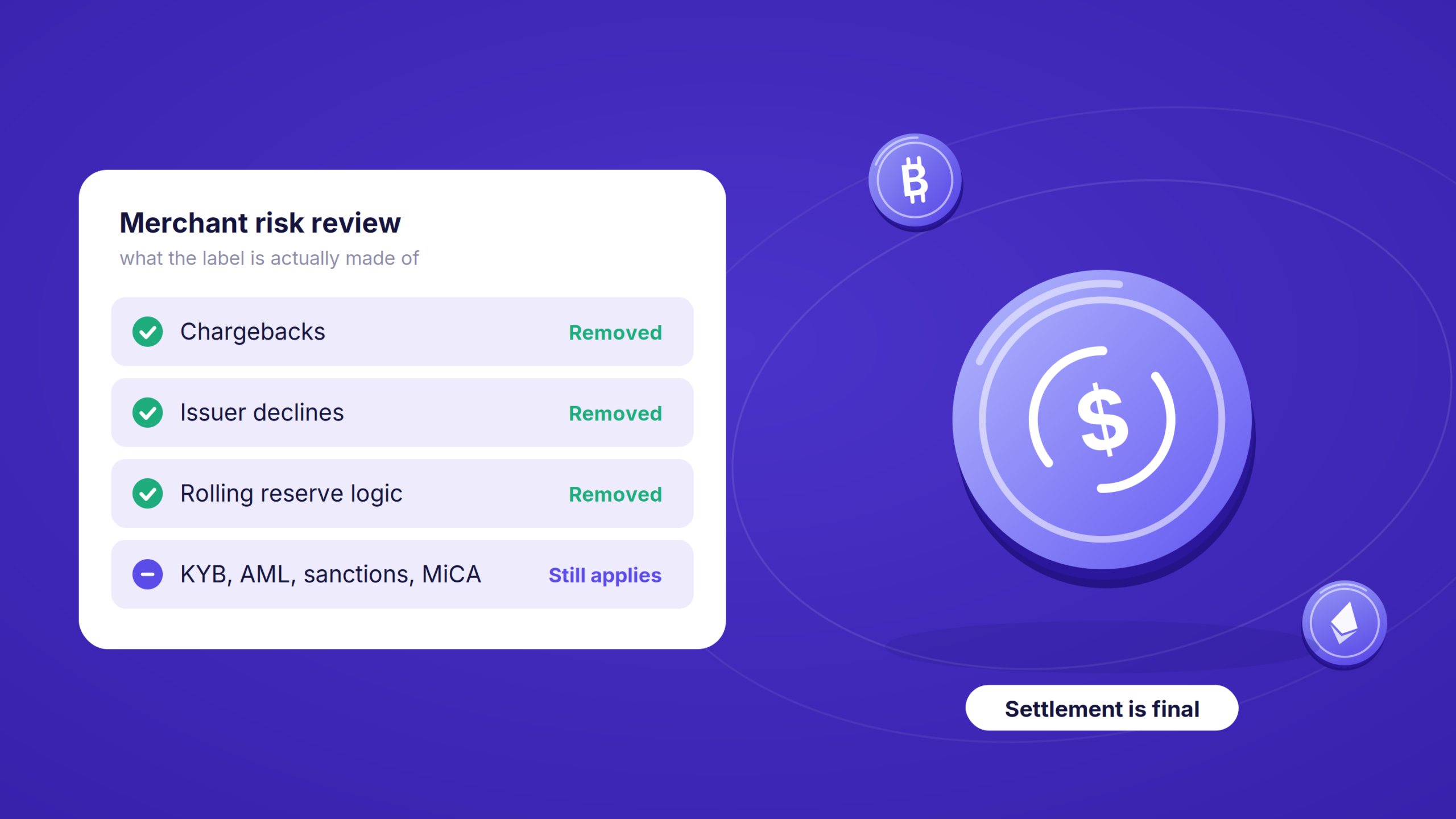
Chargebacks. A confirmed on-chain payment is final. There is no issuer standing behind it with the power to reverse it weeks later. You can still have a dispute with a customer and still choose to refund, but the decision stays with you instead of with a third party under no obligation to hear your side. The mechanics are in our piece on fraudulent chargebacks and what crypto changes.
Issuer declines. Card payments fail for reasons that have nothing to do with whether the customer has money. Geography, merchant category, a risk model having a bad day. A crypto payment does not route through an issuer, so that whole class of quiet revenue loss leaves the path.
The logic behind the reserve. Reserves exist to fund reversals. Where settlement is final on-chain, that exposure does not arise, and the discussion about your business stops being a discussion about dispute risk. Our Standard plan is 1% per transaction with no monthly fee and no setup fee, and settlement runs weekly. Enterprise rates are custom and volume-based, and settlement there is weekly or on request.
A fair question follows from that. If nobody is holding a reserve, who is holding your money between the sale and the settlement? That is a question worth asking any provider, and we wrote the version of it we would want a merchant to use on us, in a guide to proof of reserves and fund safety.
What crypto does not remove
This is where most pages on this term stop being useful to you.
Crypto is not an exit from regulation. CoinGate is authorised by the Bank of Lithuania as a Crypto-Asset Service Provider under MiCA and as a Payment Institution under the Lithuanian Law on Payments. Supervision of that kind lands on us first, and a portion of it lands on you as our merchant.
- Know Your Business stays. Registration documents, extracts from the company register, ownership and control structure, beneficial owners, what the company sells and where the revenue comes from.
- AML screening stays. Monitoring applies to crypto flows the same way it applies to fiat ones. Blockchain data is public and traceable, which makes parts of that monitoring easier rather than lighter.
- Sanctions screening stays. It applies to the business, to the people behind it and to the flows themselves.
- MiCA obligations stay. They shape what we are allowed to offer and to whom, and goodwill on either side does not change that.
If what you wanted was a processor that asks fewer questions, this is the wrong page. What changes is not the volume of compliance. It is which risk your provider prices when it looks at you. An acquirer prices dispute exposure. We do not carry that exposure, so it leaves the conversation, while the compliance half stays in full. The operating side has its own requirements, which we walked through in a guide to running a compliant crypto payment operation.
What our verification actually involves
Two tracks, and they run in parallel.
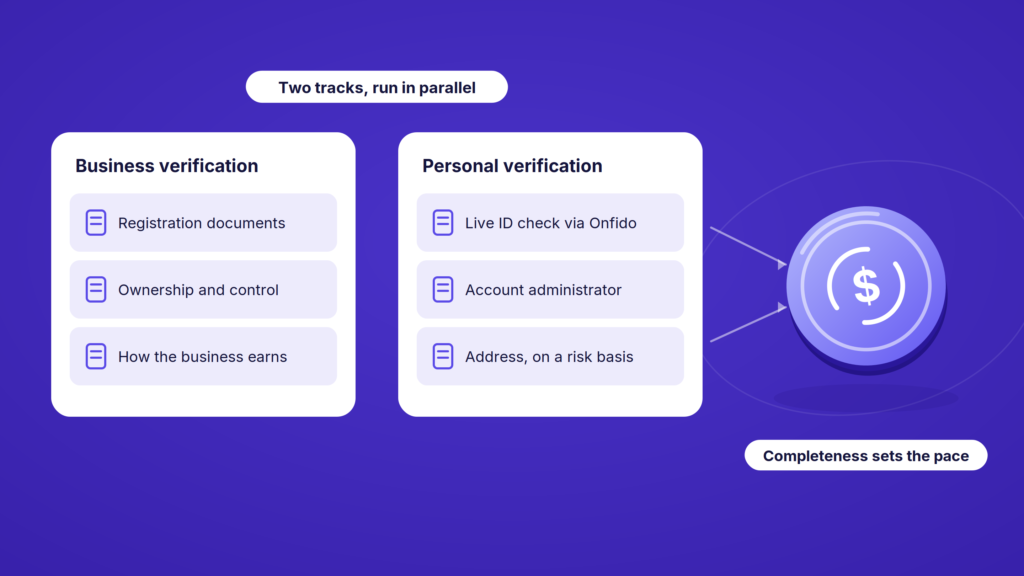
Business verification asks for the company registration documents, the ownership and control structure, and a clear description of what the business does and how it earns. A vague description of the business model invites another round of questions, which is the slowest way to do this.
Personal verification applies to the people who will actually move money. Administrator and Accountant roles have to complete it. Developer and Support roles do not, which is worth knowing before you invite your whole team. It runs in three steps: personal details including a politically exposed person declaration, your residential address, and a live ID check through Onfido.
The address is a self-declaration in most cases. Proof of address is requested on a risk basis rather than in every case, and the triggers are the kind of mismatch you would expect: citizenship or document country not matching declared residence, geolocation consistently pointing somewhere else, an unusual gap between where the company is incorporated and where the person lives, or a name that does not line up across the ID check.
One part of that is worth reading twice if you have been called high risk before. Cases that fall under enhanced due diligence always need proof of address as a minimum, and what puts a file there includes connections to high-risk jurisdictions, politically exposed persons, ownership structures more than three layers deep, and trust or intermediary arrangements. If your ownership chain runs through three holding companies, expect the longer version of this.
We do not publish a time to approval and you will not find one here. How long verification takes depends on how complete the documents you submit are. If you want the specifics of what gets asked and why, our merchant verification questions and answers go through it item by item.
Who this does not work for
Being clear about the ceiling matters here, because the fastest way to lose a week is building an integration into a category we cannot serve.
Our prohibited businesses are public, in clause 12 of our General Terms and Conditions. Read it before you apply. Two things about how it is written are worth knowing.
Parts of it are conditional. Financial services are prohibited where they are unlicensed or unregulated, which includes investment schemes, securities, derivatives and synthetic assets. Money or value transfer services are prohibited where they are unregistered. Crypto exchanges and P2P platforms are prohibited where they are unregulated or anonymous. Gambling, betting and lotteries are prohibited without valid authorisation. Adult content is prohibited without age verification or where it breaches applicable laws and content rules. ICOs, token sales and NFT transactions need our prior written consent and proper legal classification or registration. For those categories the answer is not automatically no. It is a question about licensing, registration, controls and, in some cases, a written approval you need in hand first.
Parts of it are absolute. Pyramid schemes and shell banks, artificial trading activity such as spoofing, wash trading and market manipulation, weapons, ammunition, military-grade equipment, controlled substances and unauthorised pharmaceuticals, spyware and surveillance and hacking tools, and anything designed to bypass AML, counter-terrorist financing or sanctions controls. There is no version of those that gets onboarded. The clause also closes with a catch-all covering activity that poses legal, compliance, reputational or operational risk, so a category not named above is not automatically cleared either.
If your business sits in the conditional group, settle the authorisation, the registration, the age gate or the consent question before the application rather than halfway through it.
Frequently asked questions
Will you approve us if a card acquirer already turned us down?
Not automatically, and the reason for the original decline matters. A decline driven by dispute rates concerns an exposure we do not carry, so it does not follow you here. A decline driven by the nature of the business, its licensing or its ownership still gets looked at, because those questions apply to us too.
How long does verification take?
There is no published figure and we are not going to invent one. The variable that matters is document completeness. A file with clear ownership documents and a specific description of the business moves faster than one where half the answers need a follow-up.
Can we still refund customers?
Yes. Refunds are initiated from the dashboard and the fee is 0.25 EUR plus 0.1%, where the 0.1% conversion fee applies only when the refunded currency differs from the currency used to issue the refund. The decision sits with you rather than with an issuer.
What does it actually cost?
The Standard plan is 1% per transaction, with no monthly fee and no setup fee. Enterprise rates are custom and volume-based, one of two plans alongside Standard. One thing our terms say out loud and most pricing pages do not: business customers may have bespoke fees and high-volume customers may be charged additional fees, and any fee is notified in advance. If you are moving serious volume, ask what your number is rather than assuming the published one.
Do you hold a rolling reserve?
The exposure a rolling reserve exists to fund does not arise on a final on-chain payment, which is the whole reason the reserve conversation is not part of pricing here. What we do carry is the compliance side, and that is where questions about your business come from.
The bottom line
The high risk label is mostly a card problem wearing a compliance costume. Chargebacks, issuer declines and the reserves built to absorb them make up the bulk of it, and crypto removes those three. The compliance half is real, it is not going anywhere, and the honest version of this pitch says so up front instead of letting you discover it during onboarding.
If the reserve is what keeps you up at night, the next step is to read clause 12, work out where your category sits, and have your documents ready before you apply. Thinking it is time to take a payment nobody else can reverse? See what verification actually asks for.
Accept crypto with CoinGate
Accept crypto with confidence using everything you need in one platform.