


Accept crypto with CoinGate
Accept crypto with confidence using everything you need in one platform.
Paying Suppliers in Stablecoins: What Changes and What Does Not
You approve the invoice on day 28. The bank sends the wire on day 29. On day 34 your supplier asks where the money is, and when it lands it lands short by an amount nobody can explain.
That is the payables problem. Not the price, not the terms you negotiated, but the days and the opacity between approval and confirmation. Stablecoins get pitched as the fix, and most of that pitch skips the part where the plan falls apart. So let’s start there.
Got a supplier who will take stablecoins? Set up crypto payouts and start with one small payment.
The blocker is your supplier, and it is a commercial conversation
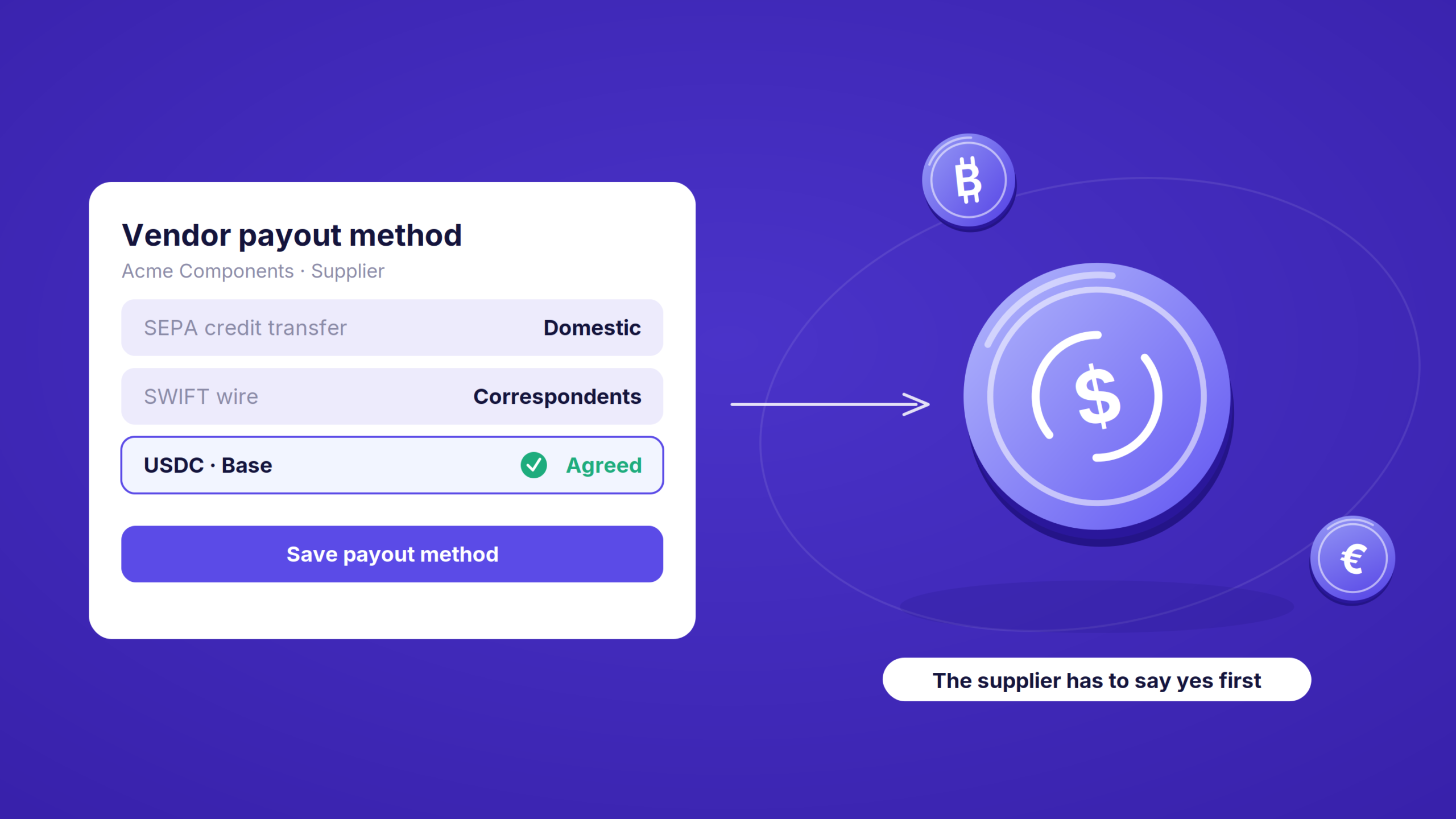
Your supplier has to be willing to accept it. That is the whole gate. No payment provider, ours included, can make a vendor take USDC instead of a wire, and no integration routes around a no from somebody else’s finance department.
The suppliers who say yes usually have a reason of their own. They already hold digital assets, or they sit in a market where receiving foreign currency is slow and expensive, or they are small enough that a four-day wire is a cash-flow event. The ones who say no have reasons just as sound: their bank, their accounting software, their auditor. A vendor is allowed to decline a payment method the same way you are.
So the first move in a B2B stablecoin payments project is not technical. Put it on the vendor onboarding form next to SEPA and SWIFT, raise it at contract renewal, and build nothing until one supplier has said yes in writing. If none of them do, you have saved yourself a project.
Why a cross-border supplier payment costs what it costs
A wire to another country is not one transfer. It is a relay. Your bank hands it to a correspondent, which may hand it to another, until it reaches your supplier’s bank. Every hop can take a fee and a day, cut-off times and weekends add more, and the currency conversion happens at a spread you did not negotiate.
The real cost is rarely the headline fee. It is the deducted amount nobody can reconcile and the shipment waiting on a confirmation. We put both rails side by side in our comparison of B2B cross-border payments against bank wires.
What a stablecoin transfer actually replaces
Only the settlement leg. Most of the confusion here comes from expecting more. The purchase order stays. The invoice stays. Your approval workflow stays. Three-way matching stays. A stablecoin transfer is a payment rail, not a procurement system.
What changes is the instrument and the timing. Instead of instructing a bank to push dollars through a chain of other banks, you send a token straight to an address your supplier controls. It arrives in minutes, and the status is not a phone call, it is a transaction hash. Most of the pain in payables was never the payment though. It was not knowing.
Stablecoins move your FX exposure, they do not remove it
Here is where honest gets uncomfortable.
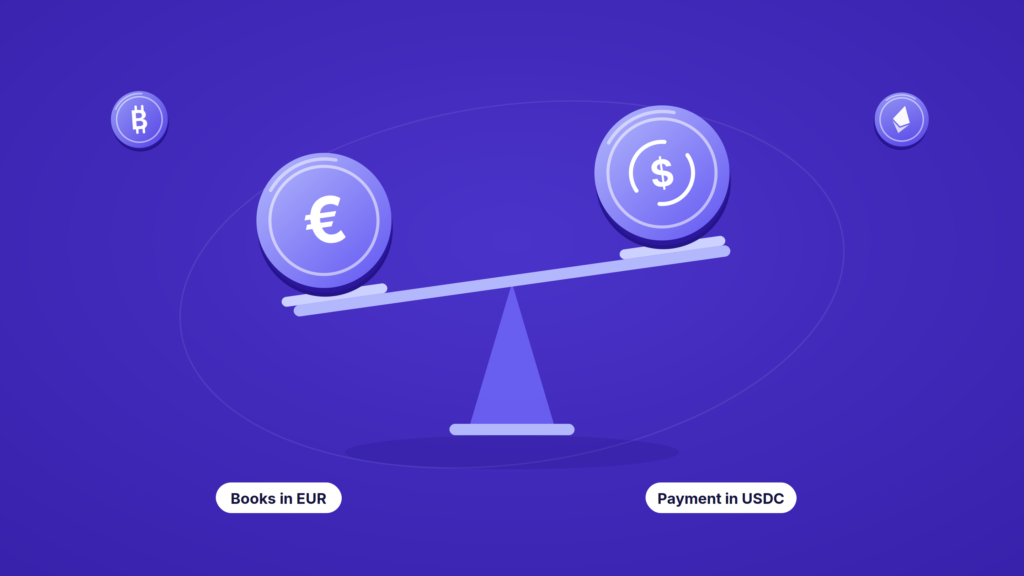
Say your functional currency is the euro and you agree to pay in USDC. You have just taken on dollar exposure. Between funding the payment and executing it the euro-dollar rate moves, and that movement is yours. It was yours when you wired dollars too. Stablecoins did not create the risk and they do not delete it. They move it, and they change who prices it and when.
What you gain is control over the timing of the conversion instead of whatever your bank applies on the day it processes. What you lose is the ability to blame the bank. So either hold the payment currency deliberately, or convert at the moment of payment and pay for it. We settle in USDC and EURC, and payouts cost 0.50 EUR plus 0.5%, rising to 0.50 EUR plus 1.5% with conversion. That percentage point is the price of not holding dollars, and whether it beats your bank’s spread is arithmetic you should do rather than assume.
There is a third route people miss. If your supplier will take euros, EURC keeps a euro business in euros end to end and the FX question disappears rather than moving. The catch is availability, since we support EURC on Ethereum only while USDC runs across seven networks. Our breakdown of which stablecoins a business should accept goes deeper here.
Terms, reconciliation and the audit trail
Net-30 is a contract term, not a property of the rail. Settling in minutes does not shorten your terms unless you renegotiate them. It does hand you a lever, though. When settlement is predictable and same-day, an early payment discount becomes a real negotiation, because you can deliver on day 5 when you say day 5.
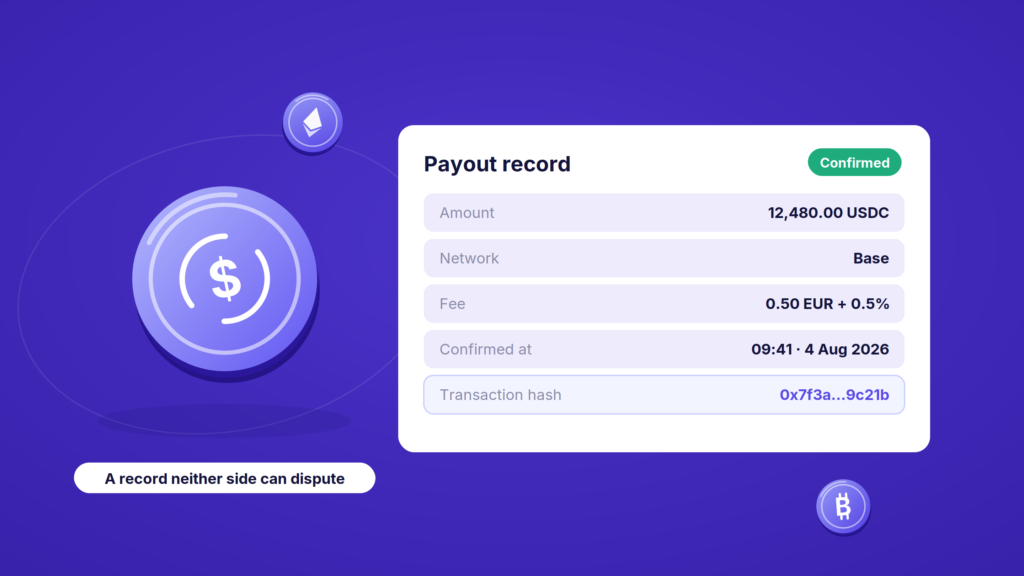
The three matching documents do not change. You gain a fourth artefact. The transaction hash is a timestamped, public record that a specific amount left your account and arrived at a specific address, and it does not depend on either party’s word. Every payout also carries amount, asset, network, fee and time. We have covered reconciling crypto payments without a manual spreadsheet and what finance teams have to change in their accounting separately.
One warning matters more than all of that. The wallet address belongs in your vendor master record and has to be verified out of band. Payables fraud is email fraud, and an address arriving by email is exactly as trustworthy as bank details arriving by email. Call the vendor on the number you already had.
Which stablecoin, and which network
The network is part of the payment instruction, not a detail underneath it. We support USDC on Ethereum, BSC, Solana, Polygon, Arbitrum, Base and Optimism, and EURC on Ethereum. Sending the right asset on the wrong network is the most expensive routine mistake here, because addresses on different networks can look similar enough to survive a glance. Two habits prevent most of it:
- Record the asset and the network together in the vendor file, the way you record IBAN and BIC. USDC on its own is not a payment instruction. USDC on Base is.
- Send a small first payment to any new address and wait for confirmation. Finance teams already do this with new bank accounts.
Your supplier does not need an account with us. They need a wallet that supports the asset on the agreed network, and that second half is the part most people drop.
Running it once, then running it often
For one supplier this is a dashboard task. Pick the asset, paste the address, review, send. At volume, bulk payouts by CSV handle up to 300 rows per file, UTF-8 and under 1 MB, and a draft batch expires after five minutes if nobody confirms it with a one-time code. The API covers payables that live inside a system rather than inside somebody’s Tuesday, and our guide to paying partners and contractors in stablecoins walks those workflows.
Access is deliberately restrictive. Payouts need valid business AML status, administrator KYC and one-time codes, and the developer role cannot execute one at all. A developer can build the integration and still not move money, which is usually the first thing a controller asks.
We do not publish payout minimums or maximums. They depend on the asset and the network and are visible in the dashboard or through the API, and eligibility depends on screening, including country screening inside the batch flow.
Where this does not fit
- A domestic supplier inside SEPA. A euro credit transfer is same-day and effectively free. Adding a rail to a process that works is how finance teams acquire technical debt.
- Processes that depend on reversibility. On-chain payments are final, so if your control model assumes somebody can recall a wire before it clears, the compensating control has to move into the approval step.
- One large annual payment to a single strategic supplier. The operational saving is noise. The relationship risk is not.
- A treasury policy that forbids holding digital assets at all. Converting at the moment of payment shortens the exposure to seconds without reducing it to zero, and that is a policy conversation first.
The receivables side interacts with this more than people expect, and how to choose what you settle in is a separate piece.
Frequently asked questions
Does my supplier need a CoinGate account to receive a stablecoin payment?
No. They need a wallet address that supports the asset on the agreed network, and funds go on-chain directly to it. Recipients are never onboarded, which is what makes this workable with a vendor who wants nothing to do with another account.
What does it actually cost to pay a supplier in USDC?
Our payout pricing is 0.50 EUR plus 0.5% of the amount, or 0.50 EUR plus 1.5% if we convert from another currency at the moment of payment. The network fee sits on top and varies by network.
Can I keep net-30 terms if the payment settles in minutes?
Yes. Terms are contractual, settlement speed is operational, and they are connected only if you decide to connect them. The usual reason to connect them is an early payment discount, where predictable settlement gives you something concrete to trade.
How does my accountant record a stablecoin payment to a vendor?
Treatment depends on your jurisdiction and your auditor, so that question belongs to them. What you can hand over is a complete record for every payment: amount, asset, network, fee, timestamp and transaction hash.
The bottom line
Paying suppliers in stablecoins changes one leg of the process and leaves the rest alone. The purchase order, the matching, the approvals and the audit trail all survive, and they should. You get settlement in minutes with a record neither side can dispute. You give up reversibility and the comfort of having an intermediary to blame.
The currency exposure does not vanish either. It moves onto your books, priced by you, at a time you choose. For some finance teams that is an improvement, for others an unwelcome new job, and knowing which you are is most of the decision.
None of it starts until a supplier says yes, and that conversation costs nothing. Already got a yes? Set up crypto payouts and start with one supplier and one small payment.
Accept crypto with CoinGate
Accept crypto with confidence using everything you need in one platform.