


Accept crypto with CoinGate
Accept crypto with confidence using everything you need in one platform.
Crypto Payment Reconciliation: Matching On-Chain Payments to Your Accounting System
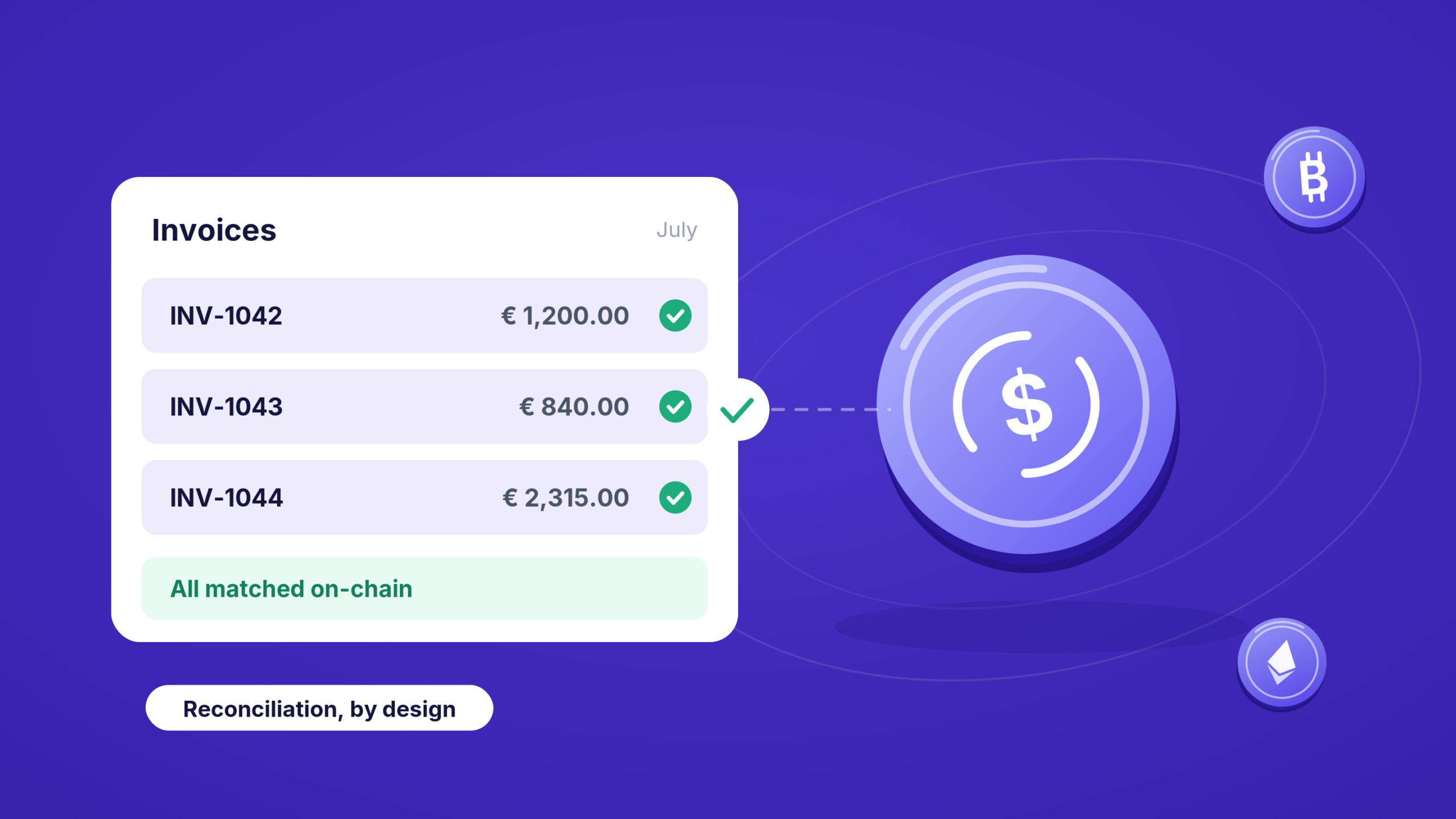
Ask a finance team what they actually dread about crypto payments, and it’s rarely the crypto part. It’s the moment at month-end when someone has to prove that the money on-chain matches the invoices in the books.
That process has a name. Reconciliation. And it’s where a lot of crypto payment setups quietly fall apart.
The good news is that reconciliation gets easy or hard based on decisions you make before a single payment arrives. So let’s look at what makes it hard, and how to remove most of that pain by design.
Tired of matching payments by hand at month-end? Set your crypto payments up to reconcile themselves.
What reconciliation actually is
Reconciliation is matching what you recorded against what you received. Every invoice you issued should tie back to money that actually landed, at the right amount, on the right date, against the right customer. When a business does this with a bank, it’s called bank reconciliation. With crypto, the idea is identical. The plumbing is different.
Done well, reconciliation runs on matching rules: invoice numbers, amounts, dates. Done badly, it turns into a person squinting at a block explorer and a spreadsheet, trying to guess which wallet payment belongs to which client.
Why crypto makes it harder than a card payment
Card and bank payments arrive with a lot of context attached. A blockchain transaction, by default, arrives with almost none. That gap is where the friction lives.
A few specific things trip businesses up.
Attribution. If ten customers pay into the same wallet address, you now have ten deposits and no built-in way to tell which is which. On-chain, they’re just amounts arriving at an address.
Under and overpayments. A customer sends slightly too little because they guessed the fee, or slightly too much. Now the amount received doesn’t match the invoice, and something has to reconcile that difference instead of flagging a permanent error.
Network fees. Gas is tiny per transaction and easy to ignore. Multiply it across hundreds of transfers and it becomes a real number that stops your wallet balance from tying out. Unreconciled gas is one of the most common reasons crypto books don’t balance.
Multiple networks. The same stablecoin can arrive on Ethereum, Base, Solana, or Polygon. Without automated tracking, reconciling across all of them by hand gets unpredictable fast.
None of these are dealbreakers. They’re just reasons to set things up properly instead of improvising.
The single biggest fix: a unique address per customer or invoice
If you take one thing from this article, take this. The address-reuse problem is the root of most reconciliation pain, and a dedicated address per customer or per invoice solves it.
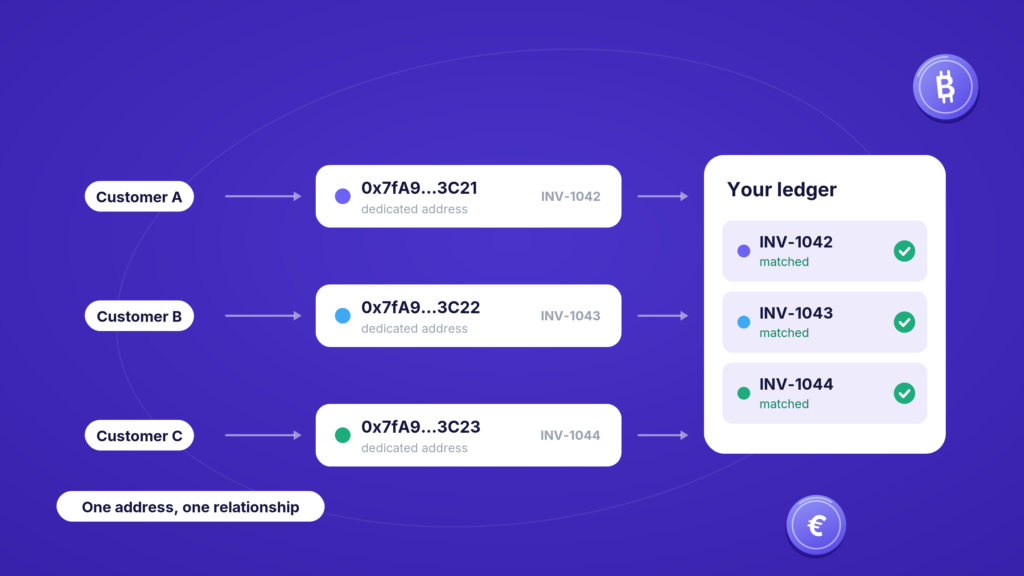
The idea is simple. Instead of pointing everyone at one wallet, you generate a fresh address tied to a specific customer or a specific invoice. When funds land on that address, attribution is automatic. You already know who it belongs to, because nobody else was ever given that address.
Think of it like a family lineage. Each address belongs to exactly one relationship, so there’s never a question of whose payment is whose. This is also why reusing one address for everything is such a mess. It links unrelated payments together and forces you to untangle them after the fact.
At CoinGate, this is the whole point of payment channels, where each client gets a persistent, dedicated address. We wrote about the pattern in Why Dedicated Deposit Addresses Are the Future of Crypto Payments and walked through concrete uses in 5 Use Cases for Persistent Crypto Deposit Addresses.
Get attribution right at the address level, and half of reconciliation disappears before it starts.
Automating the match with callbacks and statuses
The second half is knowing, in real time, when a payment happened and what state it’s in. This is where a payment API earns its place.
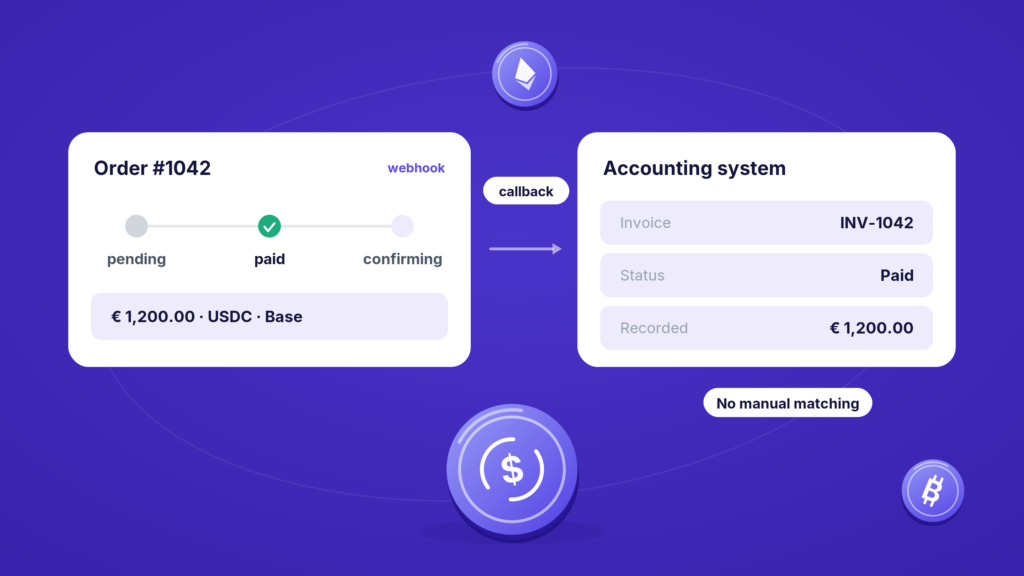
Instead of your team polling a block explorer, the payment provider pushes a notification to your system the moment something changes. This is a webhook, sometimes called a callback. It fires when an order moves through its lifecycle: pending, paid, confirming, and so on through to refunded or expired.
Feed those events into your accounting system and reconciliation becomes a background process. An order marked paid, tied to an invoice number, tied to a dedicated address, closes the loop automatically.
Two practical rules keep this reliable:
- Make your handler idempotent. A webhook can fire more than once for the same event, so receiving “paid” twice shouldn’t create two ledger entries.
- Verify before you act. Don’t trust the callback blindly. When you get a “paid” event, call the order-details endpoint to confirm it before you fulfill or record anything.
We cover the mechanics of building on these events in How to Automate Crypto Payouts via API.
The exchange-rate timing question
Here’s a subtle one that finance teams care about. A crypto payment has a value in your accounting currency, and that value can move between the moment you issue the invoice and the moment funds settle.
The clean answer is to record the fiat value at the time of the transaction. If your provider converts crypto to fiat on settlement, that value is fixed for you and there’s no holding period to account for. You billed 1,000 euros, you received 1,000 euros, done.
If you hold the crypto instead of converting it, accounting gets more involved. Under IFRS, the IFRS Interpretations Committee concluded in 2019 that cryptocurrencies aren’t cash or financial assets. They’re generally treated as intangible assets under IAS 38, or inventory under IAS 2 if held for sale. The practical consequence is that receiving crypto and later converting it are two separate events, and a later conversion at a different price is a disposal you have to record.
This is the seam between reconciliation and accounting. We go deeper on the accounting side in Accounting for Crypto Payments: What Finance Teams Need to Know. For reconciliation specifically, the takeaway is to capture the fiat value and an order ID on every payment, so the audit trail exists from day one.
A month-end that doesn’t hurt
Put it together and a healthy crypto reconciliation setup looks like this:
- A dedicated address per customer or invoice, so attribution is automatic.
- Callbacks feeding your accounting system, so payment status updates itself.
- Fiat value and order ID recorded on every transaction, so the audit trail is complete.
- Gas and network fees accounted for, so wallet balances actually tie out.
Set that up once and month-end stops being an archaeology project. If you would rather pull the same figures in code, our ledger API walkthrough reads balances and transactions straight from the API. The difference between a clean reconciliation and a hand-mapped spreadsheet is mostly the choices above.
Frequently asked questions
What is crypto payment reconciliation?
It’s the process of matching the crypto payments you received on-chain against the invoices and orders in your accounting system, confirming every recorded sale ties back to money that actually arrived, at the right amount and date.
Why is reconciling crypto payments harder than card payments?
Blockchain transactions arrive with little built-in context. Attribution, under- and overpayments, network fees, and multiple blockchains all add friction that card payments usually handle for you.
How do unique deposit addresses help reconciliation?
A dedicated address per customer or invoice makes attribution automatic. When funds arrive, you already know who they belong to, because that address was never shared with anyone else.
Do I record the crypto value or the fiat value in my books?
Record the fiat value at the time of the transaction. If your provider settles to fiat, that figure is fixed. If you hold the crypto, a later conversion becomes a separate disposal event under accounting standards like IFRS.
Can reconciliation be automated?
Yes. Using callbacks (webhooks) that push payment status into your accounting system, combined with dedicated addresses for attribution, most of the matching happens automatically. Just verify each event against the order-details endpoint before acting on it.
The short version
Reconciliation feels hard when you inherit a messy setup, and easy when you design for it. Give every customer a dedicated address, let callbacks update your books, record the fiat value on receipt, and account for gas. Do that, and the on-chain money and the invoices in your ledger will agree without anyone having to force them to.
Want reconciliation that works from day one instead of at quarter-end? Start with us.
Accept crypto with CoinGate
Accept crypto with confidence using everything you need in one platform.