


Accept crypto with CoinGate
Accept crypto with confidence using everything you need in one platform.
Crypto Payments for SaaS: Cutting Involuntary Churn From Failed Card Renewals
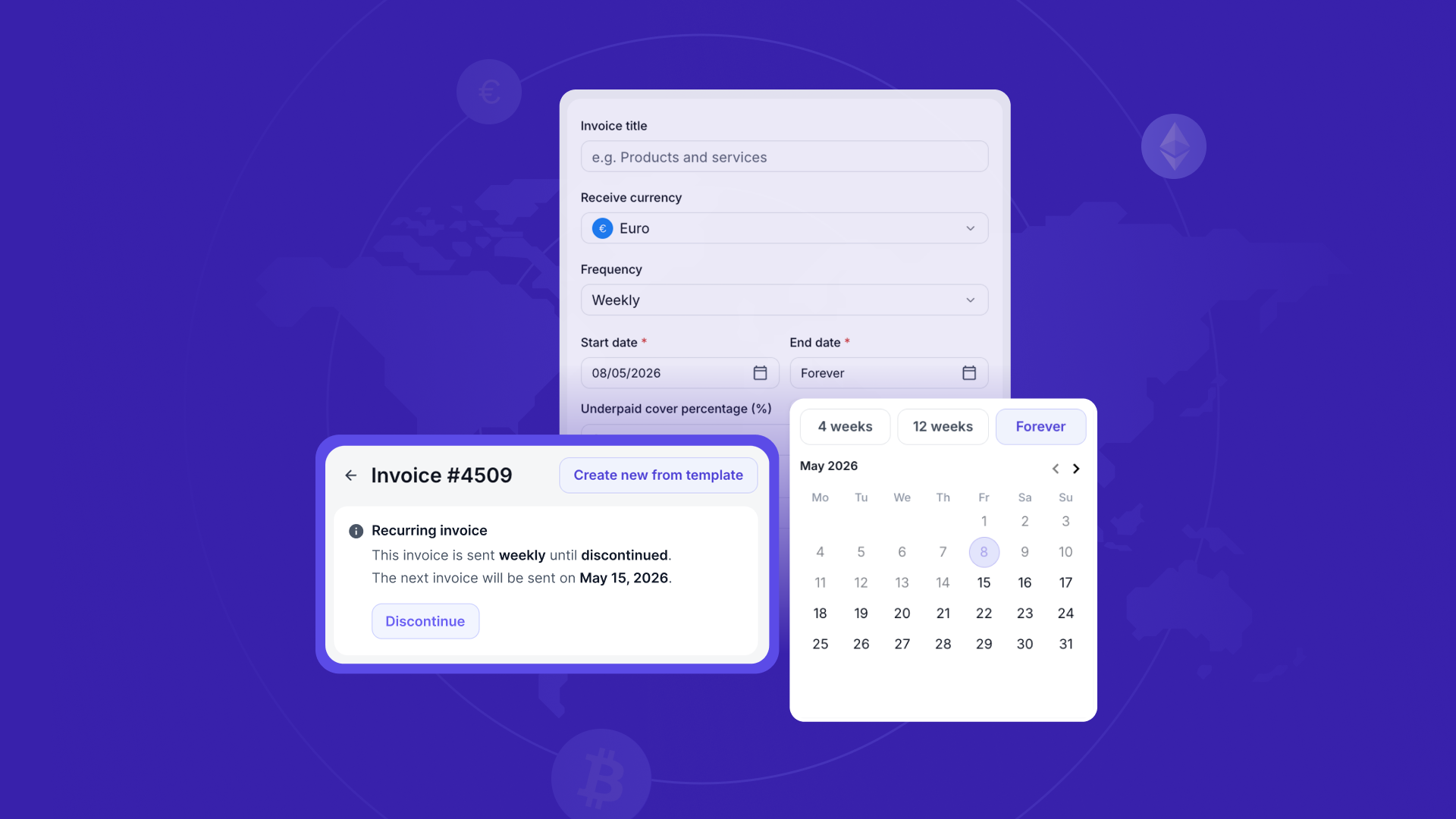
Picture a customer who loves your product. Uses it daily, would recommend it to a friend, has no intention of leaving. Next month they’re gone anyway.
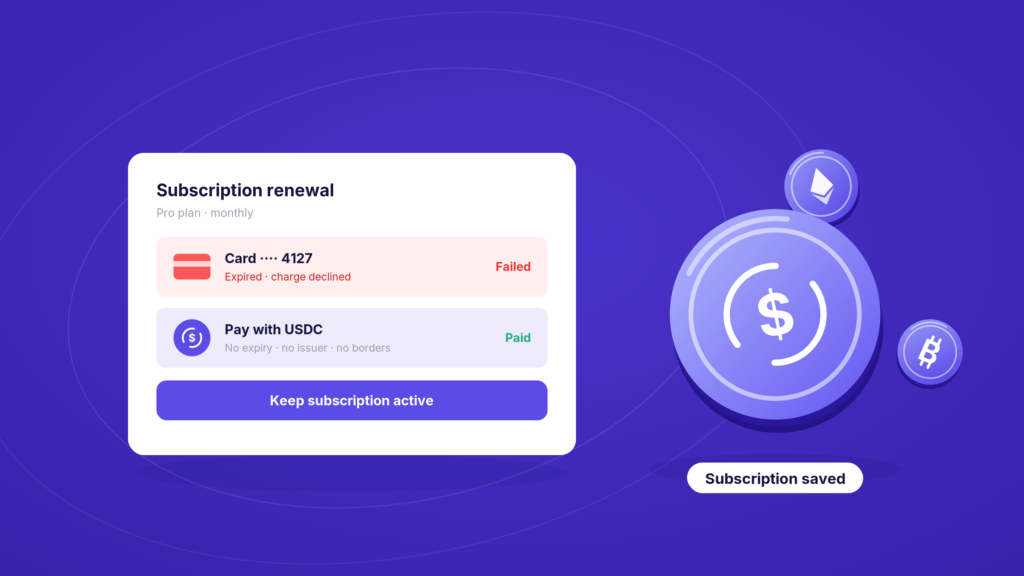
Nobody canceled. A card expired. The renewal charge bounced, a couple of dunning emails went to a folder nobody opens, and the subscription quietly lapsed. You lost a happy customer to a payment failure.
This is involuntary churn, and it’s one of the most frustrating leaks in SaaS because the customer never actually decided to leave. The good news is that it’s also one of the most fixable. Crypto payments turn out to be a surprisingly good patch for the specific way cards fail, so let’s look at why.
Losing subscribers to card failures you never see? Add crypto payments as a fallback rail.
Involuntary churn is bigger than most teams admit
Start with the number that reframes the whole problem. According to ProfitWell, up to 40% of subscription churn is involuntary, driven by failed, expired, and delinquent cards rather than genuine cancellations. Their framing is blunt. If your churn rate is 5%, one to two points of that might exist for no real reason at all.
Put differently, subscription businesses typically lose somewhere between 1% and 4% of customers every single month to payments that simply didn’t go through.
That’s revenue walking out the door with no decision behind it. And because these customers wanted to stay, recovering them is far cheaper than winning new ones.
Why card renewals fail so often
To fix the leak, you have to understand where the water gets in. Recurring card payments fail more than people expect, with failure rates on subscription charges often running in the 5% to 18% range, averaging around 13% according to Recurly data.
The reasons split into two types, and the difference matters.
Soft declines are temporary. Insufficient funds that day, a bank’s fraud hold, a network hiccup. The card is fine, the charge just didn’t land, and a retry often works. In fact, Recurly’s research across more than 1,300 subscription businesses found that most of the top decline reasons are soft, and a good chunk recover within a couple of weeks.
Hard declines are permanent. A canceled card, an invalid number, a card that’s been reissued with a new expiry. No amount of retrying fixes these. The customer has to do something, and customers rarely do.
Then there’s the cross-border tax. When a customer’s card was issued in one country and your payment processor sits in another, the issuing bank sees a foreign transaction and tightens its risk model, declining more often. For a SaaS business with global customers, that’s a permanent headwind.
What teams already do about it, and where it falls short
The standard defense is dunning. Automated retries spread over several days, recovery emails, and account-updater services that quietly check with banks for new card details before renewal.
These help. Smart retries and updaters can meaningfully cut failures. But they have a ceiling, and it’s worth being honest about it. Account updaters only catch part of the problem. They break down when a bank hasn’t integrated with the scheme, when the card is prepaid or international, or when the customer has switched provider entirely.
So dunning shrinks the leak. It doesn’t close it. And everything it does is still trapped inside the card system, which is where the failures came from in the first place.
That’s the opening for a different rail.
Why crypto attacks the exact failure modes
Here’s the useful insight. Most involuntary churn comes from things that are specific to cards. Cards expire. Cards get reissued. Issuing banks decline. Cross-border rules bite.
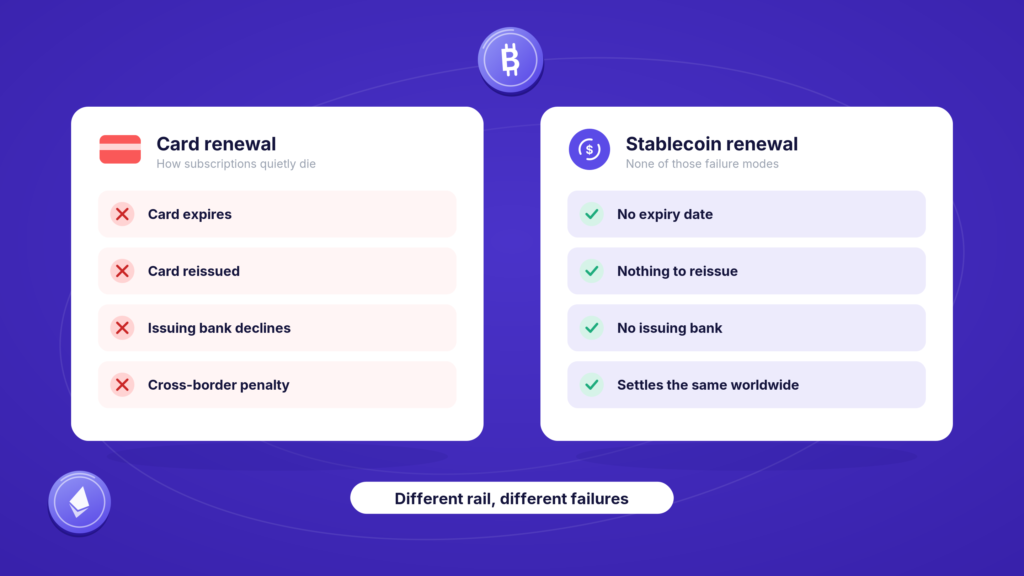
A stablecoin payment has none of those failure modes. There’s no expiry date to lapse. No issuing bank sitting in the middle deciding whether to approve your renewal. No foreign-transaction penalty, because the payment settles the same way regardless of which country the customer is in. And because a crypto payment cannot be reversed once it lands, there are no chargebacks to claw revenue back later.
For the international customers whose cards decline most, that last point is the big one. A stablecoin sent from Manila settles exactly like one sent from Madrid.
We’ve written before about how much revenue this quietly costs in Payment Decline Rates Are Costing You Revenue. Crypto is one of the cleaner answers to that specific problem.
The honest part: recurring crypto works differently
I’m not going to pretend crypto is a magic silent replacement for card-on-file. It isn’t, and anyone who tells you otherwise is skipping the important detail.
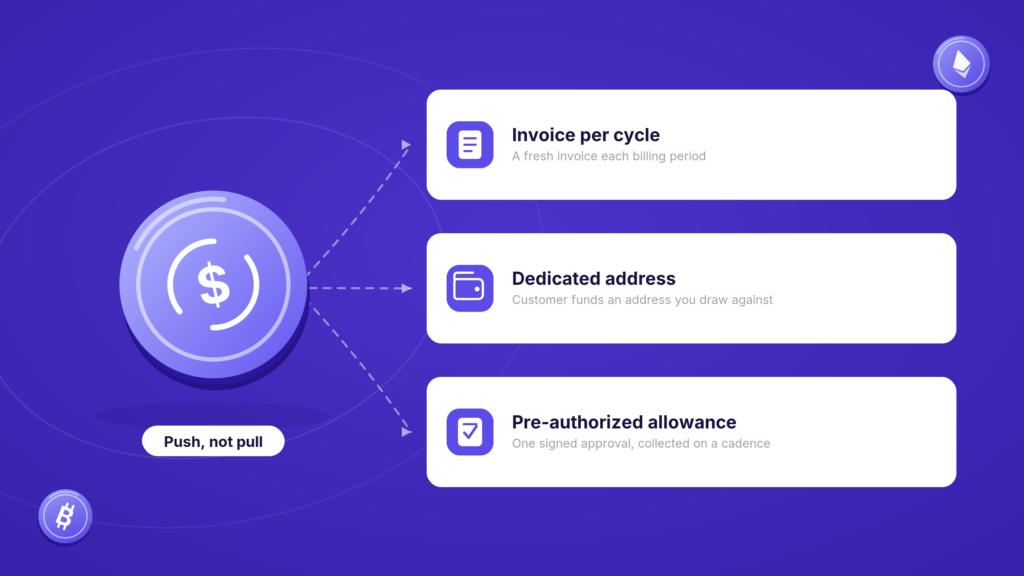
Cards use a pull model. You store the card and charge it whenever the renewal is due, without the customer lifting a finger. Public blockchains work on a push model. Funds move when the wallet holder signs the transaction. That’s precisely why there are no chargebacks, and it’s also why you can’t silently pull a subscription fee from someone’s wallet the way you can from a card.
So recurring crypto billing is built differently. In practice it takes one of a few shapes:
- Invoice per cycle. You send a fresh invoice each billing period and the customer pays it. Simple, but it relies on the customer acting each time.
- A dedicated address or payment channel. The customer funds a persistent address you draw against, which we cover in how businesses actually bill clients in crypto.
- Pre-authorized on-chain allowances. The customer signs a one-time approval letting a fixed amount be collected on a set cadence, which is the closest thing to card-on-file.
And crypto can still fail in its own ways. A wallet can run dry. An approval can be revoked. An invoice can go unpaid. What changes is that the card-specific failures, the expiries and issuer declines that cause most involuntary churn, simply don’t apply.
That’s why the smart framing isn’t “replace cards with crypto.” It’s “offer crypto alongside cards.” When a card fails, the customer has another way to keep their subscription alive, which is exactly how an alternative payment method recovers revenue that would otherwise churn. You’re not betting the business on a new rail. You’re adding a lifeboat.
Where to start
If involuntary churn is eating a point or two of your monthly revenue, the move is low-risk. Add crypto and stablecoin payments as an option, especially for renewals and especially for international customers whose cards decline most. Offer a widely-held stablecoin, and our guide to accepting USDC payments as a business covers what that takes in practice. Then watch how many “lost” customers keep paying when they finally have a way to.
Frequently asked questions
What is involuntary churn in SaaS?
It’s churn caused by failed payments rather than an active decision to cancel. Expired cards, insufficient funds, and issuer declines end a subscription even though the customer wanted to keep it. ProfitWell estimates up to 40% of subscription churn is involuntary.
Can crypto really reduce involuntary churn?
It reduces the card-specific causes of it. Stablecoin payments don’t expire, aren’t subject to issuing-bank declines, and don’t carry cross-border card penalties, which are the main drivers of involuntary churn. Offered alongside cards, crypto gives customers a way to keep paying when a card fails.
Does recurring billing work with crypto?
Yes, but differently from cards. Because crypto is push-based, recurring billing uses invoices per cycle, dedicated deposit addresses, or pre-authorized on-chain allowances rather than a silent stored charge. Each keeps a subscription alive without depending on a card.
Are crypto subscription payments reversible?
No. Once a crypto payment settles on-chain, it can’t be reversed, which eliminates chargebacks for the business. The tradeoff is that customers lose card-style dispute recourse, so a clear refund policy matters.
Should I replace card payments with crypto?
No. The better approach is to offer crypto alongside cards as a fallback. When a card renewal fails, the customer has another way to pay, recovering revenue that would otherwise be lost to involuntary churn.
The bottom line
The most painful churn is the kind where the customer never wanted to leave. Cards create a lot of it, through expiries, reissues, and declines that have nothing to do with whether someone values your product. Dunning helps but can’t reach failures that live outside the card system.
Crypto reaches them. Not as a replacement, but as a second rail that sidesteps the exact ways cards break, and quietly keeps happy customers subscribed. For a global SaaS business, that’s revenue you already earned and were about to lose for no good reason.
Thinking it’s time to stop losing subscribers to failed cards? Start with us.
Accept crypto with CoinGate
Accept crypto with confidence using everything you need in one platform.