


Accept crypto with CoinGate
Accept crypto with confidence using everything you need in one platform.
When the Basket Is Six Euros: Crypto Checkout for Digital Goods and Top-Ups
Most advice about accepting crypto quietly assumes you are selling something expensive. It talks about cross-border wires, about treasury, about the fees a card network takes on a four-figure invoice.
Our order book says most crypto payments are nothing like that.
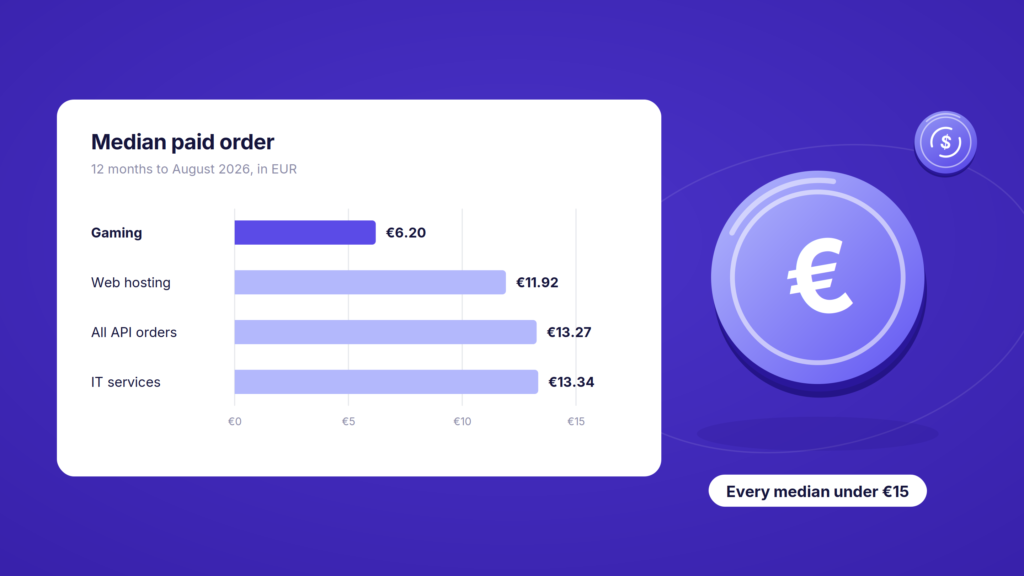
In the twelve months to the end of August 2026, the median order arriving through our API was 13.27 euros. In IT services and computer hardware it runs between 13 and 18. And at the small end of the book, the median order is 6.20 euros.
If that is your business, almost everything written about crypto payments is written for someone else. The percentages barely matter. The fixed costs matter enormously. And the shopper can see things at six euros that they would never notice at six hundred.
Selling something small, thousands of times a month? Open a CoinGate account.
Percentages are fine. Flat costs are the problem
Start with the good news, because it is good. A percentage fee scales with the order. Our processing fee is 1% on the Standard plan, and 1% of six euros is six cents. Nothing about a percentage fee breaks at small amounts.
What breaks at small amounts is everything flat.
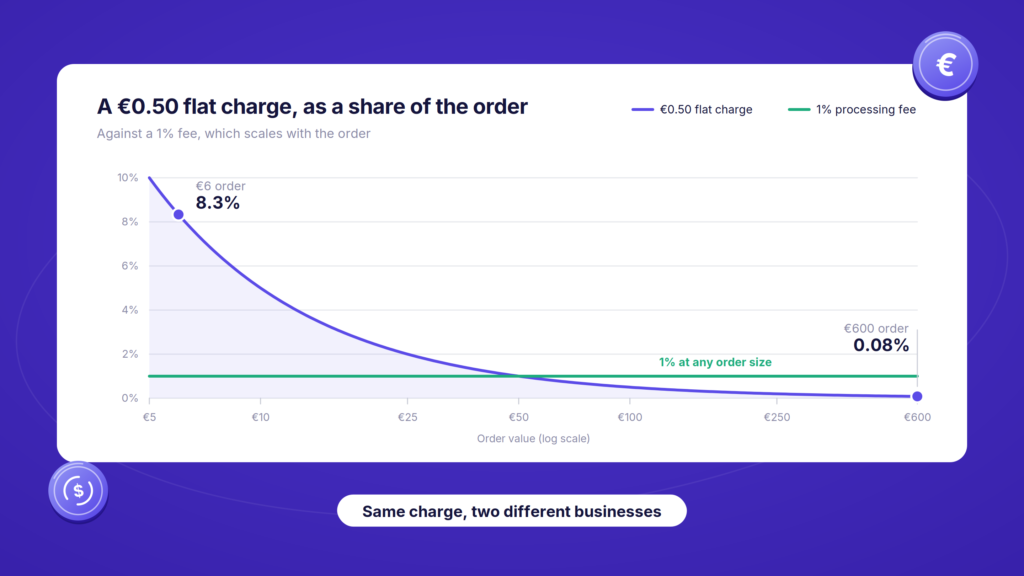
Any fixed charge, at any point in the chain, becomes a percentage as the basket shrinks, and it becomes a big one fast. Fifty cents on a six euro order is 8.3%. On a six hundred euro order it is 0.08%. Same charge, two entirely different businesses.
So the modelling exercise for a small-basket merchant is not “what is the rate”. It is “where are the fixed costs, and who pays them”. We walk through the rates themselves in our guide to crypto payment gateway fees. This post is about what they do to a small order.
Where the flat costs actually sit
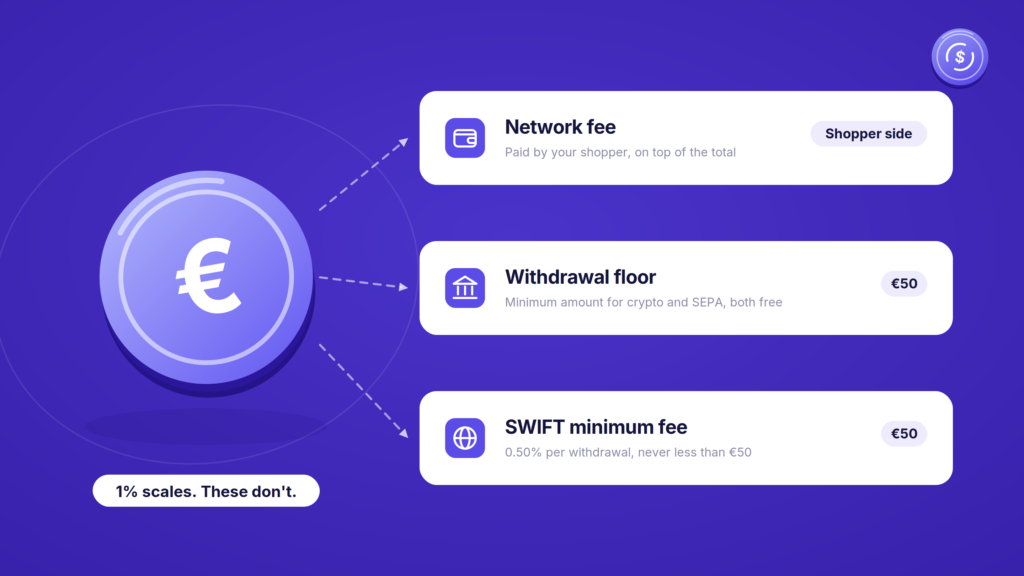
The network fee, paid by your shopper. This is the one that shows up in your support inbox. Your customer owes you six euros and their wallet asks them for six euros plus a transfer fee. At a large basket nobody blinks. At six euros a fee of thirty or forty cents is visible, and on a congested network it can be absurd enough that they simply close the tab. We do not set it and it is not part of our 1%, which is precisely why it deserves a line of copy rather than silence.
The withdrawal floor at your end. The minimum withdrawal amount is 50 euros for both crypto and SEPA. If you process ten euros a day, that is not a problem, it just means you accumulate before you move. It becomes a problem only if you were planning to sweep daily. Worth reading alongside what settlement, payout and withdrawal each actually mean, because they are three different events.
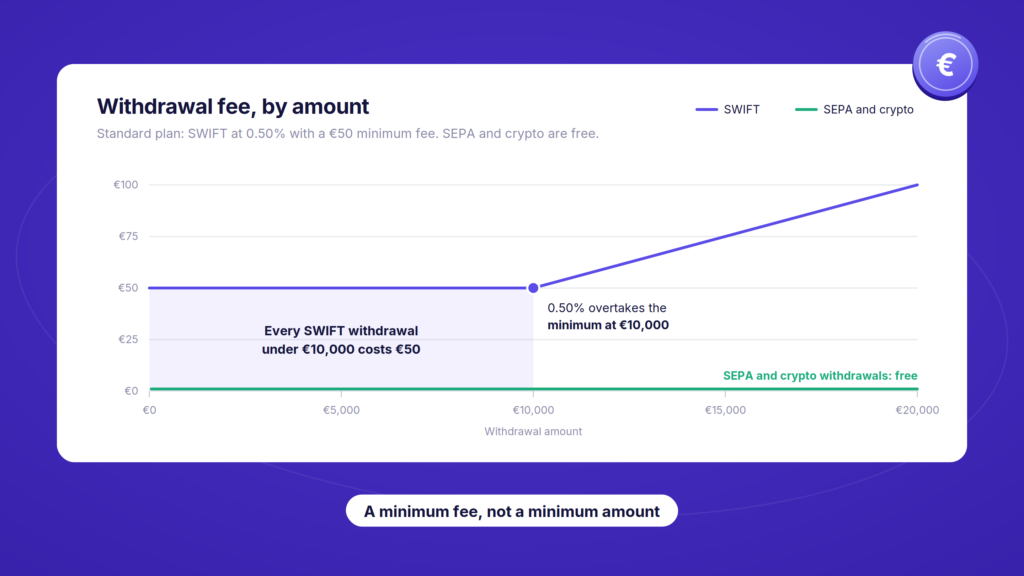
The SWIFT minimum, if you touch it. The published SWIFT withdrawal rate is 0.50%, with a minimum fee of 50 euros. That is a minimum fee, not a minimum amount, and the two get confused constantly. The consequence is worth spelling out: the 0.50% only overtakes the floor above 10,000 euros. Every smaller SWIFT withdrawal costs 50 euros flat, whatever its size. For a small-basket business settling in euros, SEPA is free and SWIFT is a trap.
Network choice is your shopper’s cost, so make the cheap options visible
Here is where the small basket changes the design rather than just the spreadsheet.
The network is chosen by the buyer, not by you, and they pay the transfer fee that comes with their choice. That is their decision to make. What you control is what they see when they make it.
Two things are worth knowing when you decide which networks to surface. Both come from our measurement of 1.48 million paid orders.
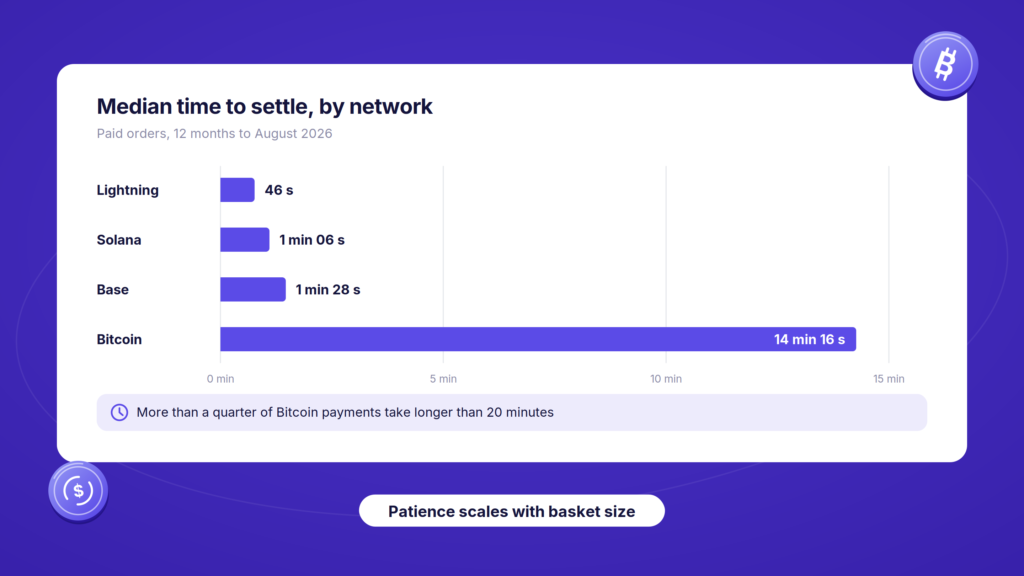
The wait varies by about an order of magnitude. A Lightning payment settles at a median of 46 seconds. Solana is 1 minute 6. Base is 1 minute 28. Bitcoin on its base layer took 14 minutes 16 across the year to August, and more than a quarter of Bitcoin payments ran past twenty minutes. That has since changed for exactly the baskets this piece is about. From 28 May 2026, Bitcoin payments of up to 100 EUR can be accepted before they confirm, and in September they took a median of 3 minutes 45 seconds.
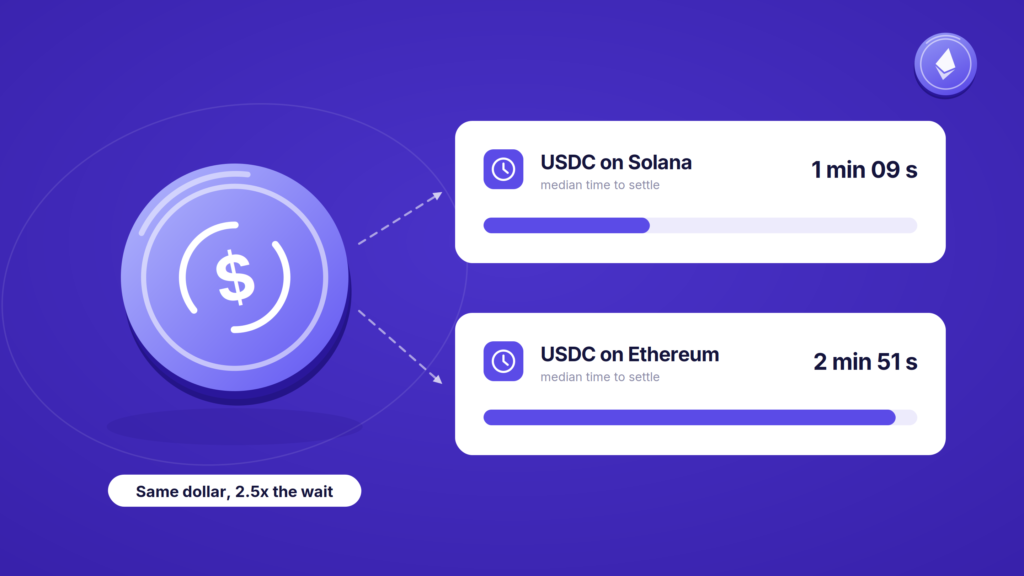
The same token behaves differently on different rails. USDC settles at a median of 1 minute 9 on Solana and 2 minutes 51 on Ethereum. Identical dollar, identical shopper, two and a half times the wait.
At six hundred euros, a fifteen minute wait is an inconvenience. At six euros it is a reason to give up, because the value of finishing is low and the cost of abandoning is zero. Patience scales with basket size. That is the single most useful sentence in this post, and it sits underneath most of what we found about why crypto checkouts do not convert.
Stop charging per item. Charge per balance
The strongest move for a small-basket business is structural rather than cosmetic. Stop putting a crypto checkout in front of a six euro purchase at all.
Two patterns do this, and both are things we already run.
Top-ups instead of per-item checkout. The customer funds a balance once, at fifty or a hundred euros, and spends it down inside your product. One payment, one network fee, one wait, twenty purchases. Every flat cost in this article divides by twenty. This is how prepaid and in-game economies have always worked and it maps onto crypto better than it maps onto cards.
Persistent deposit addresses, where a returning customer sends to the same address every time without generating a new invoice. It removes the checkout step entirely for people who buy from you often, which in a small-basket business is most of your revenue. There are five common use cases for them, and setting one up takes a few minutes.
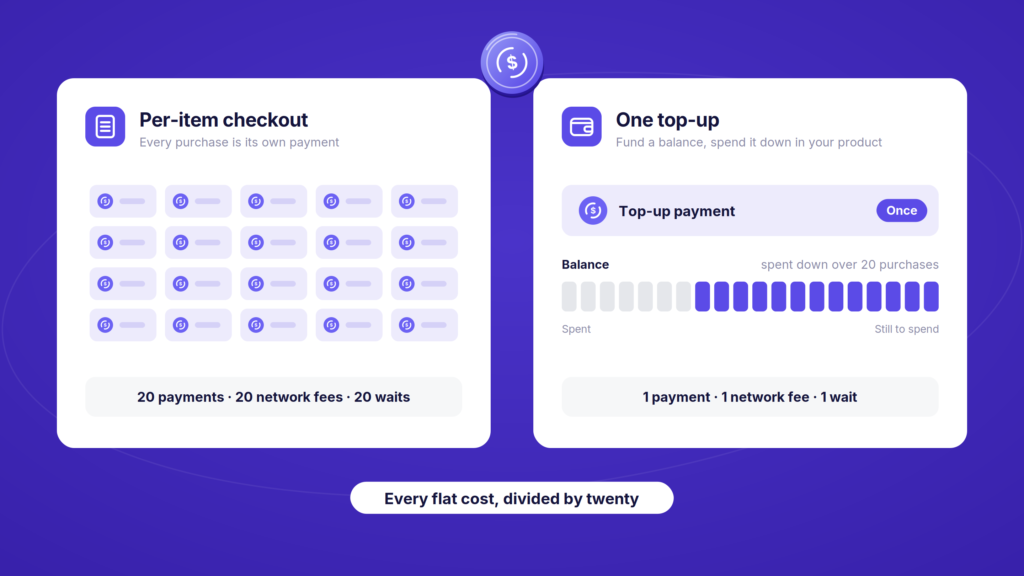
If your product can hold a balance, hold a balance. It is the difference between a payment problem and a funding problem, and the funding problem is much easier.
The tolerance setting, sized for a small order
One configuration note that is specific to this shape.
Underpaid Cover lets you accept a payment that lands slightly short, anywhere from 0% to 10%, set separately for each merchant tool you use. On a six hundred euro order, 1% is six euros and you will think carefully about it. On a six euro order, 10% is sixty cents.
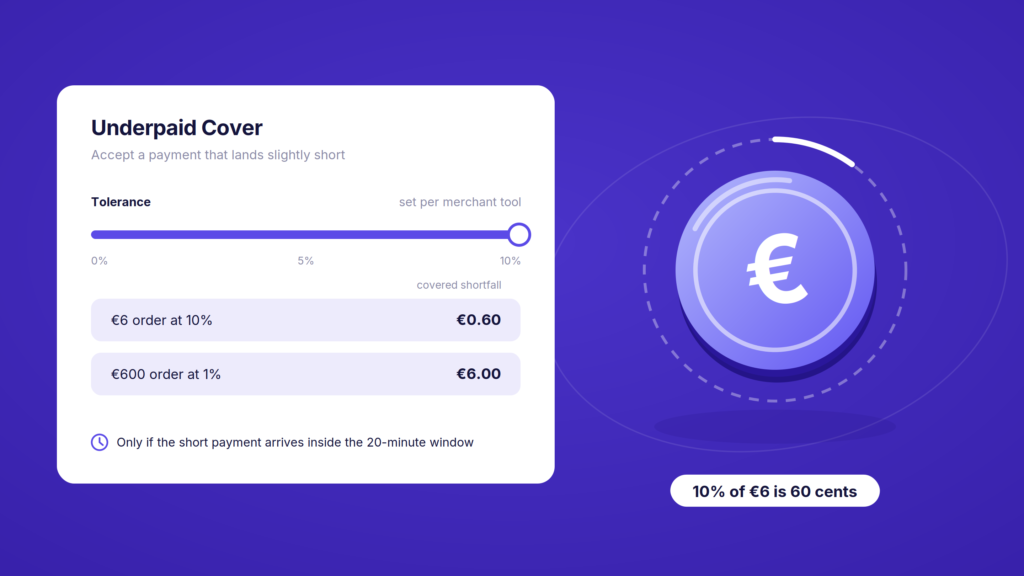
Small baskets are exactly where a generous tolerance is cheap and a strict one costs you completed orders. Most short payments are rounding rather than gaming.
One condition, because it is easy to miss: the tolerance only rescues a payment that is short and arrives inside the twenty minute payment window. Short and late is not covered.
The checklist, if your average order is under twenty euros
- Model the flat costs, not the rate. The 1% is not what decides this.
- Say in your own copy that the network fee is the shopper’s and sits on top of the total, before they reach the invoice.
- Surface the fast, cheap networks first. They are the shopper’s cost and your abandonment risk at the same time.
- Set Underpaid Cover generously. At this order size the tolerance is worth pennies and the lost orders are worth more.
- Move to balances if your product can hold one. Everything above gets divided by the number of purchases per top-up.
- Settle in euros over SEPA rather than SWIFT, and accumulate to the 50 euro floor rather than sweeping constantly.
A six euro crypto payment works. It just does not work the way a six hundred euro one does, and the difference is almost entirely about where the fixed costs land and how long your customer is willing to wait.
Running a small-basket business and wondering if this fits? Start with us.
Accept crypto with CoinGate
Accept crypto with confidence using everything you need in one platform.