


Accept crypto with CoinGate
Accept crypto with confidence using everything you need in one platform.
How IT Service Providers and Software Resellers Take Crypto Payments
There is a quiet fact in our order book that almost nobody in this industry talks about.
Over the twelve months to the end of August 2026, IT services and computer hardware businesses together accounted for 27.4% of every paid order we settled, and about a third of the value. Two verticals, a quarter of the book, and almost no writing anywhere about what actually makes crypto work for them.
So here is the version for the people actually running one of these businesses. What it solves, where it fits your billing, and what it does not fix.
Selling licences, support or hardware across borders? Open a CoinGate account.
Why this vertical got here before anyone noticed
Three things about selling IT make a crypto payment option worth more than it is worth to a shop selling shoes.
Your customers are not where you are. An MSP in Vilnius, a licence reseller in Warsaw, a hardware distributor in Riga. The buyer is in Lagos, Manila or Sao Paulo, and the card that buyer holds is exactly the card a cross-border fraud model dislikes. The payment does not fail because it is fraudulent. It fails because it looks unusual.
You deliver instantly and irreversibly. A licence key, an account credential, a provisioned instance. Once it is out, it is out, which makes you a natural target for chargeback abuse. The median crypto order in these two verticals runs between 13 and 18 euros, so you are rarely defending one large transaction. You are defending a lot of small ones, and the cost of fighting a dispute does not shrink to match the order.
Your invoices are net terms and your customers are not always punctual. A crypto payment either arrives or it does not. There is no window in which you are paid and might be unpaid again later.
Our payment gateway page puts the first part in one line: crypto payments are push-only, meaning funds cannot be reversed. That single property is doing most of the work in this vertical. It does not mean money never goes back to a customer, which is a real distinction and one we come back to below.
Where it sits in your billing stack
This is the part where most articles wave at easy integration and move on. Here is the actual picture.
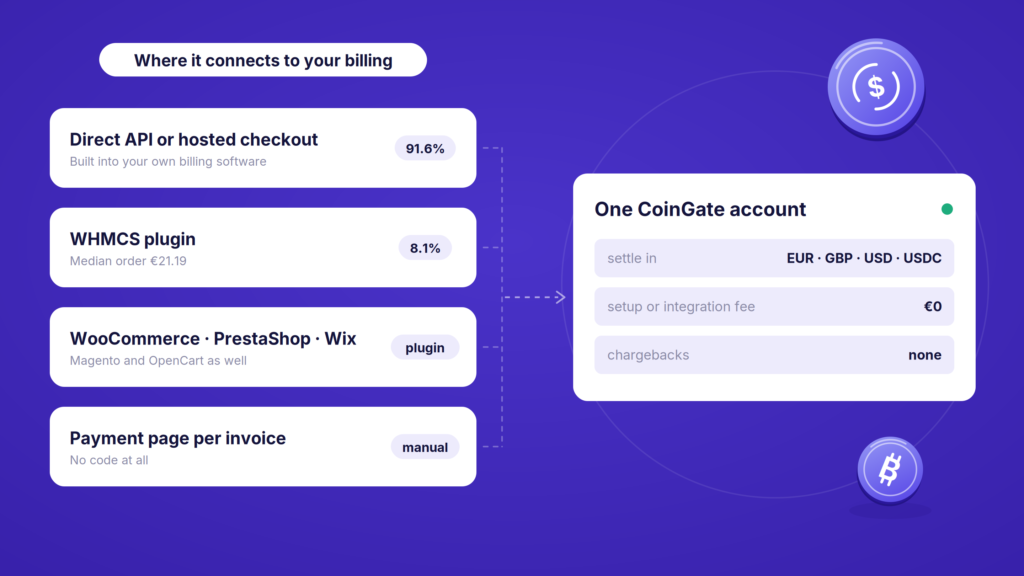
Most of you will not use a shop plugin at all. In our own book, 91.6% of paid orders arrive through the API rather than through an ecommerce plugin. That fits, because IT businesses mostly run billing software rather than a storefront. If that is you, the developer integration guide is the shorter road than this article.
If you run WHMCS, this is already solved. WHMCS carries 8.1% of every crypto order we process, at a median order of 21.18 euros. That is forty-two times WooCommerce’s order count, and it makes WHMCS our largest plugin integration by a distance. If your billing already runs on it, you are joining a well-trodden path rather than building one.
If you do run a storefront, there are plugins for WooCommerce, PrestaShop, OpenCart and Wix, each with its own setup page, plus a Magento 2 module that lives on GitHub rather than on our site.
And if you invoice by hand, you can skip integration entirely. Billing sends a bill by email or link and the client pays it without either of you writing code. Our own FAQ is blunt about it: you create and send bills directly from your dashboard, and developers can choose to automate everything via API. The longer walkthrough of invoicing international clients covers what belongs in the contract around it.
There are no setup or integration fees on any of those routes.
The settlement question, which is the one that actually gets asked
Nobody in procurement is worried about your checkout. They are worried about holding a volatile asset on the balance sheet.
You do not have to. Shoppers pay in twelve assets, and what you receive is a separate decision drawn from a separate list. Fiat in EUR, GBP or USD. Stablecoins. Or crypto, if you would rather hold it.
One detail here is worth more than the rest of this section, because it is the one that catches people. If you do nothing, you settle in USDC. That is the platform default, not a neutral state. Our help centre says it without hedging: unless otherwise specified, all processed orders are automatically settled in USDC.
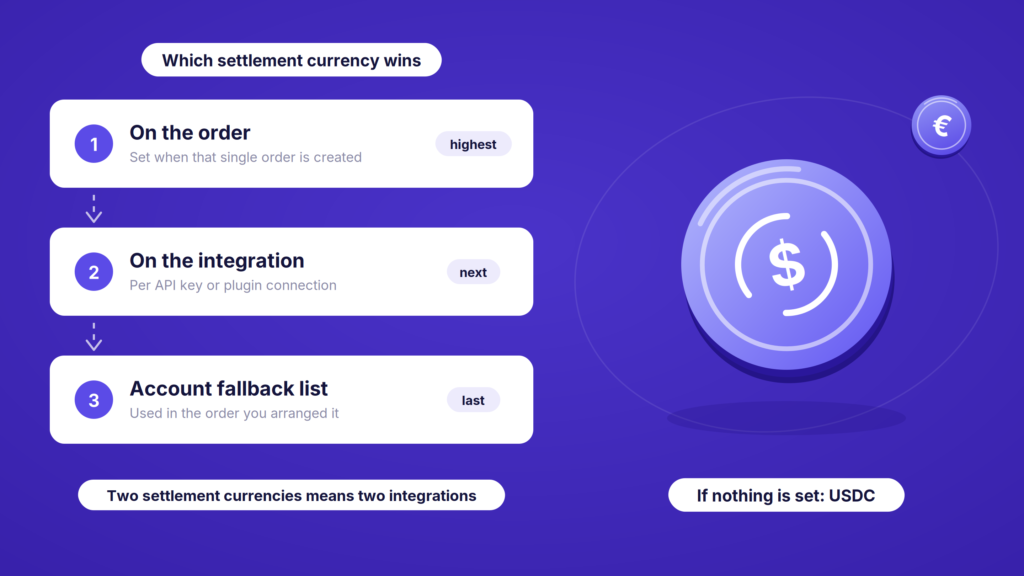
The other thing to know is how the choice resolves, because it is a priority order and not a split. A receive currency passed on the individual order wins. Below that, the currency set on the specific integration. Below that, your account’s fallback list in order, up to four entries. Then USDC.
That middle level is where the mistakes happen, because the setting is per integration and lives under Integrations, then API Management, then your API App, then the Currency Settings tab. An account-wide preference does not override it. Two settlement currencies running at once means two integrations, not a percentage. We wrote a whole post on choosing what you settle in if this is the decision you are stuck on.
One piece of vocabulary before we move on, because two clocks share a word. Settlement is the moment a payment becomes final and is credited to your CoinGate balance. It is not the moment money reaches your bank. That second movement is the withdrawal, and our pricing page lists automatic settlements as Weekly on Standard and Weekly or on-request on Enterprise. The full distinction between settlement, payout and withdrawal is worth reading once and never again.
The compliance answer for your procurement form
If you sell to businesses, somebody is eventually going to send you a vendor questionnaire, and “we use a crypto payment processor” is not an answer that survives it.
The answer that does is the one in our own footer. UAB Decentralized is authorised as a Crypto-Asset Service Provider under the EU Markets in Crypto-Assets Regulation by the Bank of Lithuania, authorisation code LB002323, and is separately licensed by the Bank of Lithuania as a Payment institution, authorisation code LB002324, to provide transfer services for Electronic Money Tokens. Two authorisations, two codes, and the scope on the second one is worth reading rather than skipping.
Here is why the number matters more than the badge. Before MiCA, a provider could be registered somewhere permissive and serve customers everywhere, and a merchant had almost no practical way to tell a supervised firm from an unsupervised one. Now there is a single authorisation that passports across the EU, and you can take the code and find it in the national register.
So when a client’s risk team asks who handles your payments, you are not asking them to trust an adjective. You hand them an entity, a supervisor and a number they can check in about a minute. That is a different conversation, and it is the one reason this section belongs in a post about billing software. If you want the longer argument, we made it in why EU-licensed providers became a market requirement.
One thing we will not tell you, because we are not your lawyers. Our own glossary is careful here, and so are we: accepting crypto as payment for your own goods is not itself a regulated crypto service, so MiCA obligations generally fall on your provider rather than on you. Your own position depends on what you actually do, and that is a question for your counsel rather than for a blog post.
What it does not fix
Three things, stated plainly, because overselling this is how you end up with a disappointed merchant.
It will not replace your card processing. Crypto is an additional rail for the customers it suits, and in this vertical that tends to be the cross-border ones and the ones who already hold crypto, not your whole book. We have said the same thing about subscription businesses and it holds here too.
It does not remove refunds, and a refund is not a reversal. Finality means nobody can force money back out of your account. It does not mean money never goes back. A refund is a new outbound payment that you initiate, so you need the customer’s wallet address and the network it sits on before you can send anything, and the customer confirms those details by email before it goes out. Refunds cost 0.25 EUR plus 0.1%, and that 0.1% only applies when the refunded currency differs from the one used to issue it, so a same-currency refund is the flat 25 cents. Across our whole book, merchants refunded 0.30% of paid orders last year.
And it is not instant everywhere. A payment on Lightning is done in 46 seconds at the median. The same payment on the Bitcoin base layer took 14 minutes and 16 seconds across the year to August, measured from the moment the shopper picks a network. If you provision automatically on payment, though, the median is not the number that should shape your expectations. 26.5% of Bitcoin payments took more than twenty minutes, against 0.0% on Lightning. That tail is what belongs in your support macros. It has shrunk since. From 28 May 2026, Bitcoin payments of up to 100 EUR can be accepted before they confirm, and in September those took a median of under four minutes, with 14% past twenty. Most orders in this vertical are far below 100 EUR, so the change lands here more than anywhere. We measured all fourteen networks across 1.48 million orders if you want to pick which ones to enable on that basis.
What to do this week
Four steps, none of which takes a day.
- Open an account and pass verification. This is the step with the longest lead time, so start here even if you are still deciding.
- Decide your settlement currency before you take a single order, and set it on the integration rather than only on the account. If you want euros, say euros. Doing nothing means USDC.
- Connect the thing you already bill with. WHMCS if you run it, the API if you do not, a bill by email or link if you invoice by hand. If you are still comparing providers, here is what to compare on.
- Run one real order end to end at a small amount, on a network you expect your customers to use, and watch what your own systems do with the callback.
IT businesses did not arrive at crypto payments out of ideology. They arrived because a meaningful share of their customers sit in places where a card is the harder option, and because a payment that cannot be reversed is worth something when you hand over a licence key the moment the money lands.
Thinking it is time to add crypto to your billing? Start with us.
Accept crypto with CoinGate
Accept crypto with confidence using everything you need in one platform.