


Accept crypto with CoinGate
Accept crypto with confidence using everything you need in one platform.
How Agencies Invoice International Clients in Crypto
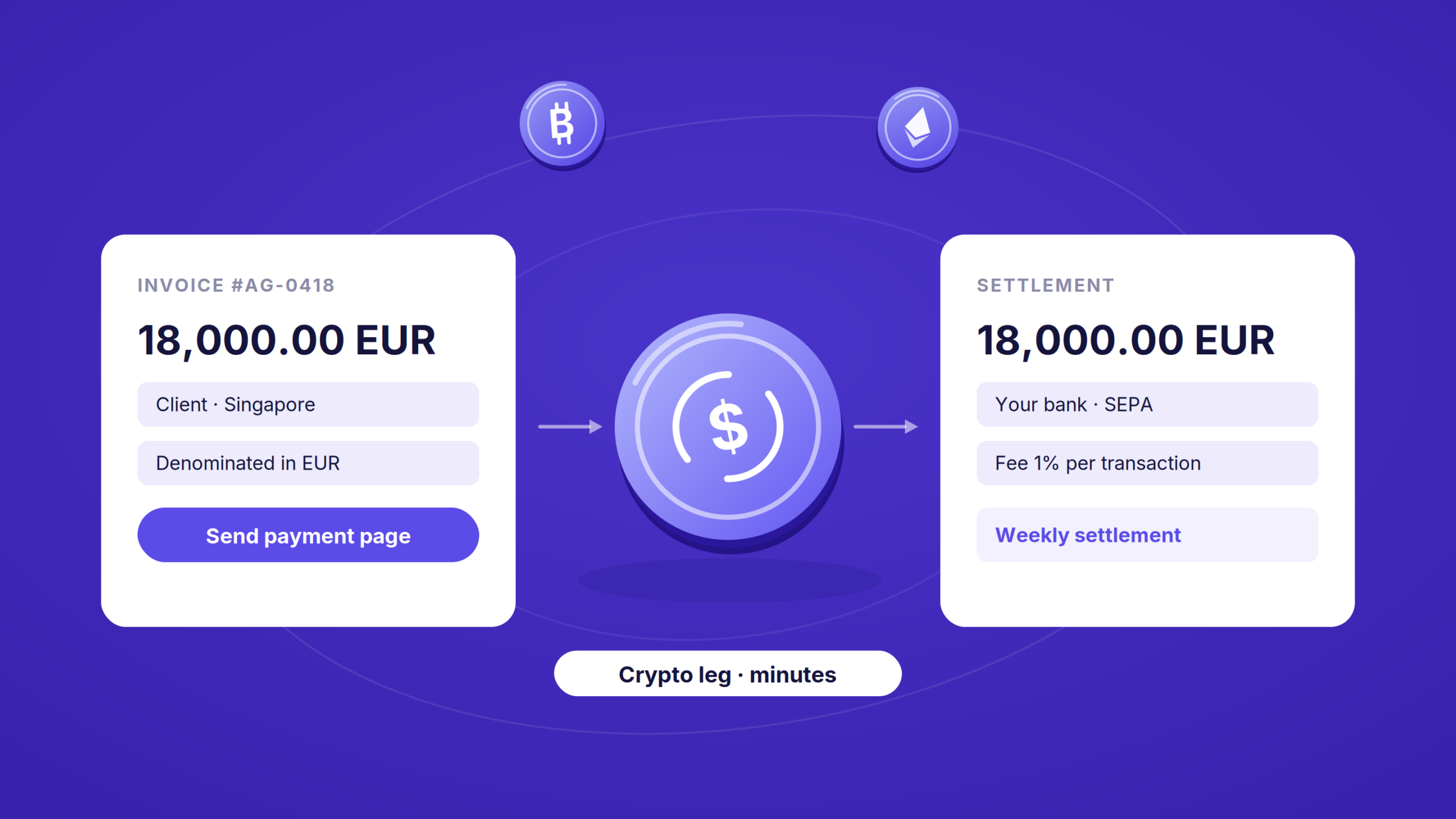
An invoice for 18,000 EUR to a client on the other side of the world. You send it on the first. The client says it was paid on the fourth. Your bank shows nothing until the eleventh, and when it lands the amount is short by a deduction nobody warned you about and nobody can explain afterwards.
This is not a post about whether your agency should accept crypto. This is one invoice, start to finish: how you quote it, how the client pays it, what reaches your account, what belongs in the contract, and what your accountant will ask for.
Still waiting on an invoice that left the client’s bank a week ago? See how crypto invoicing works, or open an account and run the next one through it.
The wire transfer problem, specifically
International wires mostly arrive. The trouble is that a five-figure invoice on a new corridor behaves unpredictably in three ways at once.
Timing is opaque. Once the payment leaves the client’s bank you have no view of it. What you get is a forwarded confirmation, which proves the payment started and says nothing about when it finishes.
The amount is not final when it is sent. Correspondent banks along the route can take a cut, rarely disclosed up front. On a small invoice that is irritating. On a five-figure one it becomes a conversation about who absorbs the difference, which is a conversation about your margin.
Compliance friction scales with newness. A first payment to an unfamiliar beneficiary in an unfamiliar country is the pattern that gets held for review, and your cash flow does not care that the bank is doing its job. The longer comparison sits in our side-by-side of crypto and bank wire for cross-border B2B payments, so here we stay on the invoice.
Quote in EUR, settle in EUR, let the client pay in crypto
The important thing here is how little of it is crypto. Your invoice is in EUR, your books are in EUR, your settlement is in EUR. The only crypto leg runs from your client’s wallet to us, and it lasts minutes.
You create a payment page for the invoice amount, send it, and the client picks an asset and network at the point of payment. Eleven assets are payable: BTC, LTC, ETH, XRP, TRX, DOGE, BNB, POL, USDC, SOL and EURC. Your client does not need a CoinGate account to pay one. Our Billing page puts it plainly: they need a crypto wallet that supports the currency and network they picked, and nothing else.
Two clocks run at checkout, and both change how you talk to the client. Your client has two hours to pick a currency and network. Once picked, they have 20 minutes to complete the transfer. That second window catches people. Tell your client to open the link when they are ready to pay, not when they are ready to read it.
On fees, read the plan column rather than the headline. Our pricing page lists two plans, Standard and Enterprise. The payment processing fee is 1% on Standard and custom, volume-based, on Enterprise. The monthly fees row reads No monthly fees in both columns, and the page’s FAQ says there are no setup or integration fees. So the 1% is a Standard-plan rate, and the two absences are true whichever plan you are on.
Fiat settlement is available in USD, EUR and GBP. SEPA is a euro scheme, so EUR moves over SEPA and USD and GBP move over SWIFT. If you would rather hold value on-chain, you can settle in USDC or EURC instead, and the two are not interchangeable: USDC is enabled on seven networks and EURC on Ethereum only, which is worth knowing before you pick the one your treasury sits in.
One piece of vocabulary is worth five minutes because two different clocks share a word. Settlement is the moment a payment becomes final and is credited to your CoinGate balance. It is not the moment money reaches your bank. That second movement is the withdrawal, and the pricing page lists automatic settlements as Weekly on Standard and Weekly / on-request on Enterprise, with the Enterprise card offering on-demand automatic settlements and the FAQ saying faster or customized payout schedules can be arranged for Enterprise clients upon request. We do not publish a settlement SLA or a guaranteed day, so build the weekly cadence into what you promise your team, and ask rather than assume if your cash flow depends on a date. The full distinction between settlement, payout and withdrawal is worth reading once.
Deposits, milestones and retainers
A deposit is just a smaller invoice. Create a payment page for the deposit amount, send it, and create the second when you deliver. Milestones work the same way, one page each.
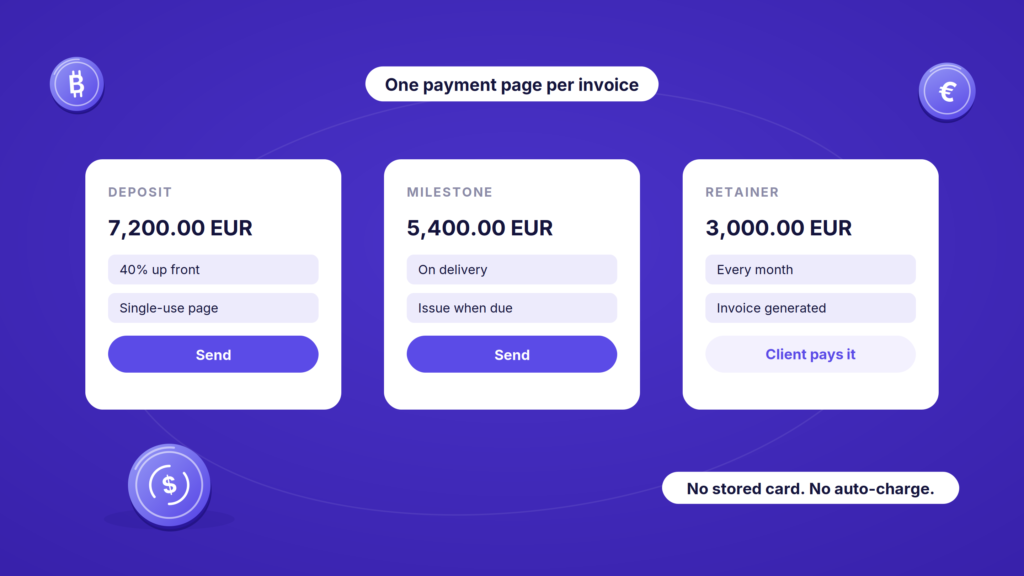
There is no instalment mechanic to configure, which is rather the point. A bill has to be paid in full to count as paid, and underpaid amounts are not accepted in increments against it. If you want a payment split into three, that is three invoices, not one invoice paid three times.
Each invoice carries its own expiry, set in days when you create it and defaulting to 30. That is the number to think about when you issue a milestone in March for work that completes in June. Set the expiry to match the terms you actually gave the client rather than accepting the default and then wondering why the link went stale.
Retainers are where the honest caveat lives, and it comes in two parts. Recurring billing is live on a weekly or monthly cadence, with a start date and an optional end date, which maps onto how most retainers already run. But it is recurring invoicing and not auto-charging. Each generated invoice still has to be paid by the client, there is no stored payment method, and nothing is debited. Crypto is push-based, so the schedule automates the request and never the charge. We go through that properly in our piece on recurring crypto payments.
The second part is the one that will actually bite an agency, and it is a consequence of the first. The scheduler does not watch whether the last invoice was paid. It keeps generating and emailing the next one on cadence regardless of payment state, and chasing the outstanding ones is yours to do. Discontinuing a series stops future invoices from being created and leaves the ones already out there live. So a client who quietly stops paying in month one collects invoices in months two and three while your dashboard looks busy and your bank does not. Put a human check on the retainer list monthly, because the system will not do it for you.
All of it is dashboard work rather than development work, with an API there if you prefer to generate invoices from your own project system. It is also, for what it is worth, the audience the product page names first: Service providers and agencies, ahead of freelancers, B2B companies and remote teams. The general, non-agency walkthrough lives in our guide to sending crypto invoices and getting paid.
What goes in the contract
Five clauses, all short.
Denominate in fiat and say so. The contract price is 18,000 EUR. Crypto is a payment method, not the unit of account. Without that sentence you will eventually argue about which day’s rate applied.
Name the accepted assets and networks. Not “cryptocurrency”. A client who sends an unsupported asset, or the right asset on the wrong network, has made a tedious problem for both of you.
Say who bears the network fee. This is the clause agencies forget. A client who sends the invoice amount minus their own transaction fee has underpaid you. There is a setting for this, called Underpaid Cover, which you set per merchant tool between 0% and 10%, and an underpaid order inside your threshold is marked paid automatically only if the payment also arrives within the 20-minute window. Late and short does not settle itself.
Set it deliberately, but do not expect it to carry the clause. We have never published a typical or recommended value, and the only distribution we have measured points the other way: in a review of one month’s underpaid orders, 84% were short by more than 5%, which is beyond most of the range the setting even offers. Tolerance absorbs rounding and small network fees. The contract sentence is what handles the rest.
Define when payment is considered made. Not when the client hits send, but when the order reaches paid status. Confirmations take time and the gap matters on a late invoice.
Cover overpayment and refunds. If a client overpays, the order completes and only the excess is in play. The client requests it back and supplies the address and network for the return themselves, so do not promise in a contract that a refund comes back the way it arrived. Refunds cost 0.25 EUR plus 0.1%, and the 0.1% applies only when the refunded currency differs from the one used to issue the refund, so a same-currency refund is the flat 25 cents. Small excesses are not refundable at all below a 2 EUR floor, which is a good reason for a line saying you credit trivial overpayments to the next invoice rather than making it a conversation.
One more, if your invoices go past due. Do not tell your team that an expired invoice is a dead one. The payment address is the part that is genuinely single use, and funds sent to an old address are not linked to the order they belonged to. The order itself is a different question: a late payment can still be settled to you, for a window you configure yourself, per merchant tool. Check your own setting rather than assuming a default, and keep asking about expired orders instead of closing them in your own system. The same applies before expiry, where a client who underpaid can top up the same invoice until it runs out. The drop-off points are all in our piece on why crypto checkouts do not convert.
What your accountant will ask for
Not much, but they want it consistently. Per invoice: the order ID, the date and time, the asset and network the client paid in, the amount received on-chain, the fiat value, and the processing fee.
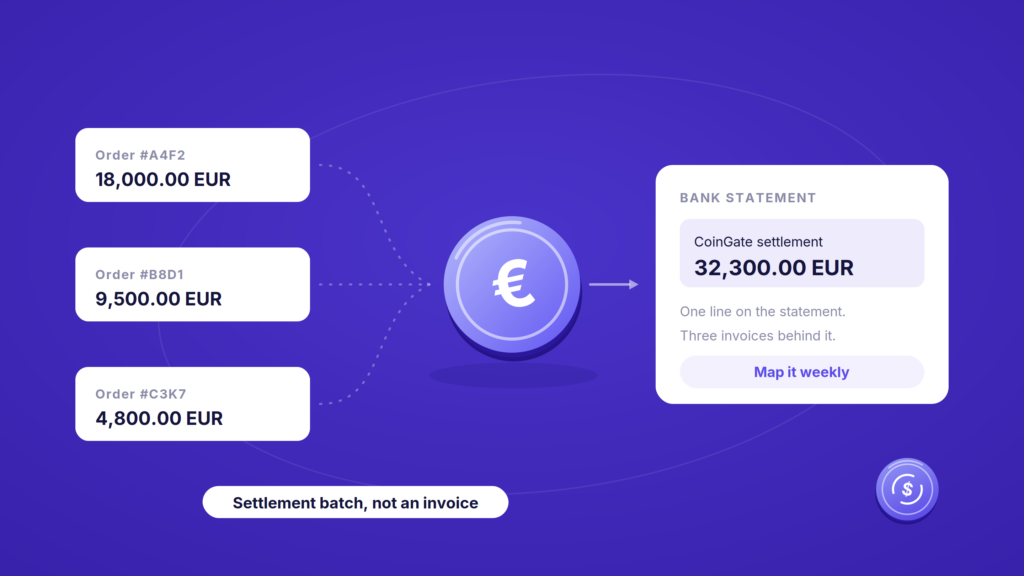
What catches people is the shape of the bank statement. Your bank line is a settlement batch, not an invoice. Several invoices sit behind one deposit, and the deposit does not carry your invoice numbers. That mapping is yours to maintain, and far easier weekly than annually. Reconciling crypto payments goes through the mechanics.
The other question is valuation, and the wording matters. You recognise revenue at the fiat value at the time of the transaction, not at the value on the day you raised the invoice. On a net-30 international invoice those are different days. If you settle to fiat the figure is fixed for you, because the conversion happens at the point of payment and what lands is a number in your accounting currency. The crypto never enters your accounts as an asset, which is most of the reason to do it. If you also pay subcontractors abroad, that is the same problem in reverse and we covered it in paying suppliers in stablecoins.
Where this does not help
Your client still has to be willing and able to pay in crypto. If not, none of the above matters, and pushing a client with no crypto operation into building one for a single invoice is a bad trade.
It does not collect a debt. A client who is not paying you is not paying you, in any currency. This removes settlement friction, not the silence behind it.
And you still onboard properly. Billing runs on a verified business account, which means real checks on the company and the people behind it. UAB Decentralized is authorised as a Crypto-Asset Service Provider under the EU Markets in Crypto-Assets Regulation by the Bank of Lithuania, and is also licensed by the Bank of Lithuania as a Payment institution to provide transfer services for Electronic Money Tokens. We do not publish an approval time, and it depends on how complete your documents are.
Frequently asked questions
Can we invoice in EUR and still receive exactly EUR?
Yes. The invoice is denominated in EUR, the client pays the crypto equivalent at the point of payment, and you settle in EUR. The practical framing for the client is the 20-minute window between choosing an asset and sending.
What if the client pays a day after the invoice expires?
An expired invoice is not automatically a closed one. A late payment can still be settled to you, for a window you configure per merchant tool, so check your own setting. What does not survive is the payment address, which is single use, so a client who digs an old address out of their history has not paid you. Send a fresh link rather than letting them reuse anything.
Can we auto-charge a monthly retainer?
No, and the distinction is worth stating precisely. Recurring billing generates invoices on a weekly or monthly cadence and emails each one, so the request repeats automatically. The charge does not. Crypto payments are pushed by the payer, so there is no stored payment method and nothing is debited. It works as a billing schedule for a retainer, not as a subscription charge.
If a retainer client stops paying, do the invoices stop?
No. The schedule runs on dates, not on payment status, so the next invoice goes out whether or not the last one was paid. Discontinuing the series stops future invoices from being created but leaves any already issued still live, so you manage the outstanding ones yourself. Review the retainer list on a cadence of your own.
How quickly does the money reach our bank?
Two steps, not one. The payment settles to your CoinGate balance when it is final, and moving that balance to your bank is the withdrawal. Our pricing page lists automatic settlements as weekly on Standard and weekly or on-request on Enterprise. We do not publish a time-to-bank guarantee, so plan around the weekly cadence rather than the day an invoice is paid.
What does the client see when they open the invoice?
A payment page with the invoice amount, a choice of asset and network, and an address to send to. Two hours to choose, 20 minutes to send once chosen. They do not need an account with us, only a wallet that supports what they picked.
The bottom line
An international invoice paid in crypto is a fiat invoice with a different settlement leg. You quote in EUR, the client pays in USDC, you receive EUR, and your accountant sees an order ID, a fiat value and a processing fee.
The interesting parts are in the contract, not the technology. Who pays the network fee, when payment counts as made, what happens on an overpayment. Write those down once and every future invoice is copy-paste.
If the next international invoice is already sitting in your drafts, open an account and run that one through it before you change anything else.
Accept crypto with CoinGate
Accept crypto with confidence using everything you need in one platform.