


Accept crypto with CoinGate
Accept crypto with confidence using everything you need in one platform.
How to Scale Partner Payments? Mass Crypto Payouts for Affiliate Networks

Affiliate and referral marketing networks are built on a simple promise: partners perform, and they get paid. The speed, reliability, and cost-efficiency of your payout process is a competitive differentiator that directly affects partner recruitment, retention, and program growth. Prop trading firms face the same problem on a shorter clock, and we covered paying traders in crypto in its own post.
Yet for many affiliate programs operating at scale, the payout process itself has become one of the biggest operational bottlenecks. Consider the reality of a mid-to-large affiliate network: hundreds or thousands of partners spread across dozens of countries, each expecting timely compensation for the traffic, leads, or conversions they deliver. Every payment cycle requires initiating, tracking, and reconciling hundreds of individual transfers – each with its own fee structure, settlement timeline, and potential for failure.
Traditional payment methods – bank wires, PayPal, and legacy payment aggregators – were not built for this volume, this geographic diversity, or the speed that modern affiliate partners expect. The friction is real. High per-transaction costs that erode payout budgets, multi-day settlement windows that frustrate partners, and limited reach into emerging markets where a growing share of affiliates operate.
Think it’s time to introduce cryptocurrency operations to your business? Sign up for CoinGate.
Mass crypto payouts offer a structurally different approach. By leveraging blockchain infrastructure, affiliate networks can batch-process thousands of payments in a single operation, settle globally in minutes, and reduce per-transaction costs by 90% or more compared to traditional banking.
This guide explores how mass crypto payouts work, what infrastructure you need to implement them, and how leading networks are already using this technology to build faster, leaner payout operations.
The Affiliate Payout Challenge at Scale
Running an affiliate payout cycle at scale exposes several systemic limitations of traditional payment infrastructure. These are not edge cases – they are structural problems that grow proportionally with network size.
Volume Creates Administrative Burden
Processing 500, 1,000, or 5,000 individual wire transfers monthly is operationally burdensome. Each payment requires individual initiation, banking detail verification, compliance checks, and manual reconciliation against your affiliate management system. As your network grows, the administrative overhead of running payout cycles grows linearly – requiring more staff time, more error handling, and more reconciliation work every month.
Cross-Border Costs Multiply Rapidly
When your affiliates span 30+ countries, each payout carries a different fee structure depending on the banking corridor, the number of intermediary banks involved, and the currency conversion requirements. A conservative estimate of $75 average cost per international SWIFT transfer becomes $75,000 in monthly processing fees for a network making 1,000 payouts. For larger networks making 5,000+ monthly disbursements, payout processing costs can exceed $375,000 per month – capital that could otherwise fund performance bonuses, platform development, or partner acquisition.
Settlement Delays Erode Partner Trust
Affiliates evaluate networks not just on commission rates, but on payment reliability and speed. A 3–5 business day SWIFT settlement window – which regularly stretches longer over weekends, holidays, or when intermediary banks trigger compliance holds – creates uncertainty for partners who depend on consistent cash flow. In competitive affiliate verticals like iGaming, e-commerce, and SaaS, payout speed is a genuine differentiator. Networks that pay faster attract and retain higher-performing affiliates; networks with slow payouts lose them to competitors.
Currency and Banking Barriers Create Partner Churn
Affiliates in emerging markets – Southeast Asia, Latin America, Sub-Saharan Africa – often face limited international banking access, receiving bank fees that significantly reduce their effective earnings, and currency conversion losses on top of the fees your network has already paid to send the transfer. A $500 payout that arrives as $430 after intermediary fees, receiving fees, and unfavorable FX rates is a tangible grievance that drives partner dissatisfaction and churn. Offering a payment method that delivers the full amount directly to partners’ wallets is a meaningful competitive advantage.
How Mass Crypto Payouts Work
Mass crypto payouts aggregate multiple payments into batched blockchain transactions, allowing a network to disburse funds to hundreds or thousands of recipients in a single coordinated operation. The concept is straightforward; the execution, when done through a purpose-built platform, is efficient and auditable.

The Core Workflow
1. Aggregate payout data: Compile recipient wallet addresses, preferred cryptocurrencies, blockchain network selections, and payment amounts. Amounts are typically denominated in fiat (USD, EUR) and converted to the appropriate crypto asset at the time of execution.
2. Upload or trigger: Submit the payout batch via CSV file upload for manual payout cycles, or trigger programmatically via API for automated, continuous disbursement operations.
3. Validation and conversion: The payout platform validates all recipient data (addresses, networks, amounts), flags any errors for correction, and performs any necessary FX conversion from your held currency to the recipient’s preferred asset.
4. Broadcast and settlement: Transactions are broadcast across the relevant blockchain networks. Recipients receive funds in their wallets – significantly faster than traditional banking, regardless of their country, time zone, or whether it is a weekend or holiday.
5. Reconciliation and reporting: Full transaction records – TXID, amount, timestamp, network fees, FX conversion data – are generated automatically for each payout. Records can be exported for accounting, audit, and tax compliance.
Why Affiliate Networks Are Adopting Crypto Payouts
Dramatic Cost Reduction
Blockchain network fees for stablecoin transfers are typically under $1 per transaction – and often under $0.01 on high-throughput networks like Tron and Solana. Compare this to the $50–$100+ cost per international SWIFT transfer. For a network processing 2,000 monthly affiliate payouts, the switch from SWIFT to crypto rails can save over $100,000–$150,000 per month in processing fees alone. Even accounting for platform fees from a regulated provider like CoinGate (0.50 EUR + 0.5% per crypto payout, or 0.50 EUR + 1.5% with FX conversion – see pricing), the net savings typically exceed 90%.
These are not theoretical savings. These show direct margin improvement or capital that can be redirected to higher affiliate commissions, better platform tooling, or business expansion.
Global Reach Without Banking Dependencies
Crypto payouts reach affiliates in countries without requiring local banking relationships, currency-specific payment rails, or regional payment processor integrations. All a partner needs is a crypto wallet – available as a free mobile or desktop application. This is particularly valuable for two affiliate segments: partners in emerging markets with limited banking infrastructure, and crypto-native partners (especially in blockchain and fintech verticals) who already prefer receiving payments in digital assets.

Speed as a Competitive Advantage
In competitive affiliate verticals – iGaming, e-commerce, SaaS, digital services – payout speed directly influences which networks attract top-performing affiliates. Networks that offer same-day or even same-hour payouts have a structural advantage in partner acquisition and retention. Crypto payouts make this possible at any scale: there is no difference in settlement speed between sending one payout and sending one thousand. Transactions typically settle within minutes rather than days, including on weekends, holidays, and outside business hours – though exact timing depends on the blockchain network and any platform-side validation steps.
Stablecoin Predictability Eliminates Disputes
By disbursing in stablecoins like USDC, networks deliver payments with a predictable, dollar-equivalent value. Affiliates receive what they are owed – $500 in USDC is $500 in value – without exposure to crypto market volatility. For networks paying in volatile assets like Bitcoin, the value at the time of payment versus the time of conversion creates potential for disputes and partner dissatisfaction. Stablecoins eliminate this variable entirely.
Transparent, Auditable, Dispute-Free Records
Every on-chain payout is independently verifiable via a public blockchain explorer. This means affiliates can confirm receipt using the TXID you provide – there is no ambiguity about whether a payment was sent, when it arrived, or how much was delivered. This eliminates one of the most common friction points in affiliate payout operations: payment disputes. Your finance team benefits as well, with clean, exportable records that simplify reconciliation, accounting, and compliance reporting.
Implementing Mass Crypto Payouts with CoinGate
CoinGate’s crypto payouts platform provides the infrastructure affiliate networks need to execute high-volume disbursements efficiently, compliantly, and at a cost structure that traditional payment methods cannot match.
CSV Batch Payouts – Scale Without Engineering
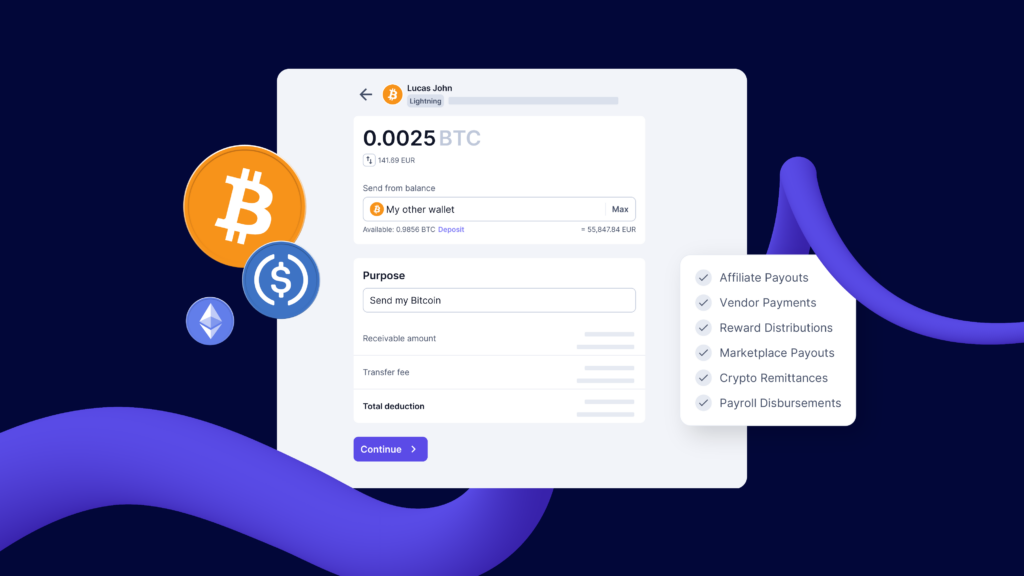
Upload a CSV file containing affiliate wallet addresses, preferred cryptocurrencies, blockchain network selections, and fiat-denominated payment amounts. CoinGate validates all data fields automatically, flags any errors before processing, performs any required FX conversion, and executes the entire batch in one operation. This approach is ideal for networks running monthly or bi-weekly payout cycles and requires zero engineering resources to implement. Prepare a spreadsheet, upload it, review and confirm – done.
API Integration – Full Automation for Continuous Operations
For networks running daily or continuous payout operations, the CoinGate Payouts API enables complete end-to-end automation:
- Trigger payouts programmatically from your affiliate management system based on your own business logic and payment schedules
- Pay in any supported cryptocurrency, with fiat-denominated amounts automatically converted at execution
- Track the full payout lifecycle via webhooks: created → processing → confirmed → completed
- Handle edge cases (failed transactions, address validation errors) automatically
- Process high-volume batches without manual intervention
This is the approach used by the majority of CoinGate’s business clients. According to CoinGate’s 2025 platform data, 85% of merchants automate payouts via API, demonstrating that automated crypto disbursement is already a production-ready infrastructure. Learn more about crypto payouts in our guide.
FX Flexibility Across Your Treasury
Hold your treasury in EUR, BTC, USDC, or any other supported asset. When a payout batch is executed, CoinGate automatically converts and delivers each recipient’s preferred cryptocurrency – you do not need to pre-purchase multiple crypto assets or manage separate wallets for each currency. One treasury, many payout currencies, automatic conversion. Standard payout fees apply: 0.50 EUR + 0.5% per crypto payout, or 0.50 EUR + 1.5% with FX conversion (see full pricing details).
Compliance, Governance, and Audit Readiness
Operating under a MiCA license and Payment Institution authorization, CoinGate provides the full governance stack enterprise networks expect:
- Full AML/KYC/KYB compliance for all payout operations
- Role-based access controls – separate payout initiators from reviewers and approvers to maintain internal controls
- Comprehensive activity logging and multi-factor authentication
- Exportable, detailed payout reports for accounting, tax filing, and regulatory audit
Industry Example: Crypto Advertising Networks
The crypto advertising sector provides a clear, operational case study for crypto payout adoption. Coinzilla, one of the largest advertising networks in the blockchain space, uses CoinGate to automate both incoming payments from advertisers and outgoing payouts to publishers.
Operating across 160+ countries with over 1 billion monthly ad impressions, Coinzilla’s payout requirements are substantial: hundreds of publishers expecting regular, reliable compensation for the traffic and impressions they deliver.
For Coinzilla, the ability to batch-process publisher payouts in crypto eliminated the operational bottleneck of managing individual bank transfers to partners spread across the globe. The result: faster settlements, dramatically lower costs per transaction, and a more satisfied publisher network – which in turn attracts more high-quality publishers to the platform.
This pattern is directly replicable across any affiliate, referral, or partner network where payouts are frequent, international, and operationally significant – from CPA networks and influencer platforms to marketplace revenue-sharing models and SaaS referral programs.
Getting Started: A Practical Roadmap
If you operate an affiliate or partner network and want to transition to crypto payouts, here is a practical, step-by-step sequence:
1. Assess your current payout profile: How many affiliates do you pay monthly? In how many countries? What are your current per-transaction costs and total monthly payout processing spend? This baseline data will help you quantify the savings opportunity.
2. Survey affiliate preferences: Gauge interest in crypto payouts among your partner base. In tech, digital services, and blockchain-adjacent verticals, you may find that a substantial portion already hold crypto wallets and actively prefer crypto compensation.
3. Start with a voluntary pilot: Offer crypto as an optional payout method for willing affiliates. Use CSV batch processing to test the workflow, validate the reconciliation process, and build internal confidence before committing to full API integration.
4. Scale with API automation: Once the pilot validates the workflow, integrate the payout API into your affiliate management platform for fully automated disbursement. Set up webhooks for real-time status tracking and exception handling. Here’s how to automate crypto payouts via API with callbacks and status tracking.

5. Default to stablecoins, offer alternatives: Make USDC the default payout currency for predictable value delivery. Allow affiliates to opt into Bitcoin, Ethereum, or other assets as an alternative – CoinGate’s FX conversion handles the complexity automatically.
6. Communicate the transition clearly: Provide affiliates with clear documentation on how to set up a wallet, what to expect during the payout process, and how to verify receipt using a TXID. Transparency during the transition drives adoption and minimizes support inquiries.
Build a Faster, Leaner Payout Operation
For affiliate networks operating at scale, mass crypto payouts are not a novelty or a niche solution – they are an operational upgrade with clear, measurable benefits. The math is compelling: 90%+ cost reduction on transaction fees, settlement in minutes instead of days, reach into every market without banking dependencies, and clean, auditable records for every disbursement.
The competitive implication is equally clear. Networks that adopt this infrastructure gain a structural advantage: lower operating costs enable higher commission rates or better margins, faster payouts attract higher-quality affiliates, and global reach opens partner acquisition in markets that were previously difficult or impossible to serve through traditional banking.
The infrastructure is mature. The regulatory framework is in place. The adoption curve is already well underway. The question for affiliate network operators is not whether mass crypto payouts will become standard – it is whether you will be among the early adopters who capture the competitive advantage, or the late adopters who are forced to catch up.
Ready to scale your affiliate payouts? Explore CoinGate’s mass payout solutions or create an account to start batch-processing partner payments today.
Accept crypto with CoinGate
Accept crypto with confidence using everything you need in one platform.