


Accept crypto with CoinGate
Accept crypto with confidence using everything you need in one platform.
Crypto Payments Do Not Keep Banking Hours. Here Is the Shape of the Day
Somebody on your team is on the hook for payments arriving. Maybe it is a support rota, maybe it is a script that provisions an account the moment the money lands, maybe it is just you checking a dashboard before bed.
So when does the money actually arrive?
“Crypto never closes” is the line everyone uses, and it rarely comes with a number attached. We put one on it. Across 1,598,649 paid orders in the twelve months to the end of August 2026, we looked at when each one was confirmed, by hour and by day.
The surprise is how little difference the clock makes at all.
Selling to customers in more than one timezone? Open a CoinGate account.
Two thirds of payments land outside business hours
Take Monday to Friday, 08:00 to 16:00 UTC, which is roughly a Central European working day.
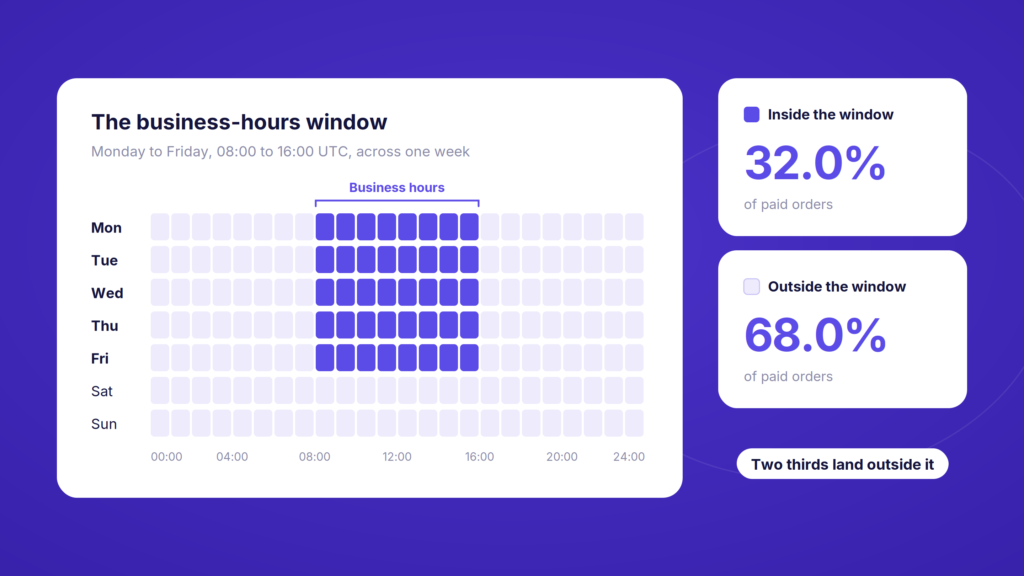
32.0% of paid orders land inside that window. 68.0% land outside it.
That is the whole argument for the cross-border case, stated as a number rather than a slogan. A customer on the US West Coast, in India or in Brazil is not paying on your office clock, and nothing in the payment path waits for them to.
Two more cuts of the same year:
- 23.83% of paid orders arrive at the weekend.
- 15.78% arrive between midnight and six in the morning UTC.
The day has a shape, and it is a very flat one
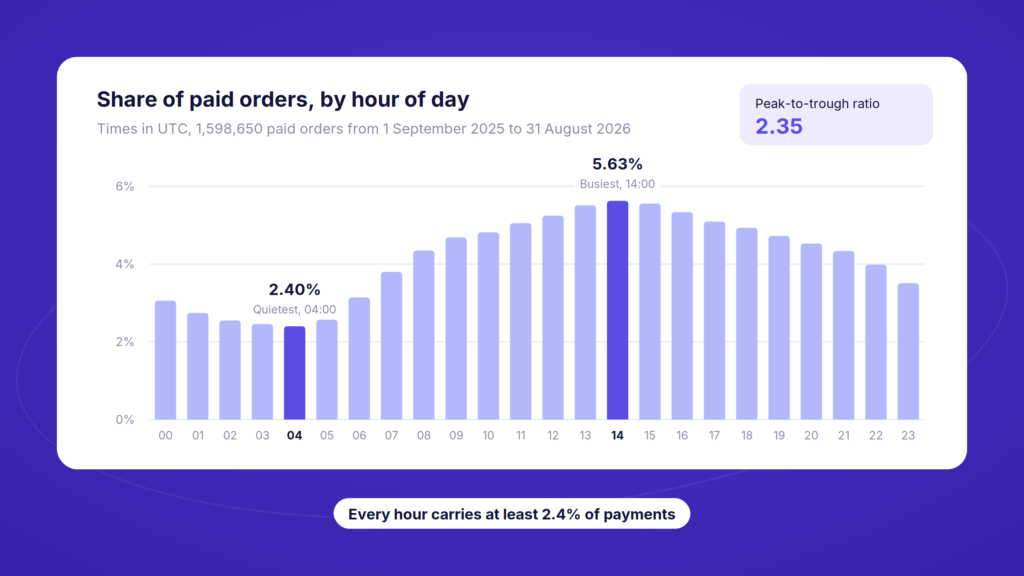
The busiest hour of the day is 14:00 UTC, carrying 5.63% of all paid orders. The quietest is 04:00 UTC at 2.40%.
That is a peak-to-trough ratio of 2.35. The busiest hour carries a little more than twice the quietest, which is closer to a gentle swell than a working day.
And the thing that does not appear in the data at all: there is no empty hour. Every one of the twenty-four carries at least 2.4% of the year’s payments. At 04:00 UTC, the quietest hour, payments still confirm at more than 40% of the peak-hour rate.
The full twenty-four hours
Every hour of the day as a share of the year’s paid orders, so you can check your own against it.
| Hour UTC | Share | Hour UTC | Share |
|---|---|---|---|
| 00:00 | 3.06% | 12:00 | 5.25% |
| 01:00 | 2.74% | 13:00 | 5.51% |
| 02:00 | 2.55% | 14:00 | 5.63% |
| 03:00 | 2.46% | 15:00 | 5.56% |
| 04:00 | 2.40% | 16:00 | 5.34% |
| 05:00 | 2.57% | 17:00 | 5.09% |
| 06:00 | 3.14% | 18:00 | 4.93% |
| 07:00 | 3.80% | 19:00 | 4.72% |
| 08:00 | 4.35% | 20:00 | 4.53% |
| 09:00 | 4.69% | 21:00 | 4.34% |
| 10:00 | 4.82% | 22:00 | 3.98% |
| 11:00 | 5.05% | 23:00 | 3.51% |
The curve rises from 04:00, peaks in the early afternoon and comes down through the evening, and at no point does it approach zero.
The week declines from Monday, and the weekend does not collapse
| Day | Share of paid orders |
|---|---|
| Monday | 16.30% |
| Tuesday | 15.44% |
| Wednesday | 15.19% |
| Thursday | 14.97% |
| Friday | 14.28% |
| Saturday | 11.86% |
| Sunday | 11.97% |
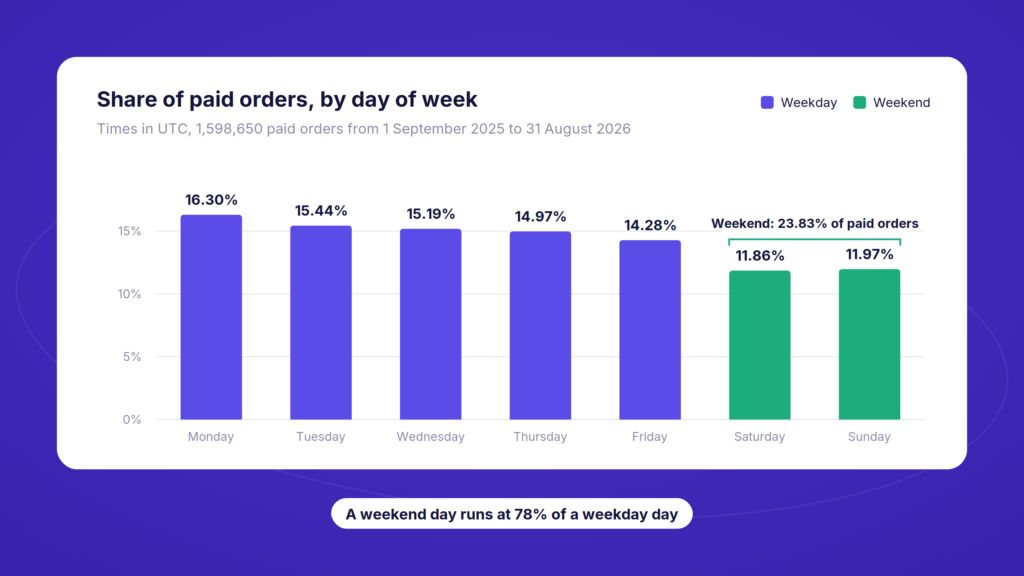
Monday is the busiest day of the week, and every weekday after it is quieter than the one before. By Friday, a day’s volume is about 11% below Monday’s. It holds month by month, too. Monday was the busiest day of the week in all twelve months.
The weekend is the part worth sitting with. A weekend day carries 78.5% of a weekday’s volume. The weekend dips and keeps going.
Nearly a quarter of the year’s payments arrive on Saturday and Sunday, the two days when a standard bank wire waits for Monday. The euro’s own settlement system, T2, is closed on both. Instant schemes are the exception, and SEPA Instant runs on every calendar day of the year, but a regular transfer still keeps banking hours.
On the shopper’s own clock, the evening is the busy part
UTC flattens a global book. A curve this smooth is partly the world taking turns, and our book is spread widely, as the regional split in our 2025 report shows. Somebody’s midnight is somebody else’s lunchtime.
So we re-read the year on the shopper’s own clock. 79% of paid orders carry the shopper’s timezone, recorded when they visited the checkout. Converted to local time, the day gets sharper, but it does not go to sleep.
- The peak moves to 16:00 local, at 5.69%. The quietest hour moves to 05:00 local, at 1.93%. That is a ratio of 2.94, against 2.35 in UTC.
- 30.9% of those payments land inside the shopper’s own working week, Monday to Friday, nine to five. 69.1% land outside it, within about a point of the UTC figure.
- 29.6% arrive between 18:00 and midnight local, and 18.2% between midnight and six in the morning.
One detail is worth reading twice. More payments land in the hour after the shopper’s own midnight (4.54%) than in the hour after 9am (3.53%).
So part of the flat UTC curve is geography, and the night does get quieter once you account for it. What does not change is the part that matters operationally. Most payments land outside the shopper’s working day, a lot of them in the evening, and nobody’s clock has an empty hour.
What to actually do with this
Four things, in the order we would do them.
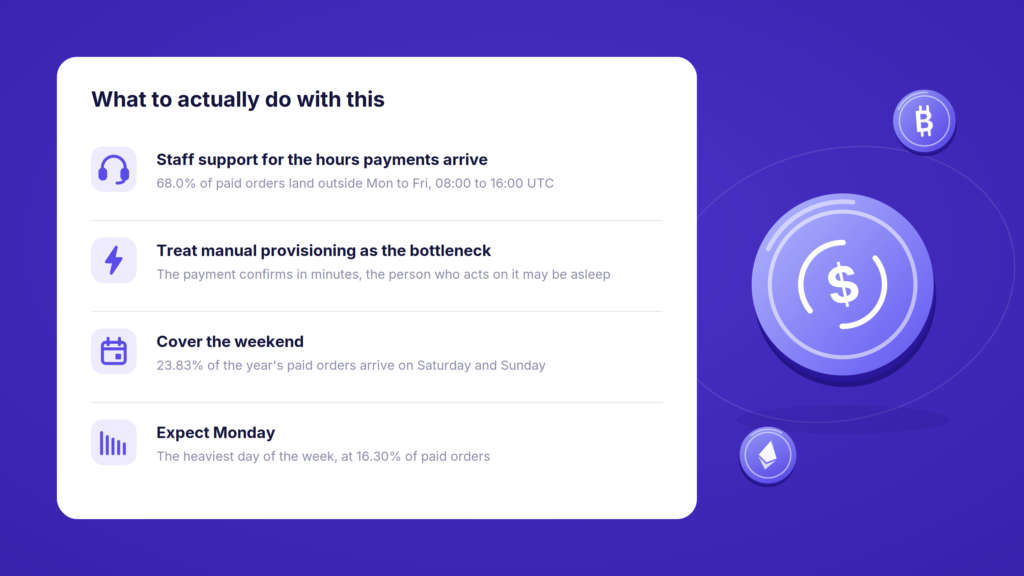
- Do not staff support as though payments stop. More than two thirds of them arrive outside business hours, on your clock and on your customer’s, and the “where is my payment” email is coming at three in the morning whether anyone is reading it or not.
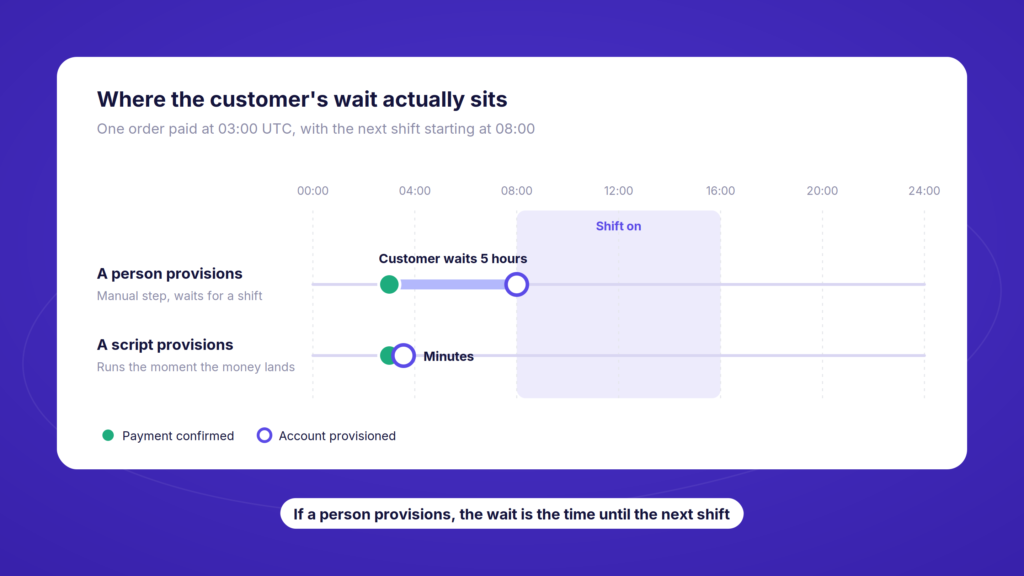
- If you provision manually, that is your real bottleneck. The payment confirms in minutes on most networks. If a human has to act on it and that human is asleep, your customer’s real wait is the time until your next shift starts.
- Weekend cover is worth more than it looks. Nearly a quarter of the year’s payments arrive on Saturday and Sunday. If nobody is watching then, those customers wait until Monday.
- Expect Monday. It was the heaviest day in every month we measured, and it lands straight after a weekend that may not have been fully covered.
Method, and one limit that matters
Every figure comes from CoinGate’s own order data: paid orders only, confirmed between 1 September 2025 and 31 August 2026, 1,598,649 in total. Paid means confirmed by the network and credited to the merchant. Times are UTC unless marked local.

The business-hours window is Monday to Friday, 08:00 to 15:59 UTC. The shopper’s own working week is Monday to Friday, 09:00 to 16:59 in their timezone.
The year contains 53 Mondays and 52 of every other day, so the day table shows each day’s share of orders, while the comparisons in the text, Friday against Monday and a weekend day against a weekday, use per-day averages.
The local-time section covers the 1,262,263 paid orders (79%) that carry a regional timezone. Inside that group the UTC business-hours share is 31.8%, against 32.0% for the whole book, so the group behaves like the whole.
The limit, and it is a real one: this is our book. It spans every timezone there is. If you sell into one country, your own curve will be sharper than either version here, and you should measure it rather than borrow ours.
Thinking it’s time your checkout kept the same hours as your customers? Start with us.
Accept crypto with CoinGate
Accept crypto with confidence using everything you need in one platform.