


Accept crypto with CoinGate
Accept crypto with confidence using everything you need in one platform.
How Hosting Providers Take Crypto Payments Without Breaking Renewals
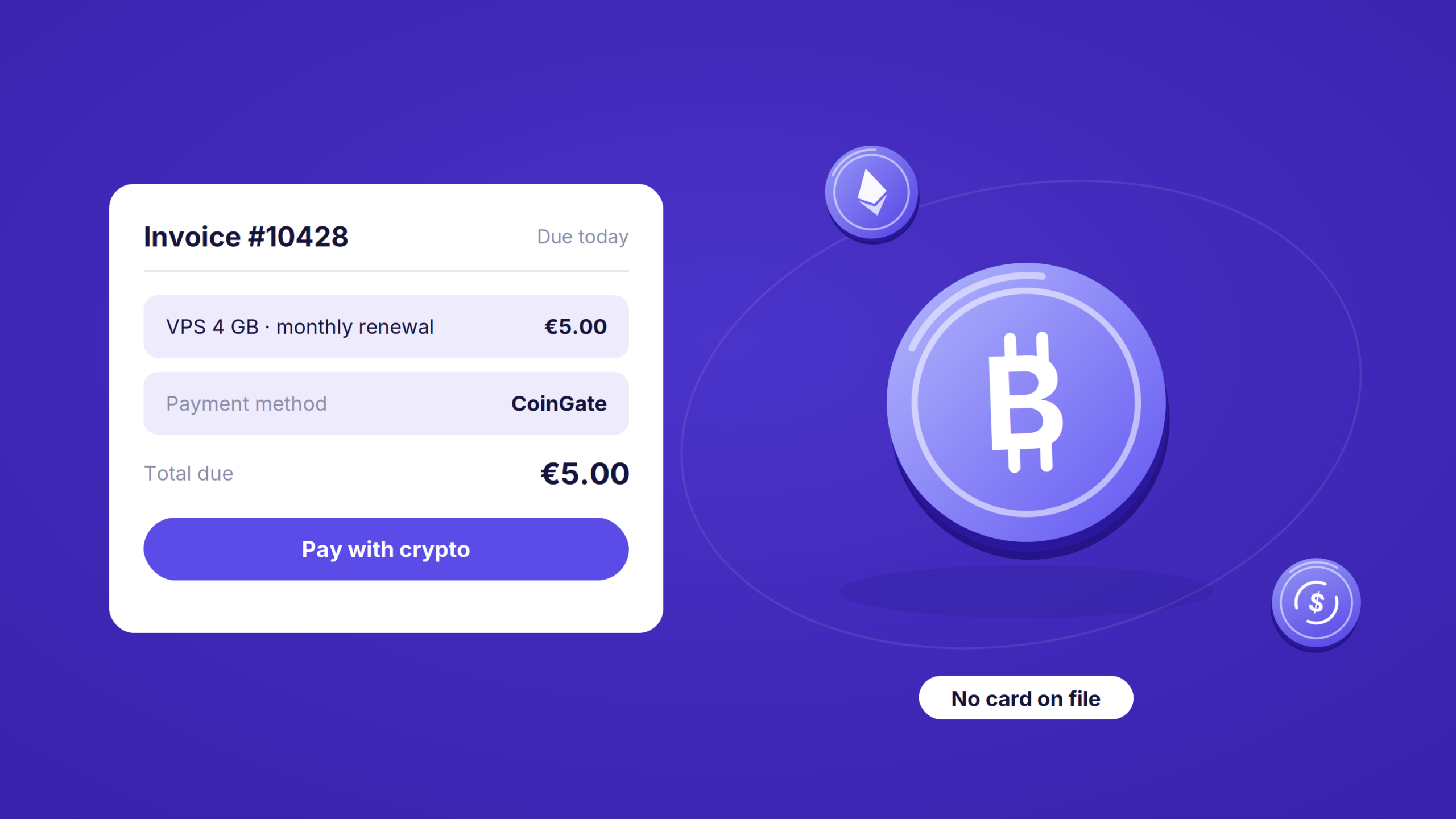
Ask a hosting company why it has not added crypto payments yet and the answer is usually a version of the same thing. Not enough demand to justify the integration work.
MVPS.net, a European VPS provider, has a number that argues with that. Its case study with us reports: “Now, 24% of our customers pay through CoinGate. It works flawlessly, and our bank does not complain about transactions coming from it.”
That is customers, not revenue, and it is one company rather than an industry average. Even so, a quarter of a customer base picking a payment option most competitors do not offer is worth a second look. We wrote up what changed for MVPS.net after they turned it on if you want the longer version.
Hosting is also a renewal business, and that is where this stops being a simple “add another payment button” story.
Watching renewals fail for reasons no one on your team controls? Add a payment rail no bank gets to decline.
Why hosting has an unusually high crypto share
Nobody buys a dedicated server by accident. The people filling in your order form are developers, sysadmins, agencies and resellers, and plenty of them already hold crypto for reasons that have nothing to do with you. They run nodes. They pay for proxies and VPNs. They have a wallet open in another tab.
On top of that, hosting is sold across borders by default. Your customer in Brazil or Vietnam is buying from a company incorporated somewhere they have never been, with a card issued by a bank that treats that transaction as exactly the sort of thing it was trained to be suspicious of.
There is a whole genre of content, ours included, telling buyers which hosting providers already take crypto. Almost none of it is written for the company on the other side of the invoice. This is that version: what picking a crypto payment gateway for hosting actually does to your billing, and what it does not.
What breaks at renewal, not at signup
A first purchase has a motivated human attached to it. The customer is on your site, they want the server today, and if the card declines they will try another one within the minute.
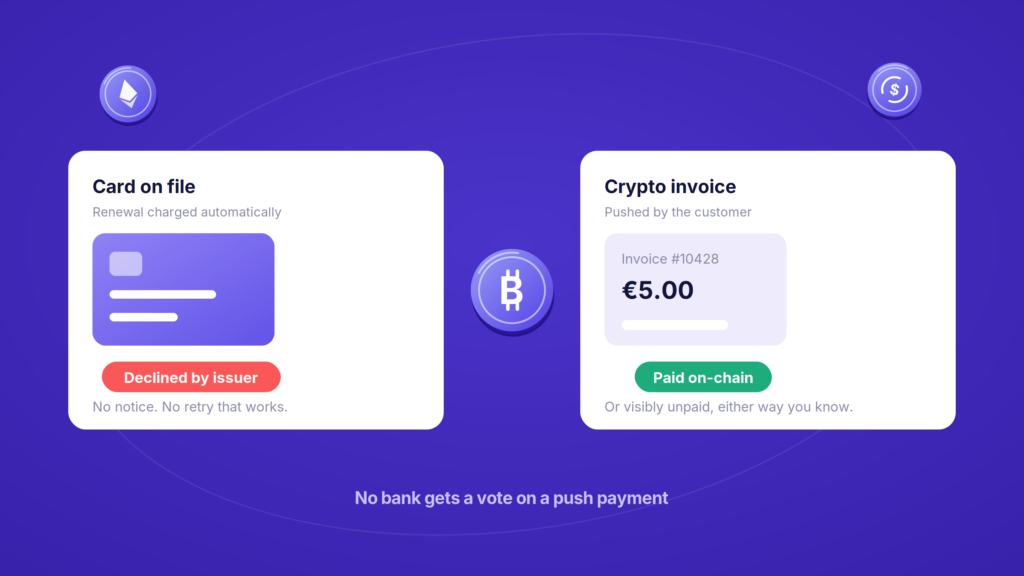
A renewal has nobody attached to it. The card expired. The bank reissued it after a fraud alert. The prepaid card the customer topped up once has forty cents left on it. The issuer looked at a recurring cross-border charge from a hosting company and said no, quietly, without telling anyone. You find out when the suspension job runs and a support ticket arrives.
SaaS companies call this involuntary churn, and it is not a marketing problem. Those customers wanted to stay.
Now the honest part. Crypto does not make renewals automatic. A blockchain payment is pushed by the person holding the funds and cannot be pulled by the merchant, so there is no crypto equivalent of a card on file. What changes is the failure mode:
- The decline disappears. A push payment either lands or it does not, and no issuing bank gets a vote.
- The failure becomes visible. Instead of a silent decline and a retry cascade, you have an unpaid invoice and a customer who knows it is unpaid.
- The work moves to the customer. Every renewal needs them to open the invoice and pay it.
Whether that trade is worth making depends on how much of your churn is currently a bank’s decision rather than a customer’s.
Your billing system, and what WHMCS actually does
Most hosting companies run WHMCS, so that is the integration that matters. Our module registers CoinGate as a payment gateway inside it, under Setup, Payments, Payment Gateways. The customer opens an invoice, picks CoinGate, and is redirected to our hosted checkout, where they choose a coin and a network and pay. A callback then marks the invoice paid inside WHMCS.
Here is the limit, stated plainly, because you will meet it anyway and it is better to meet it now. The WHMCS module cannot auto-charge a renewal. It is a third-party gateway module, which in WHMCS terms means the customer leaves your site to pay and comes back afterwards. Its configuration declares tokenised storage as false, and the module defines no capture function at all, which is the function WHMCS would need in order to charge a stored payment method. WHMCS keeps generating renewal invoices on its own schedule, because that is what its billing engine does, but each of those invoices has to be opened and paid by the customer. No stored payment method, no card on file, no automatic debit.
In practice that means your renewal email stops being an afterthought. Send it earlier than you would to a card customer. Keep the invoice open longer. Do not suspend on day one of an overdue balance, because a crypto customer has to physically do something and people are busy.
The install itself is a manual file upload rather than a marketplace button. You download the release archive and extract it into your WHMCS web root. There is no listing in the WHMCS Marketplace to install from, and the steps deserve a page of their own. We wrote them out in How to Accept Crypto Payments in WHMCS. Requirements and the current release sit on our WHMCS integration page.
If you would rather not touch WHMCS at all, our Billing tool generates recurring invoices on a weekly or monthly cadence from a start date you choose. There is no daily, quarterly or annual option, and the same caveat applies, since this is recurring invoicing rather than auto-renewing charging. Each invoice still has to be paid by the customer. How other businesses put recurring crypto payments together covers the patterns that hold up.
Settlement when the margins are thin
Hosting runs on volume and thin per-unit margins, which changes what matters in a fee schedule. The headline number is easy. We charge 1% per transaction on the Standard plan, with no monthly fee and no setup fee. Enterprise pricing is volume-based. The numbers that decide whether crypto is worth it on a five euro VPS plan sit further down the page.
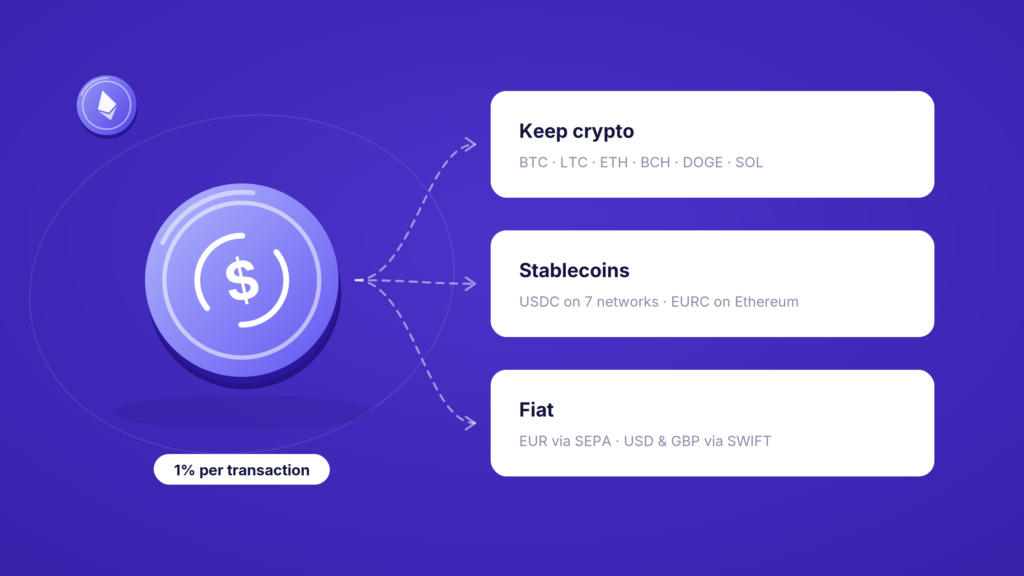
You choose what you actually receive:
- Crypto, in BTC, LTC, ETH, BCH, DOGE or SOL.
- Stablecoins. USDC across Ethereum, Binance Smart Chain, Solana, Polygon, Arbitrum, Base and Optimism, or EURC on Ethereum.
- Fiat, in USD, EUR or GBP. EUR settles over SEPA and SWIFT. USD and GBP settle over SWIFT.
That last line is where thin margins bite, and the mechanism is not the percentage. Crypto and SEPA withdrawals are free, with a 50 EUR minimum withdrawal amount. SWIFT costs 0.50%, with a minimum fee of 50 EUR. That minimum is the part to plan around: below roughly 10,000 EUR the flat floor is what you pay, so a 1,000 EUR SWIFT payout costs 5% rather than half a percent. If your customers pay single-digit monthly invoices, let the balance build rather than moving it constantly. The fee schedule we publish lists weekly settlement as the default, with on-request and custom schedules on the Enterprise plan.
One setting matters more in hosting than almost anywhere else, and that is Underpaid Cover. You set a tolerance between 0% and 10%, separately for each merchant product you use. The default is 0%. An order landing inside your tolerance is marked paid automatically, provided it was also paid within the 20 minute window described below. On a five euro invoice, network fee rounding is a genuine cause of orders arriving twelve cents short, and at a 0% tolerance those sit unpaid while the customer insists they paid.
Getting started without breaking anything
Five things, in this order.
- Open and verify a business account. Personal verification runs through Onfido as a live ID check, and the document set includes business registration, articles of association, a bank statement and proof of operational address. Our help centre says business verification usually takes one to two business days once everything is submitted, which in practice means the clock starts when your paperwork is complete rather than when you sign up.
- Decide your settlement currency before you switch anything on. It moves the withdrawal maths above more than the 1% does.
- Install the gateway in WHMCS, or call the API directly if you run your own billing.
- Set your underpayment tolerance while you are still thinking about small invoices. It starts at zero, and on every product separately.
- Rewrite the renewal email. Everyone skips this step, and it is the one that decides whether the crypto renewal actually gets paid.
Frequently asked questions
Will crypto payments actually reduce our renewal churn?
Only the part caused by cards failing. If customers leave because they no longer need the server, nothing here helps. If they leave because a reissued card silently failed on a recurring cross-border charge, crypto removes that failure and replaces it with an invoice the customer has to act on.
Can we keep a customer’s wallet on file and charge it monthly?
No. A blockchain payment is pushed by the holder of the funds, so there is nothing on your side to debit. WHMCS will still issue the renewal invoice on schedule, but your customer opens it and pays it.
Do we have to hold crypto on the balance sheet?
No. You can settle to USD, EUR or GBP, or to USDC or EURC if you want dollar or euro exposure without a bank in the loop. Splitting it also works, with part kept in crypto and the rest settled.
What happens if a customer sends slightly too little?
They receive an email showing the remaining amount and can send a second transfer to top up the same order before the checkout page expires. You can also set an Underpaid Cover tolerance between 0% and 10% per merchant product, so small shortfalls inside it are accepted automatically.
How long does a customer have to pay?
There are two clocks. From the moment the order opens, the shopper has two hours to pick a currency and network. Once picked, they have 20 minutes to send the transfer. Miss it and the checkout page expires.
What if a customer pays after the checkout page expires?
It is not automatically lost. Merchants can configure how long CoinGate should keep trying to mark an order paid after it has expired or been cancelled, which matters in hosting because a renewal invoice often gets opened, forgotten and paid a day later. What is never reused is the payment address. A new one is generated for each order, so funds sent to an old address do not credit a new one.
The bottom line
Hosting has the two ingredients that make crypto payments worth the integration work. A customer base already comfortable with it, and a renewal cycle that cards handle badly across borders. What it does not get is automation. Every crypto renewal is a customer decision, taken again every cycle, and any provider suggesting otherwise is describing something that does not exist.
One VPS provider says a quarter of its customers make that decision anyway.
Thinking your renewal flow could use a second rail that no bank gets to decline? Start with us.
Accept crypto with CoinGate
Accept crypto with confidence using everything you need in one platform.